

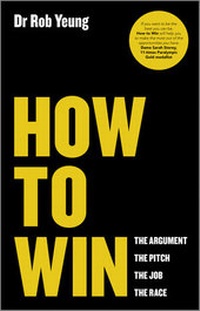
How to Win
Description

If you're not winning, you're losing. And youdon't want to be a loser, do you?
Life is full of opportunities to win or lose on a dailybasis. Want to win arguments, negotiate better and get yourway in more discussions? Want to pitch ideas that win supportand plaudits? Want to get yourself noticed and come out on top inthe job market?
Discover how to triumph when it really counts. How can you gainthe competitive advantage and come first more often? Learn how toavoid that frustration of not succeeding - when your pointisn't heard in an argument, or your hard fought pitch isrejected - and to achieve the results you know youdeserve.
THE SCIENCE OF WINNING
Drawing on the latest research and proven psychologicalprinciples, bestselling author and psychologist Dr Rob Yeungoutlines practical success strategies and powerful scenarios thatyou can apply to all facets of your life.
This is your strategy book for success at work and in life.
Get the breaks, beat the others and take your life to a wholenew level.
More details
Other editions
Additional editions
Person
Rob has a B.Sc. in psychology from University of Bristol and a Ph.D. in psychology from King's College London, University of London. He is a chartered psychologist and Associate Fellow of the British Psychological Society. His clients through Talentspace include Goldman Sachs, BBC, Bartle Bogle Hegarty, KPMG, British Airways, Baker Tilly, Eversheds, HSBC (as well as lots of much smaller businesses). He also worked for two years at a top tier consulting firm The Boston Consulting Group.
He has published research studies on personality in academic journals, particularly Personality and Individual Differences. He writes a column on confidence for UK newspaper The Daily Telegraph and contributes to newspapers including Financial Times, The Guardian and The Sunday Times.
Content
Acknowledgements xi
Introduction 1
1 Developing a Winning Outlook 9
2 Winning the Argument 35
3 Winning the Pitch 75
4 Winning the Job 117
5 Winning the Race 161
Conclusions: Onwards, Upwards and Over to You 209
Notes 227
Index 235
1
Developing a Winning Outlook
Leaders are made, they are not born. They are made by hard effort, which is the price which all of us must pay to achieve any goal that is worthwhile.
Vince Lombardi
This chapter is all about attitude. So let's kick off by exploring your views about yourself. Of course, I'll explain everything shortly.
Below are a set of rating scales for different qualities and characteristics. Take a couple of moments to weigh the extent you believe each one is either an innate talent or something that can be developed, taught and honed.
For example, if you think that intelligence comes down entirely to a natural endowment – to the gifts that you are born with – then you'd give it a score of 1 out of 10. If you believe that intelligence is 100 per cent determined by hard work and effort, then you'd give it a score of 10 out of 10. Or if you consider that it's 50/50, then you'd give it a score of 5.
Want to give it a try?
Intelligence:
Creativity:
Leadership:
The ability to tell jokes and make people laugh:
Charisma:
Athletic ability:
Public speaking:
Patience:
For as long as I can remember, I've been curious about human behaviour and what drives people. But training to become a psychologist has taken that inquisitiveness about folks to a whole new level. And now as a psychologist working mainly with businesses, it's my job to be able to size people up – to evaluate them and come to judgements about not only how good they are but also how far they'll progress in their careers.
Over the years, I've learnt that one of the biggest differentiators between winners and runners-up in life is their attitude. But to illustrate exactly how outlook can matter, let me tell you about a pair of managers I first met more than a half-decade ago, whom I'll call Anna and Matthew.
It's all in the mind
Organizations often ask me to rate the strengths and weaknesses of their managers. I've been working with one particular company, an international insurance company for quite some time now. The top bosses asked me to audit 45 of their most senior executives in the UK on a four-point scale of their potential. A “1” meant that the executive was a star with plenty of potential to take on bigger roles not just within the UK but also internationally; unfortunately, a “4” meant that the executive had probably been over-promoted and should be shuffled sideways into a less demanding role.
The assessment process began with all of the executives, including Anna and Matthew, filling out surveys asking them to rate their own strengths and failings across assorted categories of capabilities, such as “Inspiring people” and “Making business decisions”. Next, at least six colleagues also filled out similar surveys to rate each executive. Finally, I met with each executive individually to discuss their scores, interview them about their leadership successes and failures, and ultimately decide what rating – on that four-point scale – I would give them in terms of their continuing potential.
I spent two hours with each executive. Matthew stood out for his confidence, charisma and unerring certainty about himself. A lanky figure with a broad smile and a crushing handshake, he was clearly someone who was used to making headlines. He received mainly complimentary comments from his colleagues, who said that he was a strong leader that they could turn to for guidance when they weren't sure what to do.
Sure, he had a few shortcomings, but didn't everyone? I told him about some of the occasional discrepancies between how he rated himself and how his colleagues rated him. For example, they said that he could at times be absolutely certain he was right even when he was later proved to have been wrong. He also tended not to revise his opinions easily.
In response, Matthew shrugged his shoulders and agreed that no one was perfect. He smiled and said, “Well, I've always been like that – it's a bit too late to change now!” The implication: as a manager in his late 40s, he was simply too old and too set in his ways to change.
Anna was much less sure of herself. A slender woman who moved with the energy of a skittish doe, she had reached the same executive grade as Matthew and was perhaps a couple of years younger than him. However, she admitted privately that she still had so much to learn about how to lead her team effectively.
She received a mixture of comments from her colleagues and clearly wasn't happy with everything she heard. They admired a lot about her analytical mind and empathy but said that she could demonstrate more energy and enthusiasm in front of her team. They felt that she was sometimes reluctant to take decisions in the face of uncertainty too.
Anna puffed out her cheeks with disappointment at a few of the comments but listened and made careful notes. She asked sensible questions to understand the less flattering remarks that colleagues had made about her perceived failings.
She was eager for my input too. Whereas Matthew had demonstrated much greater certainty in his own ability to progress in his career, Anna sought much more guidance from me. She asked questions such as “In your experience, how have other managers addressed such issues?” and “What could I do to make the biggest difference to my leadership skills?”
So who would you think had the greater potential? Matthew or Anna?
Gifts versus growth
I first met Matthew and Anna nearly six years ago. And as I've continued working with the insurance company, I've seen how the two have progressed. Eighteen months after I first met him, Matthew was promoted into an even more senior role, looking after all of the human resources managers within the UK business. It was what Matthew and everyone else around him had expected. He was a formidable performer within the business and to this day remains a solid, dependable executive with a lot to contribute.
But what about Anna, who felt she still had so far to go?
She got promoted twice and now looks after all of the people – not just the sales team but also the finance managers, technology experts, human resources folk and so on – across all of northern Europe, including the UK. She skipped a grade ahead of Matthew and is now his boss too.
But when I met her only a few months ago, she said that she still doesn't have all the answers. She maintains that she has a great deal to learn. She believes that the world is changing so swiftly and she can only just keep up.
And so we come to the crux of the tale. An increasingly convincing tidal wave of research shows that one of the biggest predictors of how well we do in not just our careers but our lives in general is down to our attitude, our outlook on life.
Matthew has an example of what I call a “gifts mind-set”.1 * He believes himself to have certain gifts or talents but also certain weak spots that he doesn't think he can change. His strengths are that he is confident, charismatic and decisive. At the same time, he accepts that he has flaws: he can be more certain of himself than situations sometimes warrant. And he doesn't always listen to what others have to say – he doesn't change his mind often.
He sees his strengths as well as his weaknesses as aptitudes that have been bestowed upon him – as traits that are pretty much fixed and difficult to modify. You might as well ask him to alter his eye colour or height. Take him or leave him. That's the way he is now.
Anna, on the other hand, possesses what's known as a “growth mind-set”. She tackles every new situation with the attitude that it's an opportunity for her to learn. In my very first meeting with her, she was almost greedy to learn all she could and find out how she could improve. Far from feeling confident about her abilities, she was almost painfully aware of how much more she could learn.
She felt that everything was amenable to change – her strengths as well as her failings. She saw herself as a work in progress rather than a finished product. Even today, she continues to feel that she has much to learn – that she is still a work in progress.
Of course, you may be thinking that other factors have determined Anna's and Matthew's careers. Perhaps Anna got lucky. Maybe Matthew had personal problems that distracted him. But actually, there is a huge body of scientific evidence confirming that our belief in our own capacity to change matters so, so much.
Here's the science bit
Broadly speaking, people with the gifts mind-set believe that their traits and psychological characteristics are fixed. Such individuals feel that their intelligence, creativity, empathy, ability to learn new languages and so on are gifts that they only have a certain amount of. What you get when you're born is all you get – and that's the end of the story. Whether you're...
