

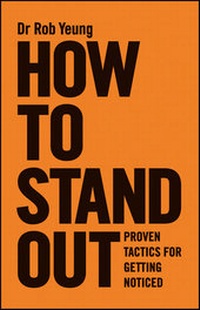
How to Stand Out
Description

You probably already have the skills to be more fulfilled and successful. But sometimes it's about showcasing these skills so that colleagues, customers, friends and the rest of the world can recognize what you do.
Drawing on extensive research and inspiring real-life examples, psychologist and bestselling author Dr. Rob Yeung guides you through proven techniques that will get you noticed for all the right reasons.How to Stand Out shows you how to:
* Utilize winning body language techniques
* Incorporate the words that get people nodding in agreement
* Supercharge your persuasive skills to sell products, pitch ideas, network, and socialize with friends
* Boost your motivation to become more successful
* Improve your confidence to get the results you desire
Praise for the Book
"We all need to sell ourselves and this book is a great, very readable guide on how to do that. This book is full of useful career advice - and brought to life by fascinating examples and often surprising insights." Rhymer Rigby, writer for The Telegraph and Financial Times and author of 28 Business Thinkers Who Changed the World
"How to Stand Out covers the latest evidence on body language, communication and persuasion. It's a rigorously researched, compelling and sometimes surprising read no matter what your goals in life. You will undoubtedly learn something new." Dr Tomas Chamorro-Premuzic, CEO of Hogan Assessments, and Professor of Business Psychology at University College London and Columbia University
"Engaging, no-nonsense and full of scientifically proven advice - an essential book for anyone wanting to outshine the crowd and get ahead in business and life."Dr. Michael Sinclair, co-author of Mindfulness for Busy People, Founder & Clinical Director, City Psychology Group
"An easy read with some well researched, practical and evidence backed advice. Definitely stands out from the crowd and can easily be applied straight away." Paul Hughes, Executive Development Director at Cranfield School of Management
"An extraordinary book for everybody: Dr Yeung's book presents a wealth of useful tips on how to build your confidence and stand out from the crowd. This book is a treasure trove of useful tips on how to outperform in a job interview, get promoted, win more customers, get your business funded or simply become more successful in life." Professor Khalid Hafeez, Dean of The Claude Littner Business School at the University of West London
"Practical, accessible tips and techniques for making yourself more interesting to clients, customers, and friends!" Tamara Box, Partner and Global Chair of the Financial Industry Group at international law firm Reed Smith LLP
"Once again, Rob Yeung demonstrates how challenge can quickly become opportunity. He has the uncanny knack of identifying our insecurities, helping us view them from a different angle and transforming them into foundation stones for building new confidence. Whether you want to learn to 'talk like TED', present your best side at a job interview, or simply want to stand out from the crowd - this new book offers simple, clear and practical guidance. Like his previous books, this is another example of why Dr Rob Yeung stands out from other psychologists and coaches." Malcolm Green, Creative Chairman at advertising agency Green Cave People
More details
Other editions
Additional editions
Person
Rob has a B.Sc. in psychology from University of Bristol and a Ph.D. in psychology from King's College London, University of London. He is a chartered psychologist and Associate Fellow of the British Psychological Society. His clients through Talentspace include Goldman Sachs, BBC, Bartle Bogle Hegarty, KPMG, British Airways, Baker Tilly, Eversheds, HSBC (as well as lots of much smaller businesses). He also worked for two years at a top tier consulting firm The Boston Consulting Group.
He has published research studies on personality in academic journals, particularly Personality and Individual Differences. He writes a column on confidence for UK newspaper The Daily Telegraph and contributes to newspapers including Financial Times, The Guardian and The Sunday Times.
He appears on television programmes including Celebrity Big Brother, BBC Breakfast, CNN news, and Working Lunch on the BBC. He previously presented the BBC television series Who Would Hire You? in which real life candidates went through the recruitment process. He also presented a further series for the BBC entitled How To Get Your Dream Job and has been an expert on Big Brother's Little Brother. He was the resident psychologist for the 2007 BBC Three series The Restaurant: You're Fried! He acted as resident psychologist on both Celebrity Big Brother and Big Brother in 2009. He was on Channel 5 only last week, being interviewed alongside Paralympic athlete Sara Storey.
Rob also teaches at several universities including Southampton, University of East London, St. Andrews and University College Dublin.
Content
Acknowledgements viii
Introduction 1
1 Boosting Self-belief and Debunking the
Confi dence Con 13
2 Persuading through Body Language and Nonverbal
Communication 47
3 Winning with Words 93
4 Augmenting Performance through Passion 161
Conclusions: Onwards, Upwards and Over to You 207
Notes 221
Index 229
Introduction
When you do the common things in life in an uncommon way, you will command the attention of the world.
George Washington Carver
What is it that helps some people stand out? What helps certain individuals get picked out of the crowd - to attract attention and get noticed at work, at a party, in life?
I'm not talking about metaphorical crowds either. How do people stand out when they are in a literal crowd, say a room full of people at a networking event all clamouring for attention?
These were the kinds of questions I was looking to answer when I went to a networking breakfast one sunny but unexpectedly cold spring morning in west London. The venue: Lala Brasserie, a glass-fronted Mediterranean restaurant by a busy intersection. I'd been told by one of the organizers that the regular meeting began at 6.45 a.m. However, when I turned up exactly on time, I was confronted by the bustle and noise of a room thronged with scores of people already deep in conversation. It turned out that, such was the desire to get talking and do deals, most people turned up at 6.30 a.m. Being almost one of the last to arrive, I had some catching up to do.
In quick succession, I met one person after the next. Marvin ran a company offering bookkeeping services. Zane was an employment lawyer. Serena, a designer of bespoke jewellery. There was Anastacia, who worked in foreign exchange. Thayne, an electrician. I met so many people that the names and faces began to blur.
At around 7.15 a.m. came the opportunity for everyone to address the whole room. The chairperson of the meeting - a strong-featured Irish woman with her hair pulled away from her face in a business-like manner - called for our attention. In a strident voice, she invited us to tell the room individually what we did and what we were looking for. It was our opportunity to pitch ourselves.
To keep the introductions moving swiftly, someone at the back of the room must have been sitting with a timer. A bell rang every 50 seconds - not even a full minute! - to keep people from hogging airtime.
There was a financial adviser, a landscape gardener, a virtual personal assistant, the owner of a firm of commercial cleaners. Graphic and Web designers, a guy who did something with email, a physiotherapist, a commercial property expert.
Twenty people had spoken but that wasn't even half of the people in the room. I was trying my best to pay attention but most of it simply wasn't sticking. Was Jacinta the therapist or was she something to do with charities? Who was the tall guy with curly grey hair and the glasses again? Yet still they came. More: an architect, several different kinds of lawyer, a telemarketer and a self-described "business growth engineer". For the most part, I couldn't keep track.
Many spoke too quietly to be heard in front of the 50-strong audience. A few read from scraps of paper in monotone voices without looking at the increasingly bored faces around them. Yet a few stood out.
A man with a lined face and a gravelly but sincere voice called Merik started with what the audience immediately realized were lyrics from a song: "I believe the children are our future. Teach them well and let them lead the way." He paused dramatically and then said, "You know the rest."
And of course we did. By quoting the opening lines to the well-known Whitney Houston song The Greatest Love, he had struck a chord with most of us and made himself instantly memorable.
He went on to say that he believed that children are the future. And that children in schools needed clean windows to be able to see properly, concentrate properly, study properly. So he asked if anyone knew of any schools that needed their windows cleaning. It was a quirky, unusual pitch for his commercial window cleaning business. And for that reason it stood out like a lighthouse on a foggy night.
Another of the small handful that stood out: Luke, a ballsy estate agent in his twenties - he looked and sounded like he could play the cheeky-but-lovable rogue on any British soap opera. He told the room how he had valued the houses of a couple of older women recently. He estimated that they could sell their houses for in excess of £1.2 million. But they had bought their houses years and years ago for around £8,000. The implication: on selling up, these women would become instant cash millionaires.
Luke joked that he didn't know if his insurance covered him should he give an elderly lady a heart attack and the throng laughed warmly for perhaps the first time that morning. Again, he managed to distinguish himself from the crowd.
The science of standing out
Think about some of the people you know who stand out. What is it that helps them get noticed? Is it that they speak slowly and forcefully - or perhaps quickly and with acerbic humour? Do they listen and make others feel like the centre of the universe? Or do they just radiate some kind of charm and good humour that draws others to them?
We're talking about star quality here. The reasons why one individual gets promoted again and again while others languish behind. The reasons why certain salespeople or small-business owners win new customers or clients seemingly without effort. The reasons why one person gets asked on date after date while others struggle to meet the right person.
This book will help you to be more engaging, entertaining and persuasive.
How To Stand Out is for anyone who wants to make an impact, to get noticed for professional or personal reasons. This book is for you if you're a business owner hungry to sell more products and services - or maybe a freelance worker who needs to sell yourself. Perhaps you're a fundraiser or campaigner who needs to get your directives across more robustly, a scientist seeking to communicate your findings or a policymaker seeking to change your community. Or you yearn to socialize more easily or even find love. Through word and deed, this book will help you to be more engaging, entertaining and persuasive. It will help you to stand out.
Finding techniques that work
So why do I want to write this book?
Allow me to introduce myself by telling you what I said at that networking event back in the spring. Remember I had about 50 people watching me and I was allowed only 50 seconds. So I was speaking faster than I would normally do.
I began by saying: "Hi, I'm Rob Yeung, an organizational psychologist, which means that I develop leaders and their teams to do their jobs better by running workshops on leadership, team effectiveness and particular skill topics. For example, I was working on Tuesday with a corporate sales manager and his team at a growing business.
"They do most of their selling to their corporate clients face-to-face. So I was running the second of three workshops designed to help them to present better. To pitch, to get their messages across. To be more memorable and ultimately land more deals. At each session I present a few new principles then the team gets to practise by putting together and then delivering impromptu speeches."
On that day, I gave just one example of the kind of workshop I've run as an organizational psychologist. Actually, I describe myself as an organizational psychologist but you could equally call me a coach, a trainer, a corporate consultant, a keynote speaker, a lecturer. I train managers. I act as a sounding board to business owners. I speak at conferences all over the world to audiences of hundreds or even thousands of people. I lecture at universities and business schools. I work with charities that want to learn to raise funds more effectively. Ultimately, I teach people techniques that will make them better in whatever their walk of life.
Of course there are many books written by consultants. But I hope I'm different from most. I completed a PhD in psychology. So I spent three solid years of doctoral research reading scientific paper after scientific paper as well as getting a few of my own research articles published in technical journals.
We need to have proof about what works and what doesn't.
The main thing I learnt was the importance of systematic evidence. That we need to have proof about what works and what doesn't when it comes to recommending practices and interventions that affect people's lives.
Scientists have long understood that there is something called a "placebo effect". In medical trials, doctors have discovered they can give patients a sham treatment - such as a pill containing nothing more than common household sugar - and yet some patients will feel better.
As a result, any pharmaceutical company wishing to launch a new drug has to prove it has genuine effects over and above those of a sham treatment. In a carefully controlled experiment, some patients are given the new drug while other patients are given the sham treatment. After perhaps weeks, months or even years, researchers then measure the symptoms of those given the drug (the experimental group) against the symptoms of those given the sham treatment (the control group). Only if those in the experimental group have improved significantly more than those in the control group can the drug...
