
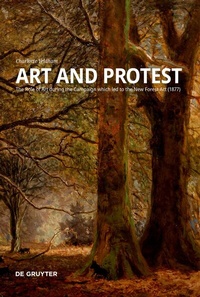
Art and Protest
Description
Alles über E-Books | Antworten auf Fragen rund um E-Books, Kopierschutz und Dateiformate finden Sie in unserem Info- & Hilfebereich.
Following official protection of natural environments for public benefit in Fontainebleau Forest in France (1861) and in Yosemite (1864) and Yellowstone (1872) in the USA, the New Forest Act of 1877 marked the first major instance in Britain. Art and artists were involved in this achievement to a greater extent than in all preceding cases. For the first time, and within an ecocritical framework, this study examines the role played by art during the previous anti-enclosure campaign - highlighting both the hitherto-unacknowledged extent of German influence in terms of the original artistic initiative and of German artists' participation in the cause, as well as the significance of connections between landscape art of the day and priorities of the early Open Spaces movement.
- Ecocriticism in art history
- With works by the German and British artists George Bouverie Goddard, Wilhelm Kümpel, Alfred Pizzi Newton, Wilhelm Trautschold, Edmund George Warren
More details
Other editions
Additional editions
Persons
Charlotte Yeldham, independent art historian (MA Oxford, PhD Courtauld Institute of Art), UK

System requirements
File format: PDF
Copy protection: Watermark-DRM (Digital Rights Management)
System requirements:
- Computer (Windows; MacOS X; Linux): Use the free software Adobe Reader, Adobe Digital Editions, or any other PDF viewer of your choice (see eBook Help).
- Tablet/Smartphone (Android; iOS): Install the free app Adobe Digital Editions or another reading app for eBooks, e.g., PocketBook (see eBook Help).
- E-reader: Bookeen, Kobo, Pocketbook, Sony, Tolino and many more (only limited: Kindle).
The file format PDF always displays a book page identically on any hardware. This makes PDF suitable for complex layouts such as those used in textbooks and reference books (images, tables, columns, footnotes). Unfortunately, on the small screens of e-readers or smartphones, PDFs are rather annoying, requiring too much scrolling.
This eBook uses Watermark-DRM, a „soft” copy protection. This means that there are no technical restrictions to prevent illegal distribution. However, there is a personalised watermark embedded in the eBook that can be used to identify the purchaser of the eBook in the event of misuse and to provide evidence for legal purposes.
For more information, see our eBook Help page.