

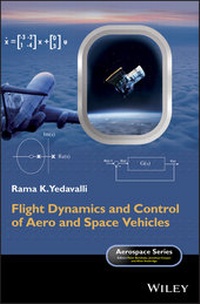
Flight Dynamics and Control of Aero and Space Vehicles
Description

Rama K. Yedavalli, The Ohio State University, USA
A comprehensive textbook which presents flight vehicle dynamics and control in a unified framework
Flight Vehicle Dynamics and Control presents the dynamics and control of various flight vehicles, including aircraft, spacecraft, helicopter, missiles, etc, in a unified framework. It covers the fundamental topics in the dynamics and control of these flight vehicles, highlighting shared points as well as differences in dynamics and control issues, making use of the 'systems level' viewpoint.
The book begins with the derivation of the equations of motion for a general rigid body and then delineates the differences between the dynamics of various flight vehicles in a fundamental way. It then focuses on the dynamic equations with application to these various flight vehicles, concentrating more on aircraft and spacecraft cases. Then the control systems analysis and design is carried out both from transfer function, classical control, as well as modern, state space control points of view. Illustrative examples of application to atmospheric and space vehicles are presented, emphasizing the 'systems level' viewpoint of control design.
Key features:
* Provides a comprehensive treatment of dynamics and control of various flight vehicles in a single volume.
* Contains worked out examples (including MATLAB examples) and end of chapter homework problems.
* Suitable as a single textbook for a sequence of undergraduate courses on flight vehicle dynamics and control.
The book is essential reading for undergraduate students in mechanical and aerospace engineering, engineers working on flight vehicle control, and researchers from other engineering backgrounds working on related topics.
More details
Other editions
Additional editions
Person
Rama K. Yedavalli is a Professor in the Department of Mechanical and Aerospace Engineering at Ohio State University. His research interests include systems level robust stability analysis and control design for uncertain dynamical systems with applications to mechanical and aerospace systems. He also works on robust control, distributed control, adaptive control, hybrid systems control and control of time delay systems with applications to mechanical and aerospace systems.
Content
Preface xxi
Perspective of the Book xxix
Part I Flight Vehicle Dynamics 1
Roadmap to Part I 2
1 An Overview of the Fundamental Concepts of Modeling of a Dynamic System 5
1.1 Chapter Highlights 5
1.2 Stages of a Dynamic System Investigation and Approximations 5
1.3 Concepts Needed to Derive Equations of Motion 8
1.4 Illustrative Example 15
1.5 Further Insight into Absolute Acceleration 20
1.6 Chapter Summary 20
1.7 Exercises 21
Bibliography 22
2 Basic Nonlinear Equations of Motion in Three Dimensional Space 23
2.1 Chapter Highlights 23
2.2 Derivation of Equations of Motion for a General Rigid Body 23
2.3 Specialization of Equations of Motion to Aero (Atmospheric) Vehicles 32
2.4 Specialization of Equations of Motion to Spacecraft 43
2.5 Flight Vehicle DynamicModels in State Space Representation 52
2.6 Chapter Summary 58
2.7 Exercises 58
Bibliography 60
3 Linearization and Stability of Linear Time Invariant Systems 61
3.1 Chapter Highlights 61
3.2 State Space Representation of Dynamic Systems 61
3.3 Linearizing a Nonlinear State Space Model 63
3.4 Uncontrolled, Natural Dynamic Response and Stability of First and Second Order Linear Dynamic Systems with State Space Representation 66
3.5 Chapter Summary 73
3.6 Exercises 74
Bibliography 75
4 Aircraft Static Stability and Control 77
4.1 Chapter Highlights 77
4.2 Analysis of Equilibrium (Trim) Flight for Aircraft: Static Stability and Control 77
4.3 Static Longitudinal Stability 79
4.4 Stick Fixed Neutral Point and CG Travel Limits 86
4.5 Static Longitudinal Control with Elevator Deflection 92
4.6 Reversible Flight Control Systems: Stick Free, Stick Force Considerations 99
4.7 Static Directional Stability and Control 105
4.8 Engine Out Rudder/Aileron Power Determination: Minimum Control Speed, VMC 107
4.9 Chapter Summary 111
4.10 Exercises 111
Bibliography 114
5 Aircraft Dynamic Stability and Control via Linearized Models 117
5.1 Chapter Highlights 117
5.2 Analysis of Perturbed Flight from Trim: Aircraft Dynamic Stability and Control 117
5.3 Linearized Equations of Motion in Terms of Stability Derivatives For the Steady, Level Equilibrium Condition 122
5.4 State Space Representation for Longitudinal Motion and Modes of Approximation 124
5.5 State Space Representation for Lateral/Directional Motion and Modes of Approximation 131
5.6 Chapter Summary 138
5.7 Exercises 139
Bibliography 140
6 Spacecraft Passive Stabilization and Control 143
6.1 Chapter Highlights 143
6.2 Passive Methods for Satellite Attitude Stabilization and Control 143
6.3 Stability Conditions for Linearized Models of Single Spin Stabilized Satellites 146
6.4 Stability Conditions for a Dual Spin Stabilized Satellite 149
6.5 Chapter Summary 151
6.6 Exercises 152
Bibliography 152
7 Spacecraft Dynamic Stability and Control via Linearized Models 155
7.1 Chapter Highlights 155
7.2 Active Control: Three Axis Stabilization and Control 155
7.3 Linearized Translational Equations of Motion for a Satellite in a Nominal Circular Orbit for Control Design 158
7.4 Linearized Rotational (Attitude) Equations of Motion for a Satellite in a Nominal Circular Orbit for Control Design 160
7.5 Open Loop (Uncontrolled Motion) Behavior of Spacecraft Models 161
7.6 External Torque Analysis: Control Torques Versus Disturbance Torques 161
7.7 Chapter Summary 162
7.8 Exercises 162
Bibliography 163
Part II Fight Vehicle Control via Classical Transfer Function Based Methods 165
Roadmap to Part II 166
8 Transfer Function Based Linear Control Systems 169
8.1 Chapter Highlights 169
8.2 Poles and Zeroes in Transfer Functions and Their Role in the Stability and Time Response of Systems 174
8.3 Transfer Functions for Aircraft Dynamics Application 179
8.4 Transfer Functions for Spacecraft Dynamics Application 183
8.5 Chapter Summary 184
8.6 Exercises 184
Bibliography 186
9 Block Diagram Representation of Control Systems 187
9.1 Chapter Highlights 187
9.2 Standard Block Diagram of a Typical Control System 187
9.3 Time Domain Performance Specifications in Control Systems 192
9.4 Typical Controller Structures in SISO Control Systems 196
9.5 Chapter Summary 200
9.6 Exercises 201
Bibliography 202
10 Stability Testing of Polynomials 203
10.1 Chapter Highlights 203
10.2 Coefficient Tests for Stability: Routh-Hurwitz Criterion 204
10.3 Left Column Zeros of the Array 208
10.4 Imaginary Axis Roots 208
10.5 Adjustable Systems 209
10.6 Chapter Summary 210
10.7 Exercises 210
Bibliography 211
11 Root Locus Technique for Control Systems Analysis and Design 213
11.1 Chapter Highlights 213
11.2 Introduction 213
11.3 Properties of the Root Locus 214
11.4 Sketching the Root Locus 218
11.5 Refining the Sketch 219
11.6 Control Design using the Root Locus Technique 223
11.7 Using MATLAB to Draw the Root Locus 225
11.8 Chapter Summary 226
11.9 Exercises 227
Bibliography 229
12 Frequency Response Analysis and Design 231
12.1 Chapter Highlights 231
12.2 Introduction 231
12.3 Frequency Response Specifications 232
12.4 Advantages of Working with the Frequency Response in Terms of Bode Plots 235
12.5 Examples on Frequency Response 238
12.6 Stability: Gain and Phase Margins 240
12.7 Notes on Lead and Lag Compensation via Bode Plots 246
12.8 Chapter Summary 248
12.9 Exercises 248
Bibliography 250
13 Applications of Classical Control Methods to Aircraft Control 251
13.1 Chapter Highlights 251
13.2 Aircraft Flight Control Systems (AFCS) 252
13.3 Longitudinal Control Systems 252
13.4 Control Theory Application to Automatic Landing Control System Design 259
13.5 Lateral/Directional Autopilots 265
13.6 Chapter Summary 267
Bibliography 267
14 Application of Classical Control Methods to Spacecraft Control 269
14.1 Chapter Highlights 269
14.2 Control of an Earth Observation Satellite Using a Momentum Wheel and Offset Thrusters: Case Study 269
14.3 Chapter Summary 281
Bibliography 281
Part III Flight Vehicle Control via Modern State Space Based Methods 283
Roadmap to Part III 284
15 Time Domain, State Space Control Theory 287
15.1 Chapter Highlights 287
15.2 Introduction to State Space Control Theory 287
15.3 State Space Representation in Companion Form: Continuous Time Systems 291
15.4 State Space Representation of Discrete Time (Difference) Equations 292
15.5 State Space Representation of Simultaneous Differential Equations 294
15.6 State Space Equations from Transfer Functions 296
15.7 Linear Transformations of State Space Representations 297
15.8 Linearization of Nonlinear State Space Systems 300
15.9 Chapter Summary 304
15.10 Exercises 305
Bibliography 306
16 Dynamic Response of Linear State Space Systems (Including Discrete Time Systems and Sampled Data Systems) 307
16.1 Chapter Highlights 307
16.2 Introduction to Dynamic Response: Continuous Time Systems 307
16.3 Solutions of Linear Constant Coefficient Differential Equations in State Space Form 309
16.4 Determination of State Transition Matrices Using the Cayley-Hamilton Theorem 310
16.5 Response of a Constant Coefficient (Time Invariant) Discrete Time State Space System 314
16.6 Discretizing a Continuous Time System: Sampled Data Systems 317
16.7 Chapter Summary 319
16.8 Exercises 320
Bibliography 321
17 Stability of Dynamic Systems with State Space Representation with Emphasis on Linear Systems 323
17.1 Chapter Highlights 323
17.2 Stability of Dynamic Systems via Lyapunov Stability Concepts 323
17.3 Stability Conditions for Linear Time Invariant Systems with State Space Representation 328
17.4 Stability Conditions for Quasi-linear (Periodic) Systems 337
17.5 Stability of Linear, Possibly Time Varying, Systems 338
17.6 Bounded Input-Bounded State Stability (BIBS) and Bounded Input-Bounded Output Stability (BIBO) 344
17.7 Chapter Summary 345
17.8 Exercises 345
Bibliography 346
18 Controllability, Stabilizability, Observability, and Detectability 349
18.1 Chapter Highlights 349
18.2 Controllability of Linear State Space Systems 349
18.3 State Controllability Test via Modal Decomposition 351
18.4 Normality or Normal Linear Systems 352
18.5 Stabilizability of Uncontrollable Linear State Space Systems 353
18.6 Observability of Linear State Space Systems 355
18.7 State Observability Test via Modal Decomposition 357
18.8 Detectability of Unobservable Linear State Space Systems 358
18.9 Implications and Importance of Controllability and Observability 361
18.10 A Display of all Three Structural Properties via Modal Decomposition 365
18.11 Chapter Summary 365
18.12 Exercises 366
Bibliography 368
19 Shaping of Dynamic Response by Control Design: Pole (Eigenvalue) Placement Technique 369
19.1 Chapter Highlights 369
19.2 Shaping of Dynamic Response of State Space Systems using Control Design 369
19.3 Single Input Full State Feedback Case: Ackermann's Formula for Gain 373
19.4 Pole (Eigenvalue) Assignment using Full State Feedback: MIMO Case 375
19.5 Chapter Summary 379
19.6 Exercises 379
Bibliography 381
20 Linear Quadratic Regulator (LQR) Optimal Control 383
20.1 Chapter Highlights 383
20.2 Formulation of the Optimum Control Problem 383
20.3 Quadratic Integrals and Matrix Differential Equations 385
20.4 The Optimum Gain Matrix 387
20.5 The Steady State Solution 388
20.6 Disturbances and Reference Inputs 389
20.7 Trade-Off Curve Between State Regulation Cost and Control Effort 392
20.8 Chapter Summary 395
20.9 Exercises 395
Bibliography 396
21 Control Design Using Observers 397
21.1 Chapter Highlights 397
21.2 Observers or Estimators and Their Use in Feedback Control Systems 397
21.3 Other Controller Structures: Dynamic Compensators of Varying Dimensions 405
21.4 Spillover Instabilities in Linear State Space Dynamic Systems 408
21.5 Chapter Summary 410
21.6 Exercises 410
Bibliography 410
22 State Space Control Design: Applications to Aircraft Control 413
22.1 Chapter Highlights 413
22.2 LQR Controller Design for Aircraft Control Application 413
22.3 Pole Placement Design for Aircraft Control Application 414
22.4 Chapter Summary 421
22.5 Exercises 421
Bibliography 421
23 State Space Control Design: Applications to Spacecraft Control 423
23.1 Chapter Highlights 423
23.2 Control Design for Multiple Satellite Formation Flying 423
23.3 Chapter Summary 427
23.4 Exercises 428
Bibliography 428
Part IV Other Related Flight Vehicles 429
Roadmap to Part IV 430
24 Tutorial on Aircraft Flight Control by Boeing 433
24.1 Tutorial Highlights 433
24.2 System Overview 433
24.3 System Electrical Power 436
24.4 Control Laws and System Functionality 438
24.5 Tutorial Summary 441
Bibliography 442
25 Tutorial on Satellite Control Systems 443
25.1 Tutorial Highlights 443
25.2 Spacecraft/Satellite Building Blocks 443
25.3 Attitude Actuators 445
25.4 Considerations in Using Momentum Exchange Devices and Reaction Jet Thrusters for Active Control 445
25.5 Tutorial Summary 449
Bibliography 449
26 Tutorial on Other Flight Vehicles 451
26.1 Tutorial on Helicopter (Rotorcraft) Flight Control Systems 451
26.2 Tutorial on Quadcopter Dynamics and Control 462
26.3 Tutorial on Missile Dynamics and Control 465
26.4 Tutorial on Hypersonic Vehicle Dynamics and Control 468
Bibliography 470
Appendices 471
Appendix A Data for Flight Vehicles 472
A.1 Data for Several Aircraft 472
A.2 Data for Selected Satellites 476
Appendix B Brief Review of Laplace Transform Theory 479
B.1 Introduction 479
B.2 Basics of Laplace Transforms 479
B.3 Inverse Laplace Transformation using the Partial Fraction Expansion Method 482
B.4 Exercises 483
Appendix C A Brief Review of Matrix Theory and Linear Algebra 487
C.1 Matrix Operations, Properties, and Forms 487
C.2 Linear Independence and Rank 489
C.3 Eigenvalues and Eigenvectors 490
C.4 Definiteness of Matrices 492
C.5 Singular Values 493
C.6 Vector Norms 497
C.7 Simultaneous Linear Equations 499
C.8 Exercises 501
Bibliography 503
Appendix D Useful MATLAB Commands 505
D.1 Author Supplied Matlab Routine for Formation of Fuller Matrices 505
D.2 Available Standard Matlab Commands 507
Index 509
Preface
The subject of flight dynamics and control is an important and integral part of any quality aerospace education curriculum. With the affinity and bias I have for this subject, I even go to the extent of saying that this discipline is an essential part of aerospace education. If we make the analogy of a flight vehicle to a human body, I liken this subject as the "brain" of the human body. After all, a flight vehicle on its own is of no use (or lifeless) without its ability to maneuver from one point to another point. In the first half of the 20th century, flight essentially meant atmospheric flight, while the second half of the 20th century expanded that notion to space vehicles as well. Thus, it is only fitting that the students of the 21st century be conversant with both aero and space flight vehicle dynamics and control. It is indeed accepted that there are plenty of excellent textbooks available on this general subject area. However, a close examination of the contents of the currently available textbooks reveals that the majority of those textbooks are exclusively aimed at either aircraft flight dynamics and control or at spacecraft flight dynamics and control, as can be seen from the references given at the end of this preface.
While universities and academic institutions with large and separate aerospace engineering departments can afford the luxury of teaching flight vehicle dynamics and control at the undergraduate level separately for air vehicles and space vehicles, in general, the most likely scenario in majority of the undergraduate curricula across major higher education institutions across the globe is that this type of separate, exclusive treatment for both of these types of vehicles within the available undergraduate curriculum became constrained by faculty/staff resources, the academic institution's mission as well as student body interests and the local job market. Hence, of late, it is felt that the undergraduate student body is better served if it is introduced to few basics of both aircraft flight vehicle dynamics and of spacecraft (satellite) dynamics and control to conform to the ABET guidelines of a satisfactory and adequate dynamics and control discipline coverage in a typical aerospace engineering department. Our then aerospace engineering department at the Ohio State University embraced this viewpoint. Within this viewpoint, it became increasingly clear that there is a need for an undergraduate level textbook that provides the needed exposure to the fundamentals of both air vehicles as well as space vehicles, adjacent to one another, so that the undergraduate student has the option to specialize in either of those two application areas for their advanced learning. For a long period of time, two separate textbooks (expensive) were prescribed; one catering to aircraft dynamics and control and another catering to spacecraft dynamics and control. The practicality of the coverage of the subject in a limited time (of either in a semester or in a quarter, depending on the academic institution's calendar) dictated that only a very minor part of each of those books was used in the entire course, leaving the students somewhat dissatisfied with a feeling that they did not get "value" for the money they spent on the dual set of textbooks. This observation solidified my desire to author a textbook that covers both topics in a single volume, which in turn would serve as a single textbook for the entire core/elective sequence of courses in the undergraduate curriculum. Hence the resulting title of this book, namely "Flight Dynamics and Control of Aero and Space Vehicles". Even though there are few books that treat both of these vehicles together, the covered material is too advanced and not suitable for the standard undergraduate population.
Typically, in a semester system, the Fall semester of the junior year starts with a flight vehicle dynamics (AAE 3520, at OSU) core course, then the Spring semester has a core course on the fundamentals of flight vehicle control (AAE 3521, at OSU), which deals with basic transfer function based linear control systems theory with applications to flight vehicles. A more advanced state space based time domain modern control theory based course with flight vehicle applications is offered as an elective at the senior level. Thus the entire flight vehicle dynamics and control at the undergraduate level consists of a year long sequence of three courses. This scenario at OSU, that existed for a long time and continues to exist even now, provided this author the needed incentive to serve the undergraduate student body at a place like OSU by offering them a single textbook that they can use throughout their undergraduate days at OSU. This type of textbook has to have contents such that it provides sufficiently strong coverage of both aircraft and spacecraft dynamics and control areas simultaneously, thereby preparing them to embark on pursuing higher learning in either of those two areas of their choice and passion. It turns out that while writing this book with this viewpoint, many intellectually stimulating and rewarding insights surfaced that clearly highlighted the similarities as well as the differences in the subject matter between these two types of flight vehicles. As an educator, this author believes that this type of overview on the treatment of the subject between these two types of vehicles is much more valuable than mastering the subject matter related to either of those two types of vehicles individually. This in itself provided sufficient impetus for the author to complete this textbook with a unified and integrated treatment given to these types of highly important flight vehicles that form the backbone of the aerospace education and practice.
As such, by its scope and intent, this book does not promise elaborate discussion and exposure to a variety of topics within each of these two types of vehicles, namely aircraft and spacecraft. Instead, it offers the minimum needed, yet sufficiently strong exposure, to the basic topics in dynamics and control of each of these two types of vehicles. Thus, it is hoped that the content of this book is evaluated and appreciated more from the appropriate balance between breadth and depth in the coverage on each of these flight vehicles. The overall objective of the book is to achieve a reasonably satisfactory balance between the coverage on each of these two types of vehicles. In that sense, this book does not conflict or replace the contributions of the many excellent textbooks available on each of these individual types of vehicles, but instead gets inspired by them and makes that type of subject matter available to the student in a single volume, but with only the needed degree of emphasis each type of vehicle warrants, in an undergraduate curriculum. Thus the interested student is left with the option of learning additional advanced material in any single discipline from those textbooks specialized in either aircraft or spacecraft.
The material covered in this book is essentially divided into four parts; Parts I (flight vehicle dynamics), II (flight vehicle control via classical transfer function based methods), III (flight vehicle control via modern, state space based methods), and IV (other related flight vehicles). It also contains four Appendices (A,B,C, and D), where Appendix A presents useful data related to aircraft and satellites (needed for Part I), Appendix B summarizes a brief review of Laplace transform theory (needed for Part II), Appendix C summarizes a brief review of matrix theory and linear algebra (needed for Part III), and finally Appendix D, which summarizes all the MATLAB commands used or needed along with author supplied MATLAB subroutines (for forming the Fuller matrices). The suggested options for use of the entire material in the book are as follows.
Courses Suggested parts in textbook Flight vehicle dynamics Part I + Appendices A, C, and D Flight vehicle control using transfer function based control theory Part II + Part IV + Appendices A, B, C, and D Flight vehicle control using time domain state space based control theory Part III + Part IV + Appendices A, B, C, and DEach of the above suggested courses is suitable for a complete semester long course on the said subject matter in the undergraduate curriculum at a standard American (possibly worldwide) university. For example, at OSU, the first course content is taught as a core course AAE3520 in the Fall semester of the junior year, the second course content is taught as as a core course AAE3521 in the Spring semester of the junior year and finally the third course content is taught as a technical elective at the senior year. Thus this book is intended to serve as a single textbook for the undergraduate to cover entire the flight dynamics and control course sequence at OSU, covering the needed material in both the aeronautical as well as space vehicles in a single volume for each of the courses mentioned above. It is believed that this feature is indeed the strength of this book that would serve the undergraduate education in a standard aerospace engineering department at any university.
While the above arrangement of the usage of the book in its entirety portrays the situation at The Ohio State University, it is possible that the contents of the book can also be used in various different combinations, tailored to the situation of any specific dynamics and control sequence of courses at a given academic institution. For...
