

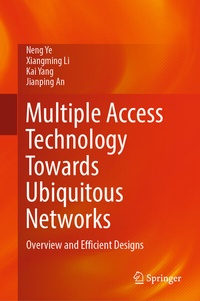
Multiple Access Technology Towards Ubiquitous Networks
Description

More details
Other editions
Additional editions
Persons
Xiangming Li received the Ph.D degree in communication and information engineering from the Beijing University of Posts and Telecommunications, Beijing, China, in 2000. From August 2000 to January 2002, he was with Agilent Technologies as a Software Engineer. From January 2002 to June 2003, he was a Post-Doctoral Fellow with the Department of Electrical and Computer Engineering, Concordia University, Canada, and with the Department of Electronic Engineering, City University of Hong Kong. From June 2003 to December 2005, he was an Associate Professor with the School of Communication and Information Engineering, Chongqing University of Posts and Telecommunications, China. From January 2006 to February 2008, he worked at NTT DOCOMO Beijing Communications Laboratories Co. Ltd., as a Researcher and Research Manager. In February 2008, he joined the School of Information and Electronics Engineering, Beijing Institute of Technology, where he is currently a Full Professor. His current research interests include wireless and mobile communications, information theory and coding, and information learning.
Kai Yang received the Ph.D. degree from Beijing Institute of Technology, China, in 2010. From Jan. 2010 to July 2010, he was with the Department of Electronic and Information Engineering, Hong Kong Polytechnic University. From 2010 to 2013, he was with Alcatel-Lucent Shanghai Bell, Shanghai, China. In 2013, he joined the Laboratoire de Recherche en Informatique, University Paris Sud 11, Orsay, France. Now, he is a professor in the School of Information and Electronics, Beijing Institute of Technology, Beijing, China. His current research interests include resource allocation, convex optimization, massive MIMO, mmWave systems, and interference mitigation.
Jianping An
received his B.E. degree from Information Engineering University in 1987, and his M.S. and Ph.D. degrees from Beijing Institute of Technology in 1992 and 1996, respectively. Since 1996, he has been with the School of Information and Electronics, Beijing Institute of Technology, where he is now a full professor and is also the Dean of the School of Cyberspace Science and Technology. From 2010 to 2011, he was a visiting professor at the University of California, San Diego. He has published more than 150 journal and conference articles and holds (or co-holds) more than 50 patents. He has received various awards for his academic achievements and the resultant industrial influences, including the National Award for Scientific and Technological Progress of China (1997) and the Excellent Young Teacher Award from China's Ministry of Education (2000). Since 2010, he has been serving as a Chief Reviewing Expert for the Information Technology Division, National Scientific Foundation of China. His current research interests are focused on digital signal processing theory and algorithms for communication systems.
