


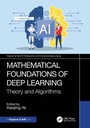
Mathematical Foundations of Deep Learning
Theory and Algorithms
1st Edition
Will be published approx. on 25. August 2026
284 pages
E-Book
978-1-040-67973-9 (ISBN)
Description

Mathematical Foundations of Deep Learning offers a comprehensive and rigorous treatment of the mathematical principles underlying modern deep learning. The book spans core theoretical topics, from the approximation capabilities of deep neural networks and the theory and algorithms of optimal control and reinforcement learning integrated with deep learning techniques to contemporary generative models that drive today's advances in artificial intelligence.
Designed as both a textbook for graduate and advanced undergraduate students as well as a long-term reference, this volume aims to equip students with a solid mathematical understanding of deep learning while serving researchers, scientists, and engineers seeking a principled framework for developing and analyzing modern artificial intelligence systems.
Features
* Comprehensive and rigorous, featuring detailed theoretical developments, mathematical proofs, and algorithmic frameworks throughout.
* Materials thoughtfully selected from this book support a full one-semester course for graduate students and advanced undergraduates.
* Concise yet precise exposition of core deep learning concepts and techniques, presented using exact and rigorous mathematical language.
Designed as both a textbook for graduate and advanced undergraduate students as well as a long-term reference, this volume aims to equip students with a solid mathematical understanding of deep learning while serving researchers, scientists, and engineers seeking a principled framework for developing and analyzing modern artificial intelligence systems.
Features
* Comprehensive and rigorous, featuring detailed theoretical developments, mathematical proofs, and algorithmic frameworks throughout.
* Materials thoughtfully selected from this book support a full one-semester course for graduate students and advanced undergraduates.
* Concise yet precise exposition of core deep learning concepts and techniques, presented using exact and rigorous mathematical language.
More details
Series
Edition
1. Auflage
Language
English
Place of publication
London
United Kingdom
Publishing group
Taylor & Francis Ltd
Target group
College/higher education
Product notice
Reflowable
Illustrations
25 Line drawings, black and white; 25 Illustrations, black and white
ISBN-13
978-1-040-67973-9 (9781040679739)
Copyright in bibliographic data is held by Nielsen Book Services Limited or its licensors: all rights reserved.
Schweitzer Classification
Other editions
Additional editions
Book
approx. 08/2026
1st Edition
Chapman & Hall/CRC
€84.50
Not yet published
Book
approx. 08/2026
1st Edition
Chapman & Hall/CRC
€197.50
Not yet published
Person
Dr. Xiaojing Ye is a Professor of Mathematics at Georgia State University in Atlanta, USA. His research interests lie in applied and computational mathematics, with a particular focus on numerical methods that integrate deep learning techniques for scientific computing. His work also spans network science, numerical optimization, image processing, and related interdisciplinary areas.
Dr. Ye began his undergraduate studies at Peking University in China in 2001, initially majoring in chemistry. Motivated by a growing interest in mathematics and physics, he transferred to the mathematics major in 2002 while pursuing physics as a minor. He received his Bachelor's degree in Mathematics major in July 2005. After one year of professional experience, he returned to academia to pursue graduate studies at the University of Florida in the USA, supported by a prestigious four-year university alumni fellowship. Dr. Ye earned a Master's degree in Statistics in 2009 and completed his Ph.D. in Mathematics in May 2011. He subsequently served as a Visiting Assistant Professor in the School of Mathematics at the Georgia Institute of Technology for two years. In 2013, he joined the Department of Mathematics and Statistics at Georgia State University as a tenure-track Assistant Professor, where he was awarded tenure and later promoted to Full Professor.
Dr. Ye began his undergraduate studies at Peking University in China in 2001, initially majoring in chemistry. Motivated by a growing interest in mathematics and physics, he transferred to the mathematics major in 2002 while pursuing physics as a minor. He received his Bachelor's degree in Mathematics major in July 2005. After one year of professional experience, he returned to academia to pursue graduate studies at the University of Florida in the USA, supported by a prestigious four-year university alumni fellowship. Dr. Ye earned a Master's degree in Statistics in 2009 and completed his Ph.D. in Mathematics in May 2011. He subsequently served as a Visiting Assistant Professor in the School of Mathematics at the Georgia Institute of Technology for two years. In 2013, he joined the Department of Mathematics and Statistics at Georgia State University as a tenure-track Assistant Professor, where he was awarded tenure and later promoted to Full Professor.
Content
1. Deep Neural Networks. 2 Network Training. 3 Deep Optimal Control. 4 Deep Reinforcement Learning. 5 Generative Models.
