

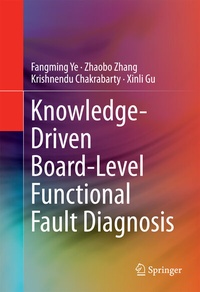
Knowledge-Driven Board-Level Functional Fault Diagnosis
Description

Explains and applies optimized techniques from the machine-learning domain to solve the fault diagnosis problem in the realm of electronic system design and manufacturing; Demonstrates techniques based on industrial data and feedback from an actual manufacturing line; Discusses practical problems, including diagnosis accuracy, diagnosis time cost, evaluation of diagnosis system, handling of missing syndromes in diagnosis, and need for fast diagnosis-system development.
More details
Other editions
Additional editions
Persons
Fangming Ye is a Staff Engineer at Huawei Technologies, with particular research interests in machine learning, data mining, resilient system design, and diagnosis system for board-level faults.
Zhaobo Zhang
is a Staff Engineer at Huawei Technologies, specializing in Data analysis and machine learning, Network reliability, Application design, Flow standardization, diagnosis automation, and memory test.
Krishnendu Chakrabarty is the William H. Younger Distinguished Professor of Engineering in the Department of Electrical and Computer Engineering and Professor of Computer Science at Duke University. He is a recipient of the National Science Foundation Early Faculty (CAREER) award, the Office of Naval Research Young Investigator award, the Humboldt Research Award from the Alexander von Humboldt Foundation, Germany, the IEEE Transactions on CAD Donald O. Pederson Best Paper award (2015), and 11 best paper awards at major IEEE conferences. Heis also a recipient of the IEEE Computer Society Technical Achievement Award (2015) and the Distinguished Alumnus Award from the Indian Institute of Technology, Kharagpur (2014). Prof. Chakrabarty is a Hans Fischer Senior Fellow at the Institute for Advanced Studies, Technical University of Munich, Germany.
Prof. Chakrabarty's current research projects include: testing and design-for-testability of integrated circuits and system; digital microfluidics, biochips, and cyberphysical systems; optimization of enterprise systems and smart manufacturing. He is a Fellow of ACM, a Fellow of IEEE, and a Golden Core Member of the IEEE Computer Society. Prof. Chakrabarty served as the Editor-in-Chief of IEEE Design & Test of Computers during 2010-2012 and ACM Journal on Emerging Technologies in Computing Systems during 2010-2015. Currently he serves as the Editor-in-Chief of IEEE Transactions on VLSI Systems .
Xinli Gu
is a Senior Director at Huawei Technologies, where he leads design solution for network product quality and reliability. He also had 12-year experiences with Cisco Systems, responsible for product testability and manufacturing quality at corporate level.
Content
Introduction.- Diagnosis System Design for Higher Accuracy.- Adaptive Diagnosis Process.- Handling Missing Syndromes.- Information-Theoretic Evaluation of Diagnosis System.- Knowledge Discover and Knowledge Transfer.- Conclusion.
