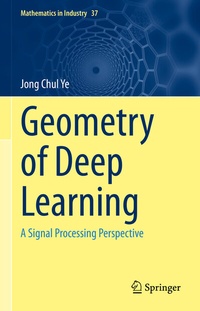
Geometry of Deep Learning
Description

The focus of this book is on providing students with insights into geometry that can help them understand deep learning from a unified perspective. Rather than describing deep learning as an implementation technique, as is usually the case in many existing deep learning books, here, deep learning is explained as an ultimate form of signal processing techniques that can be imagined.
To support this claim, an overview of classical kernel machine learning approaches is presented, and their advantages and limitations are explained. Following a detailed explanation of the basic building blocks of deep neural networks from a biological and algorithmic point of view, the latest tools such as attention, normalization, Transformer, BERT, GPT-3, and others are described. Here, too, the focus is on the fact that in these heuristic approaches, there is an important, beautiful geometric structure behind the intuition that enables a systematic understanding. A unified geometric analysis to understand the working mechanism of deep learning from high-dimensional geometry is offered. Then, different forms of generative models like GAN, VAE, normalizing flows, optimal transport, and so on are described from a unified geometric perspective, showing that they actually come from statistical distance-minimization problems.
Because this book contains up-to-date information from both a practical and theoretical point of view, it can be used as an advanced deep learning textbook in universities or as a reference source for researchers interested in acquiring the latest deep learning algorithms and their underlying principles. In addition, the book has been prepared for a codeshare course for both engineering and mathematics students, thus much of the content is interdisciplinary and will appeal to students from both disciplines.
Reviews / Votes
"This book is based on material that has been prepared for senior-level undergraduate classes, this book can be used for one-semester senior-level undergraduate and graduate-level classes." (Arzu Ahmadova, zbMATH 1493.68003, 2022)More details
Other editions
Additional editions