

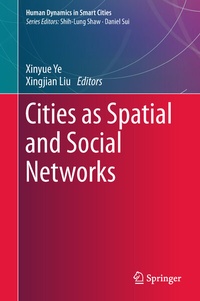
Cities as Spatial and Social Networks
Description

This book reports on the latest, cutting-edge scholarship on integrating social network and spatial analyses in the built environment. It sheds light on conceptualization and Implementation of such integration, integration for intra-city level analysis, as well as integration for inter-city level analysis. It explores the use of new data sources concerning human and urban dynamics and provides a discussion of how social network and spatial analyses could be synthesized for a more nuanced understanding of the built environment. As such this book will be a valuable resource for scholars focusing on city-related networks in a number of 'urban' disciplines, including but not limited to urban geography, urban informatics, urban planning, urban sociology, and urban studies.
More details
Other editions
Additional editions
Persons
Xinyue Ye (PhD, UCSB-SDSU) is the founding director of Computational Social Science Lab and Associate Professor in the Department of Geography at Kent State University as well as Visiting Professor at the Center for Geographical Analysis at Harvard University. His research focuses on space-time network analytics development, implementation, and application for urban computing and regional science. Dr. Ye has published about 120 refereed publications in many leading GIS and urban/regional science journals. Recent main federal research projects have been funded by Department of Commerce, Department of Energy, and National Science Foundation.
Xingjian Liu (PhD, Cambridge) is an assistant professor in the Department of Urban Planning and Design at the University of Hong Kong. His research interests are in urban form and function, regional development, urban analytics, as well as Chinese cities. Xingjian has published extensively in leading urban journals and received a number of scholarly awards, including Regional Studies Association & Routledge Early Career Award (2015) and AAG-Regional Development and Planning Specialty Group Emerging Scholar Award (2013).Content
Chapter 1. Introduction (Xinyue Ye).- Chapter 2. Planning as Computational Intelligence (Shih-Kung Lai).- Chapter 3. Towards a Spatio-Socio-Semantic Analysis Framework (Wei Luo).- Chapter 4. Hub location and network design with considerations of flow delay and point-point connection (Guoqiang Shen).- Chapter 5. Spatial Characteristics of Social Networks (Lingqian Hu).- Chapter 6. A social and spatial network approach to understanding beliefs and behaviours of farmers facing land development in Delhi, India (Jessica Cook).- Chapter 7. An interdisciplinary socio-spatial approach towards studying identity constructions in multicultural urban spaces (Lakshmi Priya Rajendran).- Chapter 8. Evaluating China's Investment Network and Mega-regions (Yuheng CAI).- Chapter 9. Exploring spatial relationships in the Pearl River Delta (Liang Xiong).- Chapter 10. Urban Networks of Leisure Activities: Using Douban Event to Measure Interaction in the Mega-city Region of the Pearl River Delta (Miaoxi Zhao).- Chapter 11. Reorganisation of the spatial economic system in a population decreasing region (Daisuke Nakamura).- Chapter 12. Socio-Spatial Network Structures in Border Regions: West and East Borders of Turkey (Cigdem Varol).- Chapter 13. Integrating spatial and social network analysis for urban studies in the new data environment (Xingjian Liu).
