

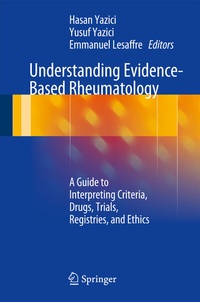
Understanding Evidence-Based Rheumatology
Description

It is imperative that health professionals caring for patients with rheumatic diseases understand how to correctly interpret evidence in their field, taking into account the merits and shortcomings of available data. Understanding Evidence-Based Rheumatology offers a practical assessment of criteria, drugs, trials, and registries and provides useful tools for successfully interpreting this data. The book introduces readers to basic analysis of trial design, statistics and application of data through no-nonsense, easy-to-follow insights. Using numerous examples, chapters outline the difficulties physicians encounter when measuring disease activity in rheumatology and offer strategies for systematically approaching these situations. Ethical issues in study design and reporting are examined and the book closes with a summary of future directions for scientific and clinical studies in rheumatology.
Understanding Evidence-Based Rheumatology is an invaluable resource for trainees, clinicians and scientists, preparing them with the necessary tools to correctly gather evidence and shed light on the difficult practice of rheumatology.
Reviews / Votes
From the book reviews:
"This book details how to correctly use and interpret evidence-based medicine in the practice of rheumatology. . The book is written for rheumatologists, rheumatology fellows, and other physicians who take care of patients with rheumatic diseases. The authors are rheumatologists. . This book focuses on an essential topic for every physician assessing and treating patients with rheumatological disease." (Maryam Pourpaki, Doody's Book Reviews, January, 2015)More details
Other editions
Additional editions
Persons
Content
1. Evidence in Rheumatology: How Does It Differ from Other Diseases?.- 2. A Review of Statistical Approaches for the Analysis of Data in Rheumatology.- 3. Disease Classification/Diagnosis Criteria.- 4. Biomarkers, Genetic Association and Genomic Studies.- 5. Outcome Measures in Rheumatoid Arthritis.- 6. Issues in Setting Up a Study and Data Collection.- 7. The Randomized Controlled Trial: Methodological Perspectives.- 8. Limitations of Traditional Randomized Controlled Clinical Trials in Rheumatology.- 9. Methodological Issues Relevant to Observational Studies, Registries and Administrative Health Databases in Rheumatology.- 10. Systematic Reviews and Meta-analyses in Rheumatology.- 11. Ethical Issues in Study Design and Reporting.- 12. Future Directions.
