

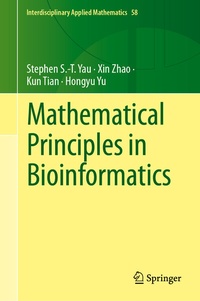
Mathematical Principles in Bioinformatics
Description

This textbook introduces bioinformatics to students in mathematics with no biology background assumed and it provides solid mathematical tools for biology students along with an understanding of how to implement them in bioinformatics problems. In addition to the basics, the text offers new approaches to understanding biological sequences. The concise presentation distinguishes itself from others on the subject, discussing and providing principles that relate to current open problems in bioinformatics as well as considering a variety of models. The convex hull principle is highlighted, opening a new interdisciplinary research area at the intersection of biology, mathematics, and computer science. Prerequisites include first courses in linear algebra, probability and statistics, and mathematical analysis. Researchers in mathematics, biology, and math-biology, will also find aspects of this text useful.
This textbook is written based on the authors' research works that have been published in various journals along with the lecture notes used when teaching bioinformatics courses at the University of Illinois at Chicago and at Tsinghua University. The content may be divided into two parts. The first part includes three chapters, introducing some basic concepts. Chapter 1 provides biological background in molecular biology for mathematicians. Chapter 2 describes biological databases that are commonly used. Chapter 3 is concerned with alignment methods including global/local alignment, heuristic alignment, and multiple alignment. The second part consisting of five chapters, describes several bioinformatics principles using a rigorous mathematical formulation. Chapter 4 introduces the time-frequency spectral principle and its applications in bioinformatics. In Chapters 5 and 6, two strategies are used, the graphical representation and the natural vector method, to represent biological sequences, and conduct sequence comparison and phylogenetic analysis without alignment. Chapter 7 presents the convex hull principle and shows how it can be used to mathematically determine whether a certain amino acid sequence can be a protein. The last chapter summarizes additional mathematical ideas relating to sequence comparisons, such as new feature vectors and metrics. This part focuses on the governing principle in biology and provides plenty of alignment-free methods, which cannot be found in any other book.
Reviews / Votes
"This book presents the main principles of general biology in a rigorous mathematical framework, with special emphasis on applications to biological problems and the development of computational tools. . this book is also suitable for mathematicians, biologists, and anyone interested in the mathematical foundations of bioinformatics. The required mathematical knowledge is explained in detail. . This book is the first to establish fundamental bioinformatics principles, bridging biology, mathematics, and computer science." (Ali Iranmanesh, zbMATH 1571.92001, 2026)
More details
Other editions
Additional editions
Persons
Xin Zhao received the B.Sc. and M.S. degrees in electronic engineering from the Beijing Institute of Technology, Beijing, China, in 2016 and 2019, respectively, where he is currently pursuing the Ph.D. degree with the School of Electronic and Information. From 2019 to 2021, he was a Research Assistant at the State Key Laboratory of Internet of Things for Smart City, University of Macau, Macau, China. His research interests include signal processing, hybrid beamforming, nonlinear precoding, RIS-aided communication, and convex optimization.
Kun Tian received a bachelor's degree in mathematics and applied mathematics from the Department of Mathematical Sciences, Tsinghua University from August 2008 to July 8. He then later returned to the Department of Mathematical Sciences and went on to receive his Ph. D. degree in Statistics from August 2012 to July 7. In July of 2017, he worked as a Postdoctoral Fellow for Mathematician Chengtong Yau at Tsinghua University. From August 2019 to present, he currently works at the School of Mathematics, Chinese Minmin University as a lecturer.
Hongyu Yu is at the Department of Mathematical Sciences, Tsinghua University, Beijing, People's Republic of China.
Content
Preface.- 1 Biological Overview.- 2 Bioinformatics Databases.- 3 Sequence Alignment.- 4 The Time-Frequency Spectral Analysis and Applications in Bioinformatics.- 5 Graphical Representation of Sequences and Its Application.- 6 The Development and Applications of the Natural Vector Method.- 7 Convex Hull Principle and Distinguishing Proteins from Arbitrary Amino Acid Sequences.- 8 New Features or Metric on Sequence Comparison.- References.
