

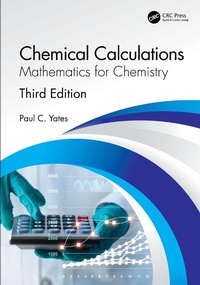
Chemical Calculations
Mathematics for Chemistry, Third Edition
3rd Edition
Published on 21. April 2023
388 pages
978-1-000-81053-0 (ISBN)
Description

Uniquely organized by chemical rather than mathematical topics, this book relates each mathematical technique to the chemical concepts where it applies. The new edition features additional, revised, and updated material in every chapter and maintains the clarity of the previous edition with the appropriate organization of topics and improved cross-referencing where mathematical techniques occur more than once. The text contains additional worked examples and end-of-chapter exercises with detailed solutions?giving students the opportunity to apply previously introduced techniques to chemically related problems. It is an ideal course companion for chemistry courses throughout the length of a degree.
Features
? This book covers the difficult area of mathematics in an easy-to-read format for students
and professionals in chemistry and related subjects.
? Structured according to chemical rather than mathematical topics.
? Each topic has at least 12 end of chapter applied chemistry problems to provide practice
in applying the techniques to real chemistry.
? Indexing of material by both chemical and mathematical topics.
? Extends its utility as a concise and practical reference for professionals in a wide array of
scientific disciplines involving chemistry.
Features
? This book covers the difficult area of mathematics in an easy-to-read format for students
and professionals in chemistry and related subjects.
? Structured according to chemical rather than mathematical topics.
? Each topic has at least 12 end of chapter applied chemistry problems to provide practice
in applying the techniques to real chemistry.
? Indexing of material by both chemical and mathematical topics.
? Extends its utility as a concise and practical reference for professionals in a wide array of
scientific disciplines involving chemistry.
More details
Edition
3rd edition
Language
English
Place of publication
London
United Kingdom
Publishing group
Taylor & Francis Ltd
Target group
College/higher education
Professional and scholarly
Illustrations
94 Line drawings, black and white; 2 Halftones, color; 3 Halftones, black and white; 2 Illustrations, color; 97 Illustrations, black and white
ISBN-13
978-1-000-81053-0 (9781000810530)
Copyright in bibliographic data and cover images is held by Nielsen Book Services Limited or by the publishers or by their respective licensors: all rights reserved.
Schweitzer Classification
Other editions
Additional editions
Book
10/2024
3rd Edition
CRC Press
€38.30
Shipment within 15-20 days

Book
04/2023
3rd Edition
CRC Press
€98.80
Shipment within 15-20 days
Person
Paul Yates has a BSc in Chemical Physics, a PhD in Chemistry and an MA in Learning and Teaching in Higher Education. After several years lecturing in physical chemistry at Keele University he moved into educational development. He was subsequently able to combine this experience in the post of Discipline Lead for the Physical Sciences at the Higher Education Academy.
He has a long standing interest in the development of mathematical skills and is the author of two textbooks on mathematics for chemists. Since returning to the university sector at Newman University he has developed an interest in the way in which data and metrics is used by various stakeholders including student supporters.
He received a Keele University Excellence in Teaching Award, is a Fellow of the Royal Society of Chemistry, a Senior Fellow of the Staff and Educational Development Association, and a Principal Fellow of the Higher Education Academy.
He has a long standing interest in the development of mathematical skills and is the author of two textbooks on mathematics for chemists. Since returning to the university sector at Newman University he has developed an interest in the way in which data and metrics is used by various stakeholders including student supporters.
He received a Keele University Excellence in Teaching Award, is a Fellow of the Royal Society of Chemistry, a Senior Fellow of the Staff and Educational Development Association, and a Principal Fellow of the Higher Education Academy.
Content
Preface
Acknowledgements
1 Fundamentals
1.1 Introduction
1.2 Positive and negative numbers
1.2.1 Addition
1.2.2 Subtraction
1.2.3 Multiplication
1.2.4 Division
1.3 Precedence in equations
1.4 Rearranging equations
1.5 Fractions
1.5.1 Identical fractions
1.5.2 Addition and subtraction
1.5.3 Multiplication
1.5.4 Division
1.6 Indices
1.6.1 Multiplication
1.6.2 Division
1.6.3 Raising to a power
1.6.4 Roots
1.6.5 Negative powers
1.7 Standard form
Exercises
Problems
2 Experimental techniques
2.1 Introduction
2.2 Measurement in chemistry
2.2.1 Decimal places
2.2.2 Significant figures
2.2.3 Combining quantities
2.3 Stoichiometric calculations
2.3.1 Multiplication and division by an integer
2.4 Uncertainty in measurement
2.4.1 Types of uncertainty
2.4.2 Combining uncertainties
2.4.2.1 Determining the maximum possible uncertainty
2.4.2.2 Determining the maximum probable uncertainty
2.4.3 Statistical treatment of uncertainties
2.4.3.1 Statistics using a calculator
2.4.3.2 Statistics using a spreadsheet
Exercises
Problems
3 Thermodynamics
3.1 Fractions and indices in the equilibrium constant
3.2 Bond enthalpies
3.2.1 Rearranging equations
3.3 The Born-Haber cycle
3.3.1 Combining uncertainties
3.4 Heat capacity
3.4.1 Expansion of brackets
3.4.2 Polynomial expressions
3.4.3 Functions
3.5 Clapeyron equation
3.5.1 Differentiation
3.6 Clausius-Clapeyron equation
3.6.1 Logarithms
3.6.2 The equation of a straight line
3.6.3 Plotting graphs
3.6.4 Plotting graphs using a spreadsheet
3.7 The ideal gas equation
3.7.1 Dimensional analysis
3.7.2 Interconversion of units
3.7.3 Constants and variables
3.7.4 Proportion
3.7.5 Functions of two variables
3.7.6 Partial differentiation
3.7.7 The differential
3.8 The van der Waals equation
3.8.1 Expression of brackets
3.8.2 Combining limits
3.9 Equilibrium constants
3.9.1 Solving quadratic equations using a formula
3.9.2 Solving quadratic equations iteratively
Exercises
Problems
4 Solution chemistry
4.1 Introduction
4.2 Concentration of solutions
4.2.1 Concentration of a solution
4.2.2 Dilution of a solution
4.3 Activity
4.4 Molality
4.4.1 Proportion
4.5 Raoult's Law
4.5.1 Straight line graphs
4.5.2 Proportion
4.6 The Debye-Hueckel equation
4.6.1 Logarithms
4.7 Ostwald's dilution law
4.7.1 Discontinuities
4.8 Partial molar volumes
4.8.1 Functions
4.8.2 Stationary points
Exercises
Problems
5 Kinetics
5.1 Introduction
5.2 Using a rate equation
5.3 Rates of change
5.4 Zero-order reactions
5.4.1 Integration
5.5 First-order reactions
5.5.1 Integration of 1/x
5.5.2 Rules of logarithms
5.6 Second-order reactions
5.6.1 Partial fractions
5.6.2 Differentiation of logarithmic functions and integration of fractions
5.7 The Arrhenius equation
5.7.1 The exponential function
5.7.2 Inverse functions
5.8 The steady state approximation
5.8.1 Simultaneous equations
Exercises
Problems
6 Structural chemistry
6.1 Introduction
6.2 Packing fractions of atoms in metals
6.3 Arrangement of atoms in crystals
6.3.1 Pythagoras' theorem
6.3.2 Pythagoras' theorem in three dimensions
6.4 Bragg's Law
6.4.1 Trigonometry
6.4.2 Inverses of trigonometric functions
6.5 The unit cell
6.5.1 Unit vectors
6.5.2 Addition and subtraction of vectors
6.5.3 Multiplication of vectors
6.6 X-ray diffraction
6.6.1 Complex numbers
6.7 Symmetry operators
6.7.1 Matrices
Exercises
Problems
7 Quantum mechanics
7.1 Introduction
7.2 Energy level transitions and appropriate precision
7.3 The photon
7.3.1 Mathematical relationships
7.4 Forces between atoms
7.4.1 Proportionality
7.4.2 Stationary points
7.5 Particle in a box
7.5.1 Complex numbers
7.5.2 Sequences
7.5.3 Inverse functions
7.5.4 Differentiation of fractional indices
7.5.5 Use of standard integrals
7.6 The free particle
7.6.1 The complex conjugate
7.6.2 The modulus of a complex number
7.7 The hydrogen atom wavefunction
7.7.1 Differentiation of a product
7.7.2 Integration by parts
7.7.3 Calculus of the exponential function
7.7.4 Multiple integration
7.7.5 Calculus of the trigonometric functions
7.8 The helium atom
7.8.1 Stationary points
7.9 Hueckel theory
7.9.1 Determinants
Exercises
Problems
8 Spectroscopy
8.1 Introduction
8.2 Calculation of dipole moments
8.3 Dipole and quadrupole moments
8.4 Electromagnetic radiation
8.4.1 Direct and inverse proportion
8.5 The Beer-Lambert Law
8.5.1 Rules of logarithms
8.6 Rotational spectroscopy
8.6.1 Sequences
8.7 Vibrational spectroscopy
8.8 Rotation-vibration spectroscopy
8.9 Nuclear magnetic resonance spectroscopy
8.9.1 Pascal's Triangle
8.10 Fourier transform spectroscopy
8.10.1 Introduction to Fourier transforms
Exercises
Problems
9 Statistical mechanics
9.1 Introduction
9.2 Molecular energy distributions
9.3 Configurations
9.3.1 Factorials
9.4 The Boltzmann equation
9.4.1 Differentiation of logarithms
9.4.2 Differentiation of products
9.5 The partition function
9.5.1 Integration by substitution
9.5.2 Calculating a series using a spreadsheet
Exercises
Problems
Appendix A Units
A.1 Prefixes
A.2 Equivalent units
Appendix B Physical constants
Answers to exercises
Answers to problems
Chemical index
Mathematical index
Acknowledgements
1 Fundamentals
1.1 Introduction
1.2 Positive and negative numbers
1.2.1 Addition
1.2.2 Subtraction
1.2.3 Multiplication
1.2.4 Division
1.3 Precedence in equations
1.4 Rearranging equations
1.5 Fractions
1.5.1 Identical fractions
1.5.2 Addition and subtraction
1.5.3 Multiplication
1.5.4 Division
1.6 Indices
1.6.1 Multiplication
1.6.2 Division
1.6.3 Raising to a power
1.6.4 Roots
1.6.5 Negative powers
1.7 Standard form
Exercises
Problems
2 Experimental techniques
2.1 Introduction
2.2 Measurement in chemistry
2.2.1 Decimal places
2.2.2 Significant figures
2.2.3 Combining quantities
2.3 Stoichiometric calculations
2.3.1 Multiplication and division by an integer
2.4 Uncertainty in measurement
2.4.1 Types of uncertainty
2.4.2 Combining uncertainties
2.4.2.1 Determining the maximum possible uncertainty
2.4.2.2 Determining the maximum probable uncertainty
2.4.3 Statistical treatment of uncertainties
2.4.3.1 Statistics using a calculator
2.4.3.2 Statistics using a spreadsheet
Exercises
Problems
3 Thermodynamics
3.1 Fractions and indices in the equilibrium constant
3.2 Bond enthalpies
3.2.1 Rearranging equations
3.3 The Born-Haber cycle
3.3.1 Combining uncertainties
3.4 Heat capacity
3.4.1 Expansion of brackets
3.4.2 Polynomial expressions
3.4.3 Functions
3.5 Clapeyron equation
3.5.1 Differentiation
3.6 Clausius-Clapeyron equation
3.6.1 Logarithms
3.6.2 The equation of a straight line
3.6.3 Plotting graphs
3.6.4 Plotting graphs using a spreadsheet
3.7 The ideal gas equation
3.7.1 Dimensional analysis
3.7.2 Interconversion of units
3.7.3 Constants and variables
3.7.4 Proportion
3.7.5 Functions of two variables
3.7.6 Partial differentiation
3.7.7 The differential
3.8 The van der Waals equation
3.8.1 Expression of brackets
3.8.2 Combining limits
3.9 Equilibrium constants
3.9.1 Solving quadratic equations using a formula
3.9.2 Solving quadratic equations iteratively
Exercises
Problems
4 Solution chemistry
4.1 Introduction
4.2 Concentration of solutions
4.2.1 Concentration of a solution
4.2.2 Dilution of a solution
4.3 Activity
4.4 Molality
4.4.1 Proportion
4.5 Raoult's Law
4.5.1 Straight line graphs
4.5.2 Proportion
4.6 The Debye-Hueckel equation
4.6.1 Logarithms
4.7 Ostwald's dilution law
4.7.1 Discontinuities
4.8 Partial molar volumes
4.8.1 Functions
4.8.2 Stationary points
Exercises
Problems
5 Kinetics
5.1 Introduction
5.2 Using a rate equation
5.3 Rates of change
5.4 Zero-order reactions
5.4.1 Integration
5.5 First-order reactions
5.5.1 Integration of 1/x
5.5.2 Rules of logarithms
5.6 Second-order reactions
5.6.1 Partial fractions
5.6.2 Differentiation of logarithmic functions and integration of fractions
5.7 The Arrhenius equation
5.7.1 The exponential function
5.7.2 Inverse functions
5.8 The steady state approximation
5.8.1 Simultaneous equations
Exercises
Problems
6 Structural chemistry
6.1 Introduction
6.2 Packing fractions of atoms in metals
6.3 Arrangement of atoms in crystals
6.3.1 Pythagoras' theorem
6.3.2 Pythagoras' theorem in three dimensions
6.4 Bragg's Law
6.4.1 Trigonometry
6.4.2 Inverses of trigonometric functions
6.5 The unit cell
6.5.1 Unit vectors
6.5.2 Addition and subtraction of vectors
6.5.3 Multiplication of vectors
6.6 X-ray diffraction
6.6.1 Complex numbers
6.7 Symmetry operators
6.7.1 Matrices
Exercises
Problems
7 Quantum mechanics
7.1 Introduction
7.2 Energy level transitions and appropriate precision
7.3 The photon
7.3.1 Mathematical relationships
7.4 Forces between atoms
7.4.1 Proportionality
7.4.2 Stationary points
7.5 Particle in a box
7.5.1 Complex numbers
7.5.2 Sequences
7.5.3 Inverse functions
7.5.4 Differentiation of fractional indices
7.5.5 Use of standard integrals
7.6 The free particle
7.6.1 The complex conjugate
7.6.2 The modulus of a complex number
7.7 The hydrogen atom wavefunction
7.7.1 Differentiation of a product
7.7.2 Integration by parts
7.7.3 Calculus of the exponential function
7.7.4 Multiple integration
7.7.5 Calculus of the trigonometric functions
7.8 The helium atom
7.8.1 Stationary points
7.9 Hueckel theory
7.9.1 Determinants
Exercises
Problems
8 Spectroscopy
8.1 Introduction
8.2 Calculation of dipole moments
8.3 Dipole and quadrupole moments
8.4 Electromagnetic radiation
8.4.1 Direct and inverse proportion
8.5 The Beer-Lambert Law
8.5.1 Rules of logarithms
8.6 Rotational spectroscopy
8.6.1 Sequences
8.7 Vibrational spectroscopy
8.8 Rotation-vibration spectroscopy
8.9 Nuclear magnetic resonance spectroscopy
8.9.1 Pascal's Triangle
8.10 Fourier transform spectroscopy
8.10.1 Introduction to Fourier transforms
Exercises
Problems
9 Statistical mechanics
9.1 Introduction
9.2 Molecular energy distributions
9.3 Configurations
9.3.1 Factorials
9.4 The Boltzmann equation
9.4.1 Differentiation of logarithms
9.4.2 Differentiation of products
9.5 The partition function
9.5.1 Integration by substitution
9.5.2 Calculating a series using a spreadsheet
Exercises
Problems
Appendix A Units
A.1 Prefixes
A.2 Equivalent units
Appendix B Physical constants
Answers to exercises
Answers to problems
Chemical index
Mathematical index
