

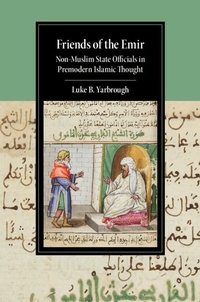
Friends of the Emir
Non-Muslim State Officials in Premodern Islamic Thought
Published on 4. June 2019
380 pages
978-1-108-75855-0 (ISBN)
Description

The caliphs and sultans who once ruled the Muslim world were often assisted by powerful Jewish, Christian, Zoroastrian, and other non-Muslim state officials, whose employment occasioned energetic discussions among Muslim scholars and rulers. This book reveals those discussions for the first time in all their diversity, drawing on unexplored medieval sources in the realms of law, history, poetry, entertaining literature, administration, and polemic. It follows the discourse on non-Muslim officials from its beginnings in the Umayyad empire (661-750), through medieval Iraq, Egypt, Syria, and Spain, to its apex in the Mamluk period (1250-1517). Far from being an intrinsic part of Islam, views about non-Muslim state officials were devised, transmitted, and elaborated at moments of intense competition between Muslim and non-Muslim learned elites. At other times, Muslim rulers employed non-Muslims without eliciting opposition. The particular shape of the Islamic discourse on this issue is comparable to analogous discourses in medieval Europe and China.
Reviews / Votes
'A breakthrough for Middle East history ... Few in the field are equipped to perform the meticulous research and incisive analysis on which this book rests. A must-read for anyone interested in Islamic law, the history of the Middle East, and Muslims' relationships to non-Muslims.' Marina Rustow, Princeton University, New Jersey 'This book reveals a spectacular mastery of very diverse medieval Arabic primary sources. It explores how and why Muslim rulers for centuries regularly employed non-Muslims in important government positions, despite the frequent disapproval of this practice by many Muslim scholars and men of letters. This is a first-class work of original scholarship.' Carole Hillenbrand, University of St Andrews, Scotland 'This richly detailed study illuminates the cultural wars of Islam's past, offering a vivid picture of Islam's value as a symbol of rule in the competition for state offices among Muslims and non-Muslims. It provides indispensable perspective for reflection on the nature of both interreligious relations and state-society relations in Islam.' Paul L. Heck, Georgetown University 'Luke B. Yarbrough has written a brilliant, revisionist, diachronic history of the often discussed opposition to the employment of non-Muslims in the pre-modern Islamic state. Upending the assumption that this antagonism was born, in the first instance, of juristic prescription and religious prejudice, Yarbrough effectively demonstrates, that it was not doctrinal discrimination, let alone religious hatred that gave rise to and perpetuated such a discourse. Rather, it was rivalry over the 'ubiquitous pursuit of resources' that lay behind the cry, expressed in multiple genres of Arabic literature, to oust non-Muslims from their often prominent positions in Islamic government.' Mark R. Cohen, Princeton University 'Friends of the Emir is a lucidly written history of pre-modern Muslim attitudes towards the employment of non-Muslims by Muslim rulers. Learned, broad, and nuanced in its approach, Yarbrough's study sees beyond the cliched dichotomies between 'historical realities' and 'legal norms' to provide a historical account as definitive as it is original.' Sean Anthony, Ohio State University '... this is an excellent and long-overdue study of an important aspect of interfaith relations and the evolution of Muslim government and identity, and a book which is comple Nabulusi's Tajrid mented by Yarborough's recent edition and translation of Ibn al-Nabulusi's Tajrid...Friends of the Emir's fluid prose and clear argumentation will render it accessible and useful to graduate students and scholars in a variety of fields.' Brian A. Catlos, Al-Masaq 'This book is ... a most important read for anyone interested in Islamic political culture in general, and in the inter faith relationships in premodern Muslim societies in particular.' Valerie Gonzalez, Journal of the Medieval Mediterranean 'The monograph will be a welcome and important addition to seminars on the intellectual and social history of the Middle East.' Kyle Longworth, Journal of Near Eastern Studies 'The book's detailed analysis of individual texts and how they contribute to a larger discourse is exemplary. Yarbrough provides insights into more familiar texts and introduces unfamiliar texts in a way that is helpful for future research. Readers interested in a particular period, place, or genre covered in the book's scope will likely find additional rewards in specific moments of illumination.' Janina Safran, Journal of the American Oriental SocietyMore details
Series
Language
English
Place of publication
Cambridge
United Kingdom
Target group
Professional and scholarly
Illustrations
Worked examples or Exercises
File size
3,61 MB
ISBN-13
978-1-108-75855-0 (9781108758550)
Copyright in bibliographic data and cover images is held by Nielsen Book Services Limited or by the publishers or by their respective licensors: all rights reserved.
Schweitzer Classification
Other editions
Additional editions
Book
06/2019
Cambridge University Press
€141.00
Shipment within 15-20 days
Person
Content
Part I. Beginnings: 1. An introduction to the prescriptive discourse surrounding non-Muslim state officials; 2. Preludes to the discourse: non-Muslim officials and late ancient antecedents; 3. The beginnings of the discourse to 236/851; 4. The discourse comes of age: the edicts of the caliph al-Mutawakkil; Part II. Elaboration: 5. Juristic aspects of the discourse; 6. Literary aspects of the discourse; Part III. Efflorescence and Comparisons: 7. The discourse at its apogee: the independent counsel works; 8. The discourse in wider perspective: comparisons and conclusions; 9. Afterword: the discourse to the nineteenth century.
