

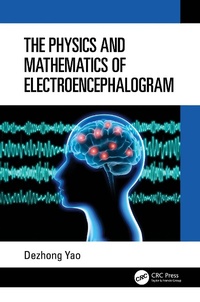
The Physics and Mathematics of Electroencephalogram
1st Edition
Published on 28. June 2024
476 pages
978-1-040-04515-2 (ISBN)
Description

This book focuses on a systematic introduction to the knowledge of mathematics and physics of electroencephalogram (EEG) and discusses an in-depth application of EEG and the development of new methods and technologies for mining and analyzing EEG.
The Physics and Mathematics of Electroencephalogram offers a systematic overview of the technology for brain function and disease. It covers six parts: background knowledge of EEG, EEG forward problems, high-resolution EEG imaging, EEG inverse problems, EEG reference electrode, and EEG cloud platform. The author reviews the critical technologies in brain function and disease, such as EEG sourcing, EEG imaging, and EEG reference electrode standardization technique. The book's aim is to clarify the mechanism of EEG from the perspective of physics, mathematics, and engineering science to help multidisciplinary readers better understand and use EEG information more effectively.
This book can be used as reference for researchers in the fields of neuroengineering, cognitive neuroscience, neurology, psychiatry, applied mathematics, and brain-like intelligence.
The Physics and Mathematics of Electroencephalogram offers a systematic overview of the technology for brain function and disease. It covers six parts: background knowledge of EEG, EEG forward problems, high-resolution EEG imaging, EEG inverse problems, EEG reference electrode, and EEG cloud platform. The author reviews the critical technologies in brain function and disease, such as EEG sourcing, EEG imaging, and EEG reference electrode standardization technique. The book's aim is to clarify the mechanism of EEG from the perspective of physics, mathematics, and engineering science to help multidisciplinary readers better understand and use EEG information more effectively.
This book can be used as reference for researchers in the fields of neuroengineering, cognitive neuroscience, neurology, psychiatry, applied mathematics, and brain-like intelligence.
More details
Edition
1. Auflage
Language
English
Place of publication
London
United Kingdom
Publishing group
Taylor & Francis Ltd
Target group
College/higher education
Professional and scholarly
Illustrations
6 Tables, black and white; 9 Line drawings, color; 51 Line drawings, black and white; 29 Halftones, color; 17 Halftones, black and white; 38 Illustrations, color; 68 Illustrations, black and white
ISBN-13
978-1-040-04515-2 (9781040045152)
Copyright in bibliographic data and cover images is held by Nielsen Book Services Limited or by the publishers or by their respective licensors: all rights reserved.
Schweitzer Classification
Other editions
Additional editions
Book
05/2026
1st Edition
CRC Press
€73.50
Shipment within 10-20 days
Book
06/2024
1st Edition
CRC Press
€278.70
Shipment within 10-20 days
Person
Dezhong Yao (Senior Member, IEEE) received the Ph.D. degree from the Chengdu University of Technology, Chengdu, China, in 1991. He is the Dean and founder, Sichuan Institute for Brain Science and Brain-Inspired Intelligence, University of Electronic Science and Technology of China (UESTC). His main research interests are Brain-X interaction including brain-computer interface, brainwave music interface, and Neuro-Imaging on music, epilepsy, cerebral palsy and plasticity.
Content
1 Overview of EEG
2 Electromagnetics behind Brain Electric Field
3 Biophysics and Source Models of EEG
4 Brain Electrical Field in Regular Head Model
5 Brain Electric Field in Realistic Head Model
6 Theory of Equivalent Distributed Sources
7 High-Resolution Cortical Imaging
8 Scalp Laplacian Imaging
9 A Unified Framework for High-Resolution EEG
10 Basic Theory of EEG Inverse Problem
11 Signal Space-Based EEG Inverse Solution
12 Iterative Minimum Norm Solution
13 Zero-Reference for Scalp EEG
14 EEG Reference Selection
2 Electromagnetics behind Brain Electric Field
3 Biophysics and Source Models of EEG
4 Brain Electrical Field in Regular Head Model
5 Brain Electric Field in Realistic Head Model
6 Theory of Equivalent Distributed Sources
7 High-Resolution Cortical Imaging
8 Scalp Laplacian Imaging
9 A Unified Framework for High-Resolution EEG
10 Basic Theory of EEG Inverse Problem
11 Signal Space-Based EEG Inverse Solution
12 Iterative Minimum Norm Solution
13 Zero-Reference for Scalp EEG
14 EEG Reference Selection
