

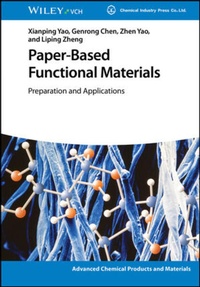
Paper-Based Functional Materials
Description

The rapid advancement of paper-based functional materials marks a transformative moment in modern materials science. Once primarily associated with writing, printing, and packaging, paper has evolved into a versatile, multifunctional platform that integrates advances from chemistry, biology, engineering, and nanotechnology. With properties such as high mechanical strength, superior conductivity, flame resistance, and biocompatibility, paper-based functional materials are gaining recognition for their applications in flexible electronics, food preservation, biomedical devices, sensors, and energy storage systems.
Paper-Based Functional Materials: Preparation and Applications provides an in-depth and systematic examination of the foundations, preparation methods, and application prospects of this emerging class of materials. Designed to progress from basic principles to applied technologies, the book covers high-performance starch-based papers, nanocellulose composites, hydrophobic and oleophobic papers, thermal insulating and flame-retardant structures, as well as advanced functional papers for detection and separation. Combining traditional papermaking expertise with cutting-edge functionalization strategies, contributors with direct experience in applied papermaking research and technology highlight the role of cellulose-based materials in meeting global sustainability goals and in substituting petroleum-based plastics.
Uniting theory, methodology, and practice in a single, comprehensive volume, Paper-Based Functional Materials: Preparation and Applications:
* Explores cross-disciplinary advances integrating chemistry, biology, and engineering in paper-based functional materials
* Details synthesis and characterization methods for high-performance starch, nanocellulose, and fiber-based papers
* Highlights applications in flexible electronics, energy storage, environmental remediation, and biomedical engineering
* Examines specialized functions such as hydrophilicity, oleophobicity, conductivity, flame retardancy, and filtration
* Outlines prospects for replacing plastics with cellulose-based solutions aligned with sustainability initiatives
* Features extensive case studies from commercial engineering and industrial practice
Paper-Based Functional Materials: Preparation and Applications is an essential reference for graduate-level courses in materials science, polymer chemistry, chemical engineering, and sustainable design, and can be adopted as a recommended text in advanced engineering curricula. It is equally valuable for researchers, R&D engineers, and industry professionals working in papermaking, biobased materials, and functional product development.
More details
Other editions
Additional editions
Persons
Genrong Chen, Senior Engineer, is chief editor for Editorial Office of Paper Chemical. He has long-term engaged in paper chemicals and related fields consulting, information research work.
Zhen Yao, Senior Engineer, she is specialized in researching and producing of starch derivatives. She is the General Manager of Hangzhou Papermaking Science & Technology Co., Ltd. and the Director of the provincial modified starch R & D center.
Liping Zheng, Senior Engineer, has long been engaged in product process innovation and engineering technology research in the field of papermaking chemicals and starch derivatives. She is the Vice President of Hangzhou Institute of Chemical Industry, the Deputy Director of the National Papermaking Chemicals Engineering Technology Research and Development Center, and the Vice President of China Papermaking Chemicals Industry Association. She has made great contributions to solving key technical problems such as major engineering design, construction, production and operation, led the construction of a new continuous fluidization process production line of 200000 t / a high performance starch based functional materials.
Content
1.1 Definition of paper-based functional materials
1.2 Raw materials of paper-based functional materials
1.3 Properties and applications of paper-based functional materials
1.4 Economic and social value of paper-based functional materials
1.5 Development trends of paper-based functional materials
Chapter 2 High-performance Starch Paper-based Functional Materials
2.1 Overview
2.2 Preparation Methods of Starch-based Functional Products
2.3 High-performance Starch-based Functional Products for Papermaking
2.4 Application Technologies of Starch-Based Functional Products in Papermaking
2.5 Outlook and Recommendations
Chapter3 Functional Materials Based on Nanocellulose Paper
3.1 Overview
3.2 Preparation and Characterization of Nanocellulose
3.3 Functional application of nanocellulose in paper making
3.4 Existing problems and prospects
Chapter 4 High Performance Fiber Paper-based Functional Materials
4.1 Introduction
4.2 Typical high-performance fiber
4.3 Wet-laid forming technology of high-performance fiber paper
4.4 Typical High-Performance Fiber-Based Functional Paper Materials
Chapter 5 Long-fiber Filter Paper-based Functional Materials
5.1 Long fibers for filter paper-based functional materials
5.2 Mechanisms of filtration
5.3 Applications of filter paper-based functional materials
Chapter 6 Hydrophobic/oleophobic/hydrophilic/oleophilic Paper-based Functional Materials
6.1 Introduction to the Mechanism of Surface Wettability of Paper-based Materials
6.2 Hydrophobic and oleophobic paper-based functional materials
6.3 Hydrophobic and lipophilic paper-based functional materials
6.4 Hydrophilic and lipophilic paper-based functional materials
6.5 Hydrophilic and oleophobic paper-based functional materials
6.6 Prospect
Chapter 7 Flame Retardant and Heat Insulation Paper-based Functional Materials
7.1 Flame Retardant Paper-based Functional Materials
7.2 Thermal insulation paper-based functional materials
Chapter 8 Paper-based functional materials for filtration and separation
8.1 Overview
8.2 Fundamental of filtration and separation
8.3 Preparation of paper-based functional materials for filtration and separation
8.4 Applications of paper-based functional materials for filtration and separation
Chapter 9 Paper-Based Functional Materials for Analysis and Detection
9.1 Development of Paper-Based Functional Materials for Analysis and Detection
9.2 Fabrication Methods for Paper-Based Analytical Detection Chips
9.3 Detection Methods of Paper-Based Functional Materials for Analysis and Detection
9.4 Applications of Paper-Based Functional Materials for Analysis and Detection
9.5 Application Cases of Paper-Based Functional Materials for Analysis and Detection
9.6 Future Prospects of Paper-Based Functional Materials for Analysis and Detection
Chapter 10 Other Paper-Based Functional Materials
10.1 Cream Paper-Based Functional Materials
10.2 Photocatalytic Paper-based Functional Materials
10.3 Basic Functional Materials for Fruit and Vegetable Preservation Paper
10.4 Electromagnetic Shielding Paper-Based Functional Materials
10.5 Paper-Based Functional Materials for Decorative Base Paper
10.6 Thermal-Sensitive Paper
1
Introduction
As modern technology advances, the demand for advanced functional materials continues to grow. However, most functional materials have significant drawbacks, such as high costs and complex manufacturing processes, which make it challenging to meet the increasing demands of the application market. In this context, paper-based functional materials have emerged as a key focus of cutting-edge technology development. Compared to traditional functional materials, paper-based functional materials offer several advantages, including strong functional properties, a wide range of applications, ease of production, low cost, biodegradability, and recyclability. These benefits make paper-based functional materials a preferred choice for future technological development.
1.1 Definition of Paper-based Functional Materials
Paper-based functional materials are advanced composite materials made primarily from plant fibers. By incorporating various functional materials-such as inorganic mineral fibers and high-performance fibers (e.g., aramid fibers, carbon fibers, and polyimide fibers)-and using modern papermaking techniques, these materials form a three-dimensional network structure with specific properties and high added value [1]. As a key component in the production of specialty paper and paperboard, the functional characteristics of these materials depend significantly on the high-performance fibers or inorganic mineral fibers added during their manufacture [2].
In paper-based functional materials, the paper serves as the substrate, with various functional materials loaded onto it [3]. These functional materials mainly include modified natural polymers like starch and fibers, synthetic organic polymers, and inorganic mineral materials, collectively known as papermaking chemicals. For many years, papermaking chemicals have been recognized as new functional materials and are included in the national catalog of industries, products, and technologies encouraged for development. Papermaking chemicals have two primary applications [4]. First, the chemicals include high-performance starch derivatives, water-soluble polymers, and newly developed nanocellulose that are used for the enhancement of ordinary paper (or paperboard). They are used to improve paper strength (dry strength, wet strength, and surface strength), retention, and filtration; reduce fiber and filler loss; and mitigate wastewater pollution. They also enhance paper properties like whiteness, smoothness, printability, softness, stiffness, tear resistance, water resistance, and breathability. Second, papermaking chemicals are applied in the production of specialty paper, which is designed for specific functions such as hydrophobicity/oleophobicity, hydrophilicity/oleophilicity, filtration/separation, flame retardancy, insulation, conductivity, luminescence, high barrier properties, detection and separation, construction and home decoration, fruit and vegetable preservation, electromagnetic shielding, dust and static resistance, corrosion and rust resistance, and antimicrobial and insect resistance. These papers have unique properties and are used in various specialized applications.
1.2 Raw Materials of Paper-based Functional Materials
The various functional materials incorporated into or composited with paper-based substrates can be categorized based on their raw material types into natural polymer materials, inorganic mineral materials, and organic polymer materials (Table 1.1).
Table 1.1 Major raw material composition of functional materials incorporated into (or composited with) paper-based substrates.
Classification Raw materials Functional products Main raw material sources Natural polymers Starch Starch-based biological products Corn, potatoes, cassava, etc. Plant fibers Nanofibers, cellulose-based biological products Wood, bamboo, rattan, cotton, etc. Inorganic minerals Inorganic minerals Functional materials such as conductive, magnetic, flame-retardant, reinforced, thermal insulation, wear-resistant, insulating, air purification, and barrier materials Inorganic minerals, carbon-based materials, magnetic materials, rare earth materials, metallic materials, etc. Petroleum-based organic polymers Functional polymer materials, such as strengthening agents, retention aids, filtration aids, adhesives, defoamers, corrosion inhibitors, oil-resistant agents, water-resistant agents, softening agents, dispersants, and deinking agents Petrochemical raw materials High-performance synthetic fibers Aramid fibers, polyacrylonitrile fibers, polyester fibers, nylon fibers, vinylon, polypropylene fibers, etc.1.2.1 Natural Polymers
Key raw materials include starch and cellulose, which are abundant renewable resources with strong compatibility with papermaking fibers and full biodegradability. Modified starches, produced through physical, chemical, or biological modifications, are essential in papermaking for enhancing strength, retention, filtration, surface sizing, coating adhesion, and interlayer bonding.
Starch-based functional materials are derived from natural starch that has been modified through physical, chemical, or biological methods to impart various functional properties. This kind of starch is commonly referred to as "modified starch." In the papermaking industry, modified starches include enzyme-converted starch, anionic starch (such as oxidized starch, phosphate starch, and carboxymethyl starch), cationic starch, amphoteric and multifunctional modified starch, cross-linked starch, hydroxyalkyl starch, composite modified starch, and grafted starch.
The benefits of these modified starches include low gelatinization temperature, good transparency and stability of the starch paste, strong affinity with fibers, excellent film-forming properties, and resistance to acids and alkalis. Modified starches are suitable for almost all types of paper and paperboard, typically used at a dosage of around 1%. They serve various functions such as strengthening, retention aid, filtration aid, surface sizing, coating adhesion, and interlayer bonding. These properties make modified starches indispensable in the papermaking industry [5], earning them the nickname "industrial MSG."
Nanocellulose consists of cellulose fibers with a one-dimensional size less than 100 nm, exhibiting unique properties characteristic of nanomaterials. These properties include size effects, quantum effects, surface effects, and macroscopic quantum tunneling effects, making their physical, chemical, and mechanical characteristics significantly different from those of macroscopic materials. As a promising new material for the "post-carbon fiber era," nanocellulose has the potential to replace metals and plastics in the future.
Nanocellulose is produced through chemical, physical, and biological methods, and its development and industrialization are still in the early stages globally. Nanocellulose and its modified products offer exceptional properties such as high strength, oil resistance, water resistance, and barrier functions, making them highly promising as biomass-based functional materials in the papermaking industry. Additionally, cellulose derivatives like carboxymethyl cellulose and hydroxypropyl cellulose are also important in papermaking coatings, contributing to improved paper properties [6].
Plant-based specialty long fibers primarily include bast fibers (such as hemp, mulberry bark, paper mulberry, and jute) and cotton fibers. Specialty papers made from these plant-based long fibers through papermaking processes exhibit high breathability and high strength, making them widely used as filtration materials for gases and liquids.
1.2.2 Inorganic Minerals
Common materials include talc, kaolin, and bentonite, which are used to enhance paper whiteness, smoothness, retention, and filtration. Other inorganic materials like mineral wool, expanded perlite, aerogel blankets, and foam glass serve as thermal insulators. Metal-based materials are often used for heat insulation, while flame retardants typically include inorganic phosphates, borates, metal hydroxides, oxides, and salts. Carbon-based materials, magnetic materials, rare earth materials, and metals also play significant roles in various functional papers.
1.2.3 Petroleum-based Organic Polymers
Derived from petrochemicals, these materials include superhydrophobic and superoleophobic functional papers used for self-cleaning, corrosion resistance, and oil transport. Common thermal insulation materials include expanded polystyrene, polyurethane sponge, cork, phenolic foam, and cellulose. These materials are typically processed through papermaking technologies to meet high-temperature and insulation requirements. Flame-retardant materials often involve halogen, phosphorus, and nitrogen compounds, and noncombustible fibers.
Paper-based functional materials...
