

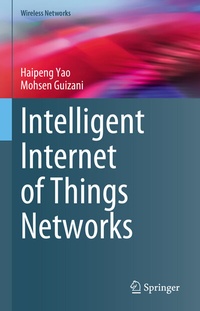
Intelligent Internet of Things Networks
1st Edition
Published on 9. June 2023
XIV, 405 pages
978-3-031-26987-5 (ISBN)
Description

This book provides an overview of the Internet of Things Network and Machine Learning and introduces Internet of Things architecture. It designs a new intelligent IoT network architecture and introduces different machine learning approaches to investigate solutions. It discusses how machine learning can help network awareness and achieve network intelligent control. It also dicusses the emerging network techniques that can enable the development of intelligent IoT networks.
This book applies several intelligent approaches for efficient resource scheduling in networks. It discusses Mobile Edge Computing aided intelligent IoT and focuses mainly on the resource sharing and edge computation offloading problems in mobile edge networks. The blockchain-based IoT (which allows fairly and securely renting resources and establishing contracts) is discussed as well.
The Internet of Things refers to the billions of physical devices thatare now connected to and transfer data through the Internet without requiring human-to-human or human-to-computer interaction. According to Gartner's prediction, there will be more than 37 billion IoT connections in the future year of 2025. However, with large-scale IoT deployments, IoT networks are facing challenges in the aspects of scalability, privacy, and security. The ever-increasing complexity of the IoT makes effective monitoring, overall control, optimization, and auditing of the network difficult. Recently, artificial intelligence (AI) and machine learning (ML) approaches have emerged as a viable solution to address this challenge. Machine learning can automatically learn and optimize strategy directly from experience without following pre-defined rules. Therefore, it is promising to apply machine learning in IoT network control and management to leverage powerful machine learning adaptive abilities for higher network performance.
This book targets researchers working in the Internet of Things networks as well as graduate students and undergraduate students focused on this field. Industry managers, and government research agencies in the fields of the IoT networks will also want to purchase this book.
This book applies several intelligent approaches for efficient resource scheduling in networks. It discusses Mobile Edge Computing aided intelligent IoT and focuses mainly on the resource sharing and edge computation offloading problems in mobile edge networks. The blockchain-based IoT (which allows fairly and securely renting resources and establishing contracts) is discussed as well.
The Internet of Things refers to the billions of physical devices thatare now connected to and transfer data through the Internet without requiring human-to-human or human-to-computer interaction. According to Gartner's prediction, there will be more than 37 billion IoT connections in the future year of 2025. However, with large-scale IoT deployments, IoT networks are facing challenges in the aspects of scalability, privacy, and security. The ever-increasing complexity of the IoT makes effective monitoring, overall control, optimization, and auditing of the network difficult. Recently, artificial intelligence (AI) and machine learning (ML) approaches have emerged as a viable solution to address this challenge. Machine learning can automatically learn and optimize strategy directly from experience without following pre-defined rules. Therefore, it is promising to apply machine learning in IoT network control and management to leverage powerful machine learning adaptive abilities for higher network performance.
This book targets researchers working in the Internet of Things networks as well as graduate students and undergraduate students focused on this field. Industry managers, and government research agencies in the fields of the IoT networks will also want to purchase this book.
More details
Series
Language
English
Place of publication
Cham
Switzerland
Publishing group
Springer International Publishing
Target group
Professional and scholarly
Product notice
Reflowable
Illustrations
XIV, 405 p. 1 illus.
File size
15,00 MB
ISBN-13
978-3-031-26987-5 (9783031269875)
DOI
10.1007/978-3-031-26987-5
Schweitzer Classification
Other editions
Additional editions
Haipeng Yao | Mohsen Guizani
Intelligent Internet of Things Networks
Book
06/2023
Springer
€181.89
Shipment within 15-20 days
Persons
Haipeng Yao (Senior Member, IEEE) received the Ph.D. degree with the Department of Telecommunication Engineering, University of Beijing University of Posts and Telecommunications, Beijing, China, in 2011. He is currently a Professor with the Beijing University of Posts and Telecommunications. He has authored or coauthored more than 150 papers in prestigious peer-reviewed journals and conferences. His research interests include future network architecture, network artificial intelligence, networking, space-terrestrial integrated network, network resource allocation, and dedicated networks. Dr. Yao served as the Associate Editor of IEEE Transactions on Sustainable Computing, IEEE Access, and the Guest Editor of IEEE Open Journal of the Computer Society and Springer Journal of Network and Systems Management. He has won several research awards including the 2022 IEEE ICC Best Paper Award, 2021 IEEE IWCMC Best Paper Award, 2020 IEEE ICCC Best Paper Award. He was the Member of the TechnicalProgram Committee and the Symposium Chair for a number of international conferences, including IWCMC 2019 Symposium Chair, and ACM TUR-C SIGSAC2020 Publication Chair.
Mohsen Guizani (Fellow, IEEE) received his BS (with distinction), MS, and Ph.D. degrees in electrical and computer engineering from Syracuse University, NY. He is currently a professor and an associate provost at Mohamed Bin Zayed University of Artificial Intelligence (MBZUAI), Abu Dhabi, UAE. Previously, he worked in different institutions in the United States. His research interests include applied machine learning and artificial intelligence, the Internet of Things, intelligent systems, smart city, and cybersecurity. He was listed as a Clarivate Analytics Highly Cited Researcher in Computer Science in 2019, 2020, and 2021. He has won several research awards including the 2015 IEEE Communications Society Best Survey Paper Award as well as four Best Paper Awards from IEEE ICC and GLOBECOM. He is the author of 10 books and more than 800 publications. He is also the recipient of the 2017 IEEE Communications Society Wireless Technical Committee (WTC) Recognition Award, the 2018 Ad Hoc Technical Committee Recognition Award, and the 2019 IEEE Communications and Information Security Technical Recognition (CISTC) Award. He served as the Editor-in-Chief of IEEE Network and is currently serving on the Editorial Boards of many IEEE transactions and magazines. He was the Chair of the IEEE Communications Society Wireless Technical Committee and the Chair of the TAOS Technical Committee. He served as an IEEE Computer Society Distinguished Speaker and is currently an IEEE ComSoc Distinguished Lecturer.
Mohsen Guizani (Fellow, IEEE) received his BS (with distinction), MS, and Ph.D. degrees in electrical and computer engineering from Syracuse University, NY. He is currently a professor and an associate provost at Mohamed Bin Zayed University of Artificial Intelligence (MBZUAI), Abu Dhabi, UAE. Previously, he worked in different institutions in the United States. His research interests include applied machine learning and artificial intelligence, the Internet of Things, intelligent systems, smart city, and cybersecurity. He was listed as a Clarivate Analytics Highly Cited Researcher in Computer Science in 2019, 2020, and 2021. He has won several research awards including the 2015 IEEE Communications Society Best Survey Paper Award as well as four Best Paper Awards from IEEE ICC and GLOBECOM. He is the author of 10 books and more than 800 publications. He is also the recipient of the 2017 IEEE Communications Society Wireless Technical Committee (WTC) Recognition Award, the 2018 Ad Hoc Technical Committee Recognition Award, and the 2019 IEEE Communications and Information Security Technical Recognition (CISTC) Award. He served as the Editor-in-Chief of IEEE Network and is currently serving on the Editorial Boards of many IEEE transactions and magazines. He was the Chair of the IEEE Communications Society Wireless Technical Committee and the Chair of the TAOS Technical Committee. He served as an IEEE Computer Society Distinguished Speaker and is currently an IEEE ComSoc Distinguished Lecturer.
Content
Introduction.- Intelligent Internet of Things Networking Architecture.- Intelligent IoT Network Awareness.- Intelligent Traffic Control.- Intelligent Resource Scheduling.- Mobile Edge Computing Enabled Intelligent IoT.- Blockchain Enabled Intelligent IoT.- Conclusions and Future Challenges.
