

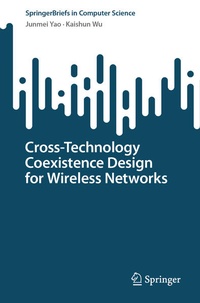
Cross-Technology Coexistence Design for Wireless Networks
Description

This book introduces readers to the fundamentals of the cross-technology coexistence problem in heterogeneous wireless networks. It also highlights a range of mechanisms designed to combat this problem and improve network performance, including protocol design, theoretical analysis, and experimental evaluation.
In turn, the book proposes three mechanisms that can be combined to combat the cross-technology coexistence problem and improve network performance. First, the authors present a fast signal identification method. It provides the basis for the subsequent protocol design and allows heterogeneous devices to adopt proper transmission strategies. Second, the authors present two cross-technology interference management mechanisms in both the time domain and the frequency domain, which can mitigate interference and increase transmission opportunities for heterogeneous devices, thus improving network performance. Third, they present a cross-technology communication mechanism basedon symbol-level energy modulation, which allows heterogeneous devices to transmit information directly without a gateway, improving transmission efficiency and paving the way for new applications in IoT scenarios. Lastly, they outline several potential research directions to further improve the efficiency of cross-technology coexistence.This book is intended for researchers, computer scientists, and engineers who are interested in the research areas of wireless networking, wireless communication, mobile computing, and Internet of Things. Advanced-level students studying these topics will benefit from the book as well.
More details
Other editions
Additional editions
Persons
Junmei Yao is currently an assistant professor at the College of Computer Science and Software Engineering, Shenzhen University, China. She received her PhD in computer science from Hong Kong Polytechnic University, Hong Kong, in 2016. Dr. Yao's research interests include wireless networks, wireless communications, and mobile computing. She has published more than 30 research papers in top-tier international journals and conferences, including IEEE TMC, IEEE TPDS, IEEE TVT, IEEE TCC, IEEE IOTJ, IEEE PerCom, IEEE ICDCS, and IEEE ICNP.
Kaishun Wu is currently a distinguished professor at the College of Computer Science and Software Engineering, Shenzhen University, China, where he leads the Research Centre of Internet of Things. Prof. Wu's research interests include wireless communications and mobile computing. He has coauthored 2 books and published over 100 refereed papers in leading international journals and conferences. He holds 63 patents, with a further 8 (US) and 100 (China) pending. Prof. Wu serves as an associate editor of IET COMMUNICATIONS and IEEE Access , and as a guest editor of IEEE Network . He is a technical program committee member of IEEE INFOCOM, IEEE ICDCS, IEEE ICC, IEEE Globecom, and so on. He won the best paper awards at IEEE Globecom 2012, IEEE ICPADS 2012, IEEE MASS 2014, and IEEE SECON 2018. Prof. Wu was selected for the 2012 Hong Kong Young Scientist Award. He was also one of the winners of the 2014 Hong Kong ICT Awards: Best Innovation. He received the 2014 IEEE ComSoc Asia-Pacific Outstanding Young Researcher Award. He is an IET Fellow and IEEE Senior Member.
Content
Chapter 1 Introduction.- Chapter 2 Heterogeneous Signal Identification.- Chapter 3 Cross-Technology Communication through Symbol-Level Energy Modulation.- Chapter 4 Cross-Technology Interference Management in Frequency domain.- Chapter 5 Cross-Technology Interference Management in Time Domain.- Chapter 6 Conclusion and Future Work.
