

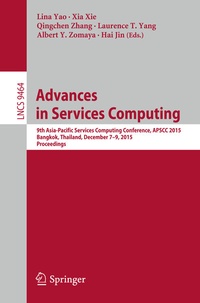
Advances in Services Computing
9th Asia-Pacific Services Computing Conference, APSCC 2015, Bangkok, Thailand, December 7-9, 2015, Proceedings
Published on 8. December 2015
XIV, 312 pages
978-3-319-26979-5 (ISBN)
Description

This book constitutes the refereed proceedings of the 9th Asia-Pacific Services Computing Conference, APSCC 2015, held in Bangkok, Thailand, in December 2015.The 17 revised full papers and 6 short papers presented were carefully reviewed and selected from numerous submissions. The papers cover a wide range of topics in services computing, web services, cloud computing, security in services, and social, peer-to-peer, mobile, ubiquitous and pervasive computing.
More details
Series
Edition
1st ed. 2015
Language
English
Place of publication
Cham
Switzerland
Publishing group
Springer International Publishing
Product notice
Reflowable
Illustrations
XIV, 312 p. 109 illus. in color.
File size
18,70 MB
ISBN-13
978-3-319-26979-5 (9783319269795)
DOI
10.1007/978-3-319-26979-5
Schweitzer Classification
Other editions
Additional editions
Lina Yao | Xia Xie | Qingchen Zhang
Advances in Services Computing
9th Asia-Pacific Services Computing Conference, APSCC 2015, Bangkok, Thailand, December 7-9, 2015, Proceedings
Book
12/2015
Springer
€53.49
Shipment within 10-15 days
Persons
Content
- Intro
- Preface
- Organization
- Invited Talks (Abstracts)
- When HPC, Big Data Science, and Wireless Technology Merge: The World of Endless Opportunities and Challenges
- Challenges and Future Research Direction of Developing Trustworthy Services Computing Systems
- Contents
- Regular Papers
- A Context-Aware Usage Prediction Approach for Smartphone Applications
- 1 Introduction
- 2 Related Work
- 3 Dataset and Evaluation Metrics
- 3.1 The Real Dataset
- 3.2 Evaluation Metrics
- 4 A Hybrid Usage Prediction Model
- 4.1 Frequency and Time Decay Model
- 4.2 Stickiness and Cycle Model
- 4.3 Location-based Collaborative Filtering
- 4.4 Combination of Three Models
- 5 Experiment and Conclusion
- 5.1 Experiment Methods and Result
- 5.2 Conclusion
- 6 A Dynamic Desktop for Android Platform
- 7 Conclusion and Future Work
- References
- A Framework for Fast Service Verification and Query Execution for Boolean Service Rules
- 1 Introduction
- 2 Motivation for This Work
- 3 Detailed Methodology
- 3.1 Algorithm for Minimal Support Set Generation
- 3.2 A Complete Example
- 4 Implementation and Results
- 5 Conclusion and Future Work
- References
- A Novel Reactive-Predictive Hybrid Resource Provision Method in Cloud Datacenter
- Abstract
- 1 Introduction
- 2 Related Work
- 3 System Architecture
- 4 RPHRPM Modules and Components
- 4.1 Resource Monitor
- 4.2 Prediction Module
- 4.3 Reactive Trigger
- 4.4 Resource Analyzer
- 4.5 Resource Controller
- 5 Experiment and Analysis
- 5.1 Experimental Setup
- 5.2 Results and Analysis
- 6 Conclusion and Future Work
- References
- A Social Balance Theory-Based Service Recommendation Approach
- Abstract
- 1 Introduction
- 2 Formalization and Motivation
- 2.1 Formalization
- 2.2 Motivation
- 3 SBT-SR: A Service Recommendation Approach Based on Social Balance Theory
- 4 Case Study
- 5 Experiment Analyses
- 5.1 The Dataset and Experiment Deployment
- 5.2 Experiment Results
- 5.3 Complexity Analyses
- 6 Related Works and Discussion
- 6.1 Related Works and Comparison Analyses
- 6.2 Further Discussion
- 7 Conclusions
- Acknowledgements
- References
- A Software-Defined Cloud Resource Management Framework
- 1 Introduction
- 1.1 Our Approach
- 1.2 Evaluations and Contributions
- 1.3 Outline
- 2 Background and Motivation
- 2.1 Cloud Resource Management
- 2.2 Challenges in Cloud Resource Management
- 2.3 Motivation
- 3 Problem Statement
- 4 System Design and Architecture
- 4.1 Methodology
- 4.2 Design Considerations in Cloud Resource Administration
- 4.3 Architecture
- 4.4 Summary of Functions
- 5 Evaluation and Results
- 5.1 Implementation
- 5.2 Discussion and Results
- 6 Related Work
- 6.1 SDN Support for Datacentre Management
- 6.2 Developments in Software-Defined Clouds
- 7 Conclusions and Future Work
- References
- Automated Clarification of Constraints in Web Services for Accurate Service Reuse
- Abstract
- 1 Introduction
- 2 Empirical Investigation
- 2.1 Dataset
- 2.2 Location Constraint
- 2.3 Object Constraint
- 3 Constraints Clarification Approach
- 3.1 Preparing Web Services Along with Tags
- 3.2 Clarifying Web Services with Constraints
- 4 Evaluation
- 4.1 Effectiveness of Constraints Clarification Approach
- 4.2 Impacts of Constraints on Relation Identification
- 5 Related Work
- 6 Conclusion
- References
- Common Topic Group Mining for Web Service Discovery
- Abstract
- 1 Introduction
- 2 Related Work
- 3 Problem Definition and Solution Overview
- 3.1 Problem Definition
- 3.2 Overall Framework
- 4 Mining Common Topic Groups
- 5 Web Service Matching and Ranking Based on CTGs
- 6 Experiments and Result Analysis
- 6.1 Evaluation of Service Discovery Based on Topic Models
- 6.2 Evaluation of CTG-Based Service Discovery
- 7 Conclusions and Future Work
- References
- Context-Aware Web Services Recommendation Based on User Preference Expansion
- Abstract
- 1 Introduction
- 2 Related Works
- 3 A Motivating Example
- 4 CASR-UPE Algorithm: Context-Aware Web Services Recommendation Based on User Preference Expansion
- 4.1 Problem Definition
- 4.2 Modeling the Influence of User Location Update on User Preference
- 4.3 Context-Aware Similarity Mining for Updated Location
- 4.4 QoS Predication and Services Recommendation
- 5 Experiments
- 5.1 Datasets and Data Processing
- 5.2 Evaluation Metrics
- 5.3 Evaluation
- 5.4 Discussion
- 6 Conclusion
- Acknowledgment
- References
- CPFirewall: A Novel Parallel Firewall Scheme for FWaaS in the Cloud Environment
- Abstract
- 1 Introduction
- 1.1 Anomaly Detection
- 1.2 Load Balance
- 1.3 Dynamic Scale
- 2 Related Work
- 3 System Architecture
- 4 CPFirewall Implementation
- 4.1 Anomaly Detector
- 4.2 Rule Allocator
- 4.3 Classifier
- 4.4 Monitor
- 5 Experiment and Analysis
- 5.1 Rule-Splitting Algorithm Experiment
- 5.2 Rule Allocation Experiments
- 5.3 System Performance Experiment
- 6 Conclusion and Future Work
- References
- Dependency Aware Business Process Analysis for Service Identification
- 1 Introduction
- 2 Related Work
- 3 Dependency Aware Service Identification
- 3.1 Requirement Acquisition
- 3.2 Scenario Matching
- 3.3 Service Grouping
- 4 Case Study
- 4.1 Requirement Acquisition
- 4.2 Scenario Matching and Service Grouping
- 4.3 Discussion
- 5 Conclusion and Future Work
- References
- Dynamic Allocation of Virtual Resources Based on Genetic Algorithm in the Cloud
- 1 Introduction
- 2 Related Work
- 3 Problem Formulation
- 4 Multi-objective Genetic Algorithm (MOGA)
- 4.1 Encoding
- 4.2 Initial Population Generation
- 4.3 Fitness Function
- 4.4 Three Main Operators
- 4.5 Termination Condition
- 5 Performance Evaluation
- 5.1 Evolutionary Process of MOGA
- 5.2 Stabilization Time and Migration Overhead
- 6 Conclusion and Future Work
- References
- Effective Mashup Service Clustering Method by Exploiting LDA Topic Model from Multiple Data Sources
- Abstract
- 1 Introduction
- 2 Related Work
- 3 Mashup Service Clustering Approach
- 3.1 Mashup Service Clustering Framework
- 3.2 Data Preprocessing
- 3.3 DAT-LDA
- 3.4 Mashup Service Clustering
- 4 Experiments
- 4.1 Experiment Settings
- 4.2 Evaluation Metrics
- 4.3 Baseline Approaches
- 4.4 Experiment Results
- 4.4.1 The Number of Optimal Topic
- 4.4.2 Clustering Accuracy Comparison
- 4.4.3 The Impact of T
- 5 Conclusions
- References
- Efficient Search-Based Automatic Execution Replay for Virtual Machines
- 1 Introduction
- 2 Method
- 2.1 Method Overview
- 2.2 The Record Phase
- 2.3 The Search Phase
- 2.4 The Replay Phase
- 3 Implementation
- 4 Evaluation
- 5 Related Work
- 6 Conclusion and Future Work
- References
- Leveraging Process Mining on Service Events Towards Service Composition
- Abstract
- 1 Introduction
- 2 Related Work
- 3 Framework Overview
- 4 Detailed Approach
- 4.1 Log Processing and Process Mining Based on the Meta-Model
- 4.2 Service Composition Based on Scene Model
- 4.3 Further Development and Deployment Based on BPEL Instance
- 5 Case Study and Discussion
- 5.1 Case Study
- 5.2 Discussion
- 6 Conclusion
- References
- RAID-6Plus: A Fast and Reliable Coding Scheme Aided by Multi-failure Degradation
- Abstract
- 1 Introduction
- 2 Backgrounds and Motivation
- 2.1 Failure Modes in Disk and SSD
- 2.2 Growing Reconstruction Window for Single Failure
- 2.3 Motivation
- 3 System Design
- 3.1 Optimal Reconstruction for Single Failure in RDP
- 3.2 Redundancy Coding in RAID-6Plus
- 3.3 Reconstruction in RAID-6Plus
- 4 Performance Analysis
- 4.1 Parity Computation Complexity
- 4.2 Update Penalty
- 4.3 Reconstruction Cost
- 4.4 Storage Overhead and Reliability
- 5 Conclusions
- References
- The Searching Ranking Model Based on the Sharing and Recommending Mechanism of Social Network
- Abstract
- 1 Introduction
- 2 Related Work
- 3 Using Social Sharing and Recommending Mechanism to Optimize Search Ranking
- 3.1 Relevant Conceptions of SRRR
- 3.2 Process of SRRR
- 4 Analysis of SRRR
- 4.1 Theoretical and Empirical Analysis
- 4.2 Experimental Verification
- 5 Conclusions and Future Work
- Acknowledgement
- References
- WebCDN: A Peer-to-Peer Web Browser CDN Based WebRTC
- Abstract
- 1 Introduction
- 2 Development of WebRTC and HTML5
- 3 Design of WebCDN Architecture
- 3.1 Design of WebCDN Client
- 3.2 Design of WebCDN Server
- 4 Workflow of WebRTC
- 4.1 Client Initial Workflow
- 4.2 Resource Request Workflow
- 5 Experiment and Evaluation
- 5.1 Latency of WebRTC
- 5.2 Simulation Experiment
- 6 Conclusion
- References
- Short Papers
- DDS: A Deadline Driven Workflow Scheduling Algorithm for Hybrid Amazon Instances
- Abstract
- 1 Introduction
- 2 Background
- 2.1 Related Work
- 2.2 Instances in Cloud
- 2.3 Workflows
- 3 System Model
- 4 Deadline Driven Scheduling Algorithm
- 4.1 Deadline Assignment
- 4.2 Global Weight Calculation and Group Partition
- 4.3 Mapping Instances and Out-of-Bid Strategy
- 5 Experiments
- 5.1 Instance Resource Pool
- 5.2 Bidding Strategies and Baseline Algorithms
- 5.3 Experimental Results and Analyses
- 5.4 Results Analyses
- 6 Conclusion
- References
- GPU-based Static State Security Analysis in Power Systems
- 1 Introduction
- 2 Related Work
- 3 The Workflow and Modules of Static State Security Analysis
- 3.1 Overview of Static State Security Analysis
- 3.2 Preprocessing
- 3.3 Power Flow Calculation
- 3.4 Static State Security Analysis
- 4 Performance Evaluation
- 4.1 Dataset and Experimental Environment
- 4.2 Evaluation of the Static State Security Analysis System
- 5 Conclusion and Future Work
- References
- Improved WSN Capabilities Through Efficient Duty-Cycle Mechanism
- Abstract
- 1 Introduction
- 2 Related Work
- 2.1 Nodes Clustering Organization
- 2.2 Duty Cycle Mechanism
- 2.3 Cross-Layer Scheduling Algorithms for Power Efficiency
- 3 Proposed Protocol
- 3.1 Assumptions
- 3.2 Description of the Proposed Protocol
- 3.2.1 Phase 1: Initialization and Grid Formation
- 3.2.2 Phase 2: Synchronization of Duty-Cycle
- 4 Performance Evaluation
- 4.1 Metrics of Comparison
- 4.2 Simulation Results
- 5 Conclusion
- References
- Mining Multiple Periods in Event Time Sequence
- Abstract
- 1 Introduction
- 2 Related Works
- 3 Problem Definition
- 3.1 Event and States
- 3.2 Multiple Periods
- 3.3 Support and Support Threshold
- 3.4 Basic Thoughts of Multiple Periods Acquisition Algorithm
- 4 Mining Multiple Periods
- 4.1 Preliminary Screening and Storage of Suspected Periods
- 4.2 Acquiring True Periods and Changing Matrix Dynamically
- 5 Experiments
- 5.1 Determining the Support Threshold
- 5.2 Analysis of All Employees' Attendance Data
- 5.3 Compared Experiment
- 5.4 Time and Space Complexity of This Algorithm
- 6 Conclusion
- References
- Social Aware Mobile Payment Service Popularity Analysis: The Case of WeChat Payment in China
- 1 Introduction
- 2 Theoretical Foundations and Related Work
- 2.1 Technology Acceptance Model
- 2.2 Social Network Based Mobile Payment Analysis
- 3 Hypotheses
- 3.1 TAM
- 3.2 Trust
- 3.3 Perceived Enjoyment
- 3.4 Use Context
- 3.5 Social Interaction
- 4 Analysis and Result
- 4.1 Data Collection
- 4.2 Exploratory Factor Analysis
- 4.3 Confirmatory Factor Analysis
- 4.4 Discussion
- 5 Conclusion and Future Work
- References
- Towards Truly Elastic Distributed Graph Computing in the Cloud
- Abstract
- 1 Introduction
- 2 Background and Model
- 3 System Architecture
- 4 Two-Level Graph Partitioning
- 5 Execution Engine and Dynamic Load Balancing
- 6 Differentiated Fault Tolerance
- 7 Preliminary Evaluation and Discussions
- 8 Related Work
- 9 Conclusion
- References
- Author Index
