

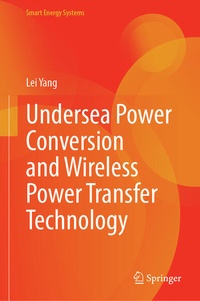
Undersea Power Conversion and Wireless Power Transfer Technology
Description

This book constructs a complete knowledge framework of undersea wireless power transfer technology, following the main thread of "fundamental theories-key technologies-application scenarios-future challenges". In the section on fundamental theories, authors delve into the characteristics of electromagnetic wave propagation in seawater media, magnetic coupling resonance mechanisms, electric field coupling mechanisms, and energy-information co-transmission models. The chapter on key technologies focuses on core issues such as high-frequency inverter design, adaptive impedance matching, multi-objective optimization algorithms, and pressure-and corrosion-resistant materials. The section on application scenarios combines practical cases from deep-sea exploration, underwater Internet of Things (IoT), and military equipment to analyze the engineering challenges faced in implementing these technologies. Additionally, this book features a special chapter on "Interdisciplinary Integration," highlighting the importance of cross-domain innovation involving ocean engineering, power electronics, mechanical engineering, materials science, and artificial intelligence within this field.
More details
Other editions
Additional editions
Person
Lei Yang, IEEE Senior Member, received the B.S degree from Information Engineering University, Zhengzhou, China, in 2011, and the M.S. and Ph.D. degree from Northwestern Polytechnical University, Xi'an, Shaanxi, China, in 2014 and 2017, respectively. He is currently working as Associate Professor at the Xi'an University of Technology. His research interests include nonlinear control methods, wireless power transfer systems, switched-capacitor (SC) converter. He has published more than 50 high-level papers and authorized more than 10 invention patents. He hosts the sub-task of the Key Program of the Joint Funds of the National Natural Science Foundation of China, the Youth Program of the National Natural Science Foundation of China, the General Program of the China Postdoctoral Science Foundation, and the Key Research and Development Plan Project of Shaanxi Province. Depending on the preliminary research achievements of this project, his team won the gold medal of the 2ND China Post-Doctoral Innovation & Entrepreneurship Competition and other scientific research awards. He serves as Chief Scientist of Shaanxi Province Wireless Power Supply Key Equipment "Scientist + Engineer" Team. He has been awarded as the "National Outstanding Postdoctoral Fellow in Innovation and Entrepreneurship".
Content
System overview.- Principles and Topologies of Undersea Wireless Power Transfer.- Undersea Power Conversion and Connection Technologies.- Platform-based Undersea Wireless Power Transfer Technology and Control Strategies.- Undersea Wireless Power and Information Co-channel Transmission Technology.- Cluster-based Undersea Wireless Power Transfer System and Centralized Control Strategies.- Interdisciplinary Research and Prospects of Undersea Wireless Power Transfer Technology.- Design and Application Practice Cases of Undersea Wireless Power Transfer System.
