

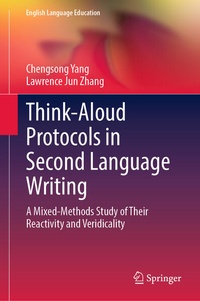
Think-Aloud Protocols in Second Language Writing
Description

This book addresses the validity of think-aloud protocols (TAPs) in L2 writing research through a mixed methods study and proposes effective approaches for their valid implementation. The book uncovers the reactive effects that TAPs have on L2 writing performance and processes, and examines how individual factors moderate this reactivity. It further presents and categorizes participants' perceptions regarding reactivity and veridicality. To enhance veridicality, the book identifies incomplete TAPs using retrospective verbal reports as a reference point. Recommendations for utilizing TAPs include considering participants' individual differences, recent experiences, and emotions.
This book will be valuable to educators teaching methodology in second or foreign language education, applied linguistics, or writing research, and to L2 researchers or graduate students with a broad interest in research methods, process-based research, or writing studies, or planning to incorporate TAPs into their research.
More details
Other editions
Additional editions
Persons
Chengsong Yang is associate professor of applied linguistics at Xi'an Jiaotong University, China. He holds a PhD degree from The University of Auckland, New Zealand, and an MA in Applied Linguistics from the National Institute of Education, Nanyang Technological University, Singapore. He has articles published in Perspectives, Applied Linguistics, Journal of Second Language Writing, Journal of English for Academic Purposes, Reading and Writing, System, Asia Pacific Education Researcher, and others.
Lawrence Jun Zhang, PhD , is Professor of Applied Linguistics/TESOL at The University of Auckland, New Zealand. His main areas of interest are reading and writing in English as a second/foreign language. He has published extensively along these lines in leading journals, including Applied Linguistics, Modern Language Journal, TESOL Quarterly, Journal of English for Academic Purposes, Language Teaching Research, Journal of Second Language Writing, Studies in Second Language Acquisition, System, Computer-Assisted Language Learning, among others. His co-authored book, Teaching Writing in English as a Foreign Language: Teachers' Cognition Formation and Reformation, was published by Springer in 2022. He also serves as an Editor-in-Chief for System (Elsevier).
Content
Foreword by Rod Ellis.- Introduction.- Literature Review.- Methodology.- Reactivity: Results from Quantitative Analyses of Performance.- Reactivity: Results from Qualitative Analyses of Reflections.- Veridicality: Results from Qualitative Analyses of Reflections.- Veridicality: Results from Comparison of Reports.- Discussion.- Conclusions, Limitations, and Implications for Using TAPs.
