

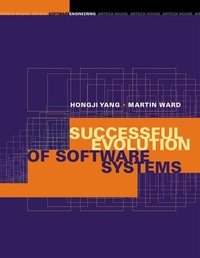
Successful Evolution of Software Systems
1st Edition
Published on 1. January 2002
300 pages
978-1-58053-588-5 (ISBN)
Description

In today's fast-changing, competitive environment, having an up-to-date information system (IS) is critical for all companies and institutions. Rather than creating a new system from scratch, reengineering is an economical way to develop an IS to match changing business needs. Using detailed examples, this practical book gives you methods and techniques for reengineering systems for flexibility and reliability. It helps you reengineer a system to continue to provide for business critical missions as well as achieve a smooth transformation to an up-to-date software technology environment. What's more, it shows you how to redevelop a flexible system that can evolve to meet future business objectives, reduce start time and save money in the reengineering process.
More details
Other editions
Additional editions
Martin Ward | Hongji Yang
Successful Evolution of Software Systems
Book
12/2002
Artech House Publishers
€104.18
Shipment within 10-20 days
Content
- Successful Evolution of Software Systems
- Contents vii
- Preface xiii
- Acknowledgments xv
- Chapter 1 Constant Software Changes
- 1.1 Legacy systems 1
- 1.2 Business changes 2
- 1.3 Software evolution 3
- References 4
- Chapter 2 Software Engineering and Evolution 5
- 2.1 Computer system evolution 5
- 2.2 Software engineering 8
- 2.3 Software quality 11
- 2.4 Software everywhere 12
- 2.5 Software maintenance 14
- 2.6 Evolving software 19
- References 19
- Chapter 3 Software Reengineering for Evolution 23
- 3.1 Introduction 23
- 3.2 Software reengineering cycle 24
- 3.3 Taxonomy of software reengineering 26
- 3.4 Reverse engineering 29
- 3.5 Current state of formal methods in reengineering 31
- 3.6 Classification of formal methods 33
- 3.7 Criteria and results 42
- 3.8 Analysis and summary 45
- References 47
- Chapter 4 WSL and Transformation Theory 53
- 4.1 Introduction 53
- 4.2 Background 55
- 4.3 Syntax and semantics of the kernel language 57
- 4.4 Proving the correctness of a refinement 64
- 4.5 Algorithm derivation 70
- 4.6 Extending the kernel language 71
- 4.7 Example transformations 73
- 4.8 Why invest WSL? 76
- References 80
- Chapter 5 The FermaT Evolution Workbench 83
- 5.1 Introduction 83
- 5.2 Previous tranformation tools 84
- 5.3 Analyzing assembler code 88
- 5.4 The FermaT workbench 89
- 5.5 Results 100
- References 101
- Chapter 6 An Intergrated Evolution Framework 103
- 6.1 Characteristics of legacy systems 103
- 6.2 The expanded evolution approach 106
- 6.3 EWSL 110
- 6.4 Summary 116
- References 116
- Chapter 7 Process for Evolution 119
- 7.1 A process for evolution 119
- 7.2 Implementing the process 119
- 7.3 Translating into EWSL 123
- 7.4 Restructuring 123
- 7.5 Abstracting 124
- 7.6 Understanding with the support of the domain knowledge-based analysis (DKBA) tool 132
- 7.7 Reusing components 149
- 7.8 Retargeting 154
- 7.9 Measuring software evolution 155
- References 169
- Chapter 8 Case Studies in Evolution 175
- 8.1 First case study: Book index generator 177
- 8.2 Second case study: Topological sorting algorithm 190
- 8.3 Third case study: Assembler reengineering 204
- 8.4 Forth case study: A mass migration exercise 218
- 8.5 Fifth case study: Migrating a telecommunications system 228
- 8.6 Sixth case study: Mine drainage system 229
- 8.7 Summary 235
- References 237
- Chapter 9 Concluding Remarks 239
- 9.1 Is software evolution a bridge too far? 239
- 9.2 Formal or not formal?
- 9.3 Coping with new development paradigms 240
- 9.4 Questions answered 242
- Appendix A WSL Transformations 243
- A.1 Assertions 243
- A.2 Conditionals (see Table A.1) 244
- A.3 Assignments 244
- A.4 Invariants 246
- A.5 Loops 247
- A.6 Unbounded Loops 248
- A.7 Absorption 249
- A.8 False loop 250
- A.9 Loop doubling 250
- A.10 Loop inversion 250
- A.11 Loop unrolling 251
- A.12 The induction rule for recursion 252
- A.13 General recursion removal 253
- A.14 Recursion removal examples 257
- References 260
- Appendix B Abstraction Rules 261
- B.1 Elementary abstraction rules 261
- B.2 Further abstraction rules 266
- About the authors 271
- Index 273
