

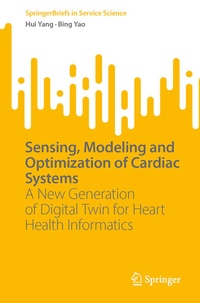
Sensing, Modeling and Optimization of Cardiac Systems
Description

This book reviews the development of physics-based modeling and sensor-based data fusion for optimizing medical decision making in connection with spatiotemporal cardiovascular disease processes. To improve cardiac care services and patients' quality of life, it is very important to detect heart diseases early and optimize medical decision making. This book introduces recent research advances in machine learning, physics-based modeling, and simulation optimization to fully exploit medical data and promote the data-driven and simulation-guided diagnosis and treatment of heart disease. Specifically, it focuses on three major topics: computer modeling of cardiovascular systems, physiological signal processing for disease diagnostics and prognostics, and simulation optimization in medical decision making. It provides a comprehensive overview of recent advances in personalized cardiac modeling by integrating physics-based knowledge of the cardiovascular system with machine learning and multi-source medical data. It also discusses the state-of-the-art in electrocardiogram (ECG) signal processing for the identification of disease-altered cardiac dynamics. Lastly, it introduces readers to the early steps of optimal decision making based on the integration of sensor-based learning and simulation optimization in the context of cardiac surgeries.
This book will be of interest to researchers and scholars in the fields of biomedical engineering, systems engineering and operations research, as well as professionals working in the medical sciences.
More details
Other editions
Additional editions
Persons
Dr. Hui Yang is an IISE fellow, a Professor of Industrial & Manufacturing Engineering and Biomedical Engineering at Pennsylvania State University, USA, and is affiliated with the Penn State Cancer Institute (PSCI), Clinical and Translational Science Institute (CTSI), Institute for Computational and Data Sciences (ICDS), and CIMP-3D. He is a department editor of IISE Transactions on Healthcare Systems Engineering; associate editor of IISE Transactions, IEEE Journal of Biomedical & Health Informatics, IEEE Transactions on Automation Science & Engineering, and IEEE Robotics & Automation Letters; and Associate Editor for Proceedings of IEEE CASE, EMBC, and BHI. Dr. Yang is specialized in physics-based and data-driven models of cardiac systems - from ion channels to cells to tissues to the entire heart - for optimized medical decision making.
Dr. Bing Yao is an Assistant Professor at the Department of Industrial and Systems Engineering, University of Tennessee Knoxville, USA. Before joining UTK, she was an Assistant Professor at the School of Industrial Engineering and Management, Oklahoma State University, USA. She received her Ph.D. in Industrial Engineering and Operations Research from Pennsylvania State University. Her research interests include biomedical and health informatics, computer simulation and optimization, data mining and signal processing, and physical-statistical modeling.
Content
A tentative ToCs attached.
