

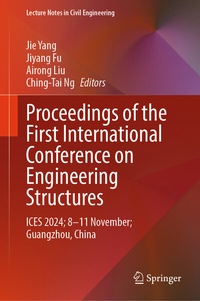
Proceedings of the First International Conference on Engineering Structures
Description

This book includes peer reviews articles from the First International Conference on Engineering Structures (ICES2024), held at Guangzhou, China, on 8-11 November 2024. The conference is an international multi-disciplinary forum for scientists and engineers to disseminate the latest innovations and achievements, discuss current trends and emerging issues in structural engineering and structural mechanics communities, and promote information exchange within multidisciplinary field. The book focuses on new developments and innovative applications of structural and mechanics principles and digital technologies for the analysis and design of engineering structures.
More details
Other editions
Additional editions
Persons
Prof. Jie Yang is the Distinguished Professor in School of Engineering, RMIT University. He is currently serving as the Lead Editor-in-Chief of Engineering Structures and is the Highly Cited Researcher by Clarivate Analytics from 2019-2023. His main research interests include advanced composite structures, mechanical metamaterials, functionally graded structures, nanocomposites, structural stability and dynamics, multi-scale numerical simulation, smart structures and control, applied mechanics, computational mechanics, and nano/micro-mechanics.
Prof. Fu Jiyang is currently the Vice President of Guangzhou University and recip-ient of the National Science Fund for Distinguished Young Scholars. He has successively served as the Director of Research Center for Wind Engineering and Engineering Vibration of Guangzhou University, Vice Dean of the School of Civil Engineering of Guangzhou University, and Deputy Director of the Guangzhou Science and Technology Innovation Committee. Long dedicated to the ?eld of structural wind engineering, he has pioneered innovations in in-situ measurements, wind tunnel testing, and wind-resistance optimization design for large-scale complex structures. His work includes 130+ SCI-indexed papers, 60+ authorized Chinese invention patents, and 16 PCT international patents, which prompt him to be named to the "Annual Impact" list of the world's top 2% of scientists.
Prof. Airong Liu is currently Professor and Director of Center for Wind Engineering and Engineering Vibration, Guangzhou University. She was externally appointed as Vice Director of China International Science and Technology Cooperation Base, Vice Director of Guangdong Engineering Technology R&D Center, Council member of The Chinese Society of Theoretical and Applied Mechanics on Civil Engineering, and Editorial Board member of Engineering Structures. Her main research interests include intelligent inspection of Civil Engineering, structural stability and dynamics.
Prof. (Alex) Ching-Tai Ng is Professor in the School of Architecture and Civil Engineering at The University of Adelaide. He currently serves as the Co-Editor-in-Chief of Engineering Structures. His primary research focuses on Structural Health Monitoring (SHM), nondestructive evaluation (NDE), smart sensing technologies, vibration testing, smart materials, system identification, advanced composite materials, and engineering reliability. He is particularly passionate about applying SHM and NDE techniques across diverse engineering disciplines to tackle complex, multidisciplinary research challenges.
