

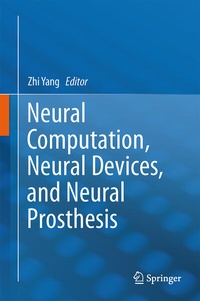
Neural Computation, Neural Devices, and Neural Prosthesis
Description

In the past decades, interdisciplinary investigations overlapping biology, medicine, information science, and engineering have formed a very exciting and active field that attracts scientists, medical doctors, and engineers with knowledge in different domains. A few examples of such investigations include neural prosthetic implants that aim to improve the quality of life for patients suffering from neurologic disease and injury; brain machine interfaces that sense, analyze, and translate electrical signals from the brain to build closed-loop, biofeedback systems; and fundamental studies of intelligence, cognitive functions, and psychological behaviors correlated to their neurological basis. Although this interdisciplinary area is still in its infancy, it can potentially create some of the most significant impact: treating diseases that are considered untreatable, interpretation and communication of neuron ensembles, or even a revolutionary perception and understanding of life different from philosophical or immaterial approaches. Fortunately, several academic societies recognize the value and impact of this growing field, firmly supporting related research. Such support will drive a booming future in the next twenty or thirty years.
Research in this area is frequently project-driven, and the generated knowledge has been scattered in different fields of neuroscience, computation, material and technology, circuits and system, clinical reports, and psychology-the scope considerably across the boundary of traditionally defined disciplines.
Neural Computation, Neural Devices, and Neural Prosthesis
is intended to assemble such knowledge, from there suggesting a systematic approach guiding future educational and research activities. The targeted audience includes both students and researchers.
Reviews / Votes
From the book reviews:
"This is a good reference for cardiac, respiratory, and central nervous system implants for remote control. The cortical visual prostheses, retinal, and neurotransmitter devices are described in detail. The engineering both electrical & electronic, are very well described. . This text is a very good reference, up to date, and relevant for physiologists, bioengineers, students, and fellows working in this broad area of research. This book is very unique." (Joseph J. Grenier, Amazon.com, July, 2014)
More details
Other editions
Additional editions
Content
1. Electromagnetic Effects of Wireless Transmission for Neural Implants.- 2. Energy-Efficient Digital Processing for Neural Action Potentials.- 3. Doppler Radar Noncontact Vital Sign Monitoring.- 4. From Auditory and Visual to Immersive Neurofeedback Application to Diagnosis of Alzheimer's Disease.- 5. Eyelid Reanimation Prototype for Facial Nerve Paralysis.- 6. Flexible Electrode for Implantable Neuroprosthetic Devices.- 7. Visual Prostheses.- 8. Near-Field Wireless Power and Data Transmission to Implantable Neuroprosthetic Devices.- 9. Neural Recording and Neural Stimulation Circuits and Systems.- 10. Neuron Chips.- 11. Analysis and Design of 3D Potentiostat for Deep Brain Implantable Devices.- 12. Computational Models and Hardware Implementations for Neuron-Machine Interactions.- 13. Analysis and Design of 3D Potentiostat for Deep Brain Implantable Devices.- 14. Advances in Learning Visual Saliency: From Image Primitives to Semantic Contents.
