

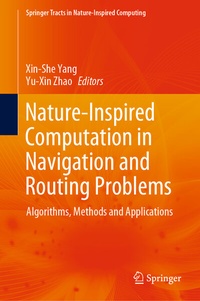
Nature-Inspired Computation in Navigation and Routing Problems
Description

This book discusses all the major nature-inspired algorithms with a focus on their application in the context of solving navigation and routing problems. It also reviews the approximation methods and recent nature-inspired approaches for practical navigation, and compares these methods with traditional algorithms to validate the approach for the case studies discussed. Further, it examines the design of alternative solutions using nature-inspired techniques, and explores the challenges of navigation and routing problems and nature-inspired metaheuristic approaches.
More details
Other editions
Additional editions
Persons
Dr. Xin-She Yang obtained his DPhil in Applied Mathematics from the University of Oxford, then worked at Cambridge University and UK's National Physical Laboratory as a Senior Research Scientist. Now he Reader in modelling and optimization at Middlesex University London. He is also the IEEE CIS task force chair for business intelligence and knowledge management. With more than 250 research publications and 25 books, he has named as a highly cited researcher by Clarivate Analytics (formerly Thomson Reuters Web of Science) for four consecutive years (2016, 2017, 2018 and 2019). His main research interests include computational intelligence, nature-inspired computing, applied mathematics, machine learning, modelling and simulation as well as data mining.
Prof. Yu-Xin Zhao received his Ph.D. degree in Navigation, Guidance, and Control from Harbin Engineering University (HEU) in 2005 and completed postdoctoral research in Control Science and Engineering at Harbin Institute of Technology (HIT) in 2008. He is currently the Dean and a Professor at the College of Automation, Harbin Engineering University. His research interests include artificial intelligence, filtering theory, navigation theory and application, as well as intelligent transportation systems. He has published more than 100 papers, including more than 40 international journal papers in these areas. He also has 18 national patents. Dr. Zhao has won numerous awards, including the Young ChangJiang Scholar (2018) and LongJiang Scholar. He has served the academic community in various capacities, including Fellow of IET, senior member of IEEE, a member of the Royal Institute of Navigation, and a Fellow of China Navigation Institute.
Content
Navigation, Routing and Nature-Inspired Computation.- Navigation and Navigation Algorithms.- Is Vehicle Routing Problem Dead? Review of Vehicle Routing Problems from a Nature-Inspired Perspective.- Travelling Salesman Problem: Resolution Layers.- Flow Shop Scheduling by Nature-Inspired Algorithms.- Mobile Robot Path Planning by Flower Pollination Algorithm.- Smartphone Indoor Localization Using Bio-Inspired Modeling.- A New Obstacle Avoidance Technique - Travelling Cranes.- Natural Heuristic Methods for Under Water Vehicle Path Planning.
