

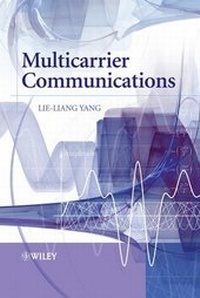
Multicarrier Communications
Description

More details
Other editions
Additional editions
Person
Dr. Lie-Liang Yang, Reader, PhD, School of Electronics and Computer Science, University of Southampton, UK
Since December 1997, Dr Yang has been with the Communications Research Group at the School of Electronics and Computer Science of the University of Southampton, where he has been an academic staff member since 2002. His research has covered a wide range of areas in information theory, digital communications, mobile communications, wireless networking, signal processing for wireless communications, as well as wideband, broadband and ultrawide bandwidth (UWB) code-division multiple-access (CDMA). He has published over 190 research papers, which include about 70 journal papers and more than 120 conference papers, mainly in IEEE journals and IEEE conference proceedings. He has co-authored one book, which was jointly published by John Wiley & Sons and IEEE Press, and also published many book chapters in the field of wireless communications. He has presented invited lectures in a number of universities in both UK and China, and also provided tutorial lectures at conferences.
Content
1 Introduction.
1.1 Spread Spectrum.
1.2 Orthogonal Frequency-Division Multiplexing.
1.3 Multiple Access.
1.4 Duplex.
1.5 Diversityin Wireless Communications.
1.6 Organization of the Book.
2 Principles of Code-Division Multiple-Access Communications.
2.1 Direct-Sequence Spread Spectrum.
2.2 Multicarrier Spread-Spectrum Communications.
2.3 Frequency-Hopped Spread-Spectrum Communications.
2.4 Time-Hopping Spread-Spectrum Communications.
2.5 Hybrid Direct-Sequence/Frequency-HoppingMultiple-Access.
2.6 Hybrid Direct-Sequence/Time-Hopping Multiple-Access.
2.7 Summary and Discussion.
3 Principles of Multicarrier Communications.
3.1 Introduction.
3.2 Orthogonal Frequency-Division Multiplexing.
3.3 Frequency-Domain Spread Multicarrier CDMA.
3.4 Single-Carrier Frequency-Division Multiple Access.
3.5 Orthogonal Multicarrier DS-CDMA.
3.6 Multitone DS-CDMA.
3.7 Generalized Multicarrier DS-CDMA.
3.8 Time-Hopping Multicarrier CDMA.
3.9 Time-Frequency-Domain Spread Multicarrier DS-CDMA.
3.10 Summary and Discussion.
4 Performance of Multicarrier Systems over Gaussian Channels.
4.1 Introduction.
4.2 Performance of Orthogonal Frequency-Division Multiplexing.
4.3 Performance of Single-User Frequency-Domain Spread Multicarrier CDMA.
4.4 Performance of Single-User Multicarrier DS-CDMA.
4.5 Performance of Single-User Time-Hopping Multicarrier CDMA.
4.6 Performance of Time-Frequency-Domain Spread Multicarrier DS-CDMA Supporting Multiusers.
4.7 Equivalence Between Single-Carrier DS-CDMA and Multicarrier CDMA.
4.8 Summary and Discussion.
5 Performance of Multicarrier Systems over Frequency-Selective Fading Channels.
5.1 Introduction.
5.2 Frequency-Selective Fadingin Multicarrier Systems.
5.3 Intersymbol Interference Suppression: Cyclic-Prefixing and Zero-Padding.
5.4 Generation of Fading Statistics for Multicarrier Signals.
5.5 Performance of Orthogonal Frequency-Division Multiplexing.
5.6 Performance of Single-User Frequency-Domain Spread Multicarrier CDMA.
5.7 Performance of Single-Carrier Frequency-Division Multiple Access.
5.8 Frequency-Domain Equalizationin Single-Carrier DS-CDMA.
5.9 Performance of Single-User Multicarrier DS-CDMA.
5.10 Performance of Single-User Time-Hopping Multicarrier CDMA.
5.11 Performance of Time-Frequency-Domain Spread Multicarrier DS-CDMA Supporting Multiusers.
5.12 Summary and Discussion.
6 Coherent Multiuser Detection.
6.1 Introduction.
6.2 Multiuser Detection in Frequency-Domain Spread Multicarrier CDMA.
6.3 Multiuser Detection in Multicarrier DS-CDMA.
6.4 Multiuser Detection in Time-Frequency-Domain Spread Multicarrier DS-CDMA.
6.5 Summary and Discussion.
7 NoncoherentMultiuser Detection.
7.1 Representation of Discrete Time-Hopping Multicarrier CDMA Signals.
7.2 Noncoherent Single-User Detection.
7.3 Optimum Prior Noncoherent Multiuser Detection.
7.4 Prior Noncoherent Decorrelating Multiuser Detection.
7.5 Prior Noncoherent MMSE Multiuser Detection.
7.6 Optimum Posterior Noncoherent Multiuser Detection.
7.7 Suboptimum Posterior Noncoherent Multiuser Detection in Rayleigh Fading Channels.
7.8 Posterior Noncoherent Interference Cancellation.
7.9 Summary and Discussion.
8 Multiuser Transmitter Preprocessing.
8.1 Principles of Transmitter Preprocessing: An Example.
8.2 Transmitter Preprocessing in Frequency-Domain Spread MC-CDMA.
8.3 Transmitter Preprocessing in Frequency-Domain Spread MC DS-CDMA Systems.
8.4 Relationship Between Linear Multiuser Transmission and Linear Multiuser Detection.
8.5 Extraction of Channel Knowledge for Transmitter Preprocessing in Multicarrier CDMA Systems.
8.6 Summary and Discussion.
9 Multiantenna Multicarrier CDMA.
9.1 Multiple-Input Multiple-Output Communications.
9.2 Spatial Diversity.
9.3 Spatial-Division Multiple Access.
9.4 Performance of Multicarrier CDMA Using Space-Time Coding.
9.5 Time-Frequency-Domain Space-Time Spread Multicarrier DS-CDMA.
9.6 Space-Time MC DS-CDMA over Fast Time-Varying Fading Channels.
9.7 Summary and Discussion.
Bibliography.
Index.
