

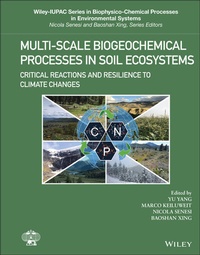
Multi-Scale Biogeochemical Processes in Soil Ecosystems
Description

Provides a state-of-the-art overview of research in soil biogeochemical processes and strategies for greenhouse gas mitigation under climate change
Food security and soil health for the rapidly growing human population are threatened by increased temperature and drought, soil erosion and soil quality degradation, and other problems caused by human activities and a changing climate. Because greenhouse gas emission is the primary driver of climate change, a complete understanding of the cycles of carbon and major nutritional elements is critical for developing innovative strategies to sustain agricultural development and environmental conservation.
Multi-Scale Biogeochemical Processes in Soil Ecosystems: Critical Reactions and Resilience to Climate Changes is an up-to-date overview of recent research in soil biogeochemical processes and applications in ecosystem management. Organized into three parts, the text examines molecular-scale processes and critical reactions, presents ecosystem-scale studies of ecological hotspots, and discusses large-scale modeling and prediction of global biogeochemical cycles. Part of the Wiley - IUPAC Series on Biophysico-Chemical Processes in Environmental Systems, this authoritative volume:
* Provides readers with a systematic and interdisciplinary approach to sustainable agricultural development and management of soil ecosystems in a changing climate
* Features contributions from an international team of leading scientists
* Examines topics such as soil organic matter stabilization, soil biogeochemistry modeling, and soil responses to environmental changes
* Discusses strategies for mitigating greenhouse gas emission and improving soil health and ecosystems resilience
* Includes an introduction to working across scales to project soil biogeochemical responses to climatic change
Multi-Scale Biogeochemical Processes in Soil Ecosystems: Critical Reactions and Resilience to Climate Changes is essential reading for scientists, engineers, agronomists, chemists, biologists, academic researchers, consultants, and other professionals whose work involves the nutrient cycle, ecosystem management, and climate change.
More details
Other editions
Additional editions
Persons
Yu (Frank) Yang, PhD, is Associate Professor of Environmental Chemistry, Department of Civil and Environmental Engineering, University of Nevada, Reno, USA.
Marco Keiluweit, PhD, is Assistant Professor of Soil Biogeochemistry, University of Massachusetts in Amherst, USA.
Nicola Senesi, PhD, is Professor Emeritus and Professor of Soil Chemistry (retired), University of Bari, Italy.
Baoshan Xing, PhD, is Professor of Environmental and Soil Chemistry, Stockbridge School of Agriculture, University of Massachusetts in Amherst, USA.
Content
Series Preface
Preface
List of Contributors
Chapter 1 Introduction: Working across scales to project soil biogeochemical responses to climate
S.A. Billings and P. L. Sullivan
SECTION 1
Chapter 2 The Science and Semantics of ,Soil Organic Matter Stabilization'
Markus Kleber and Adam Lindsley
Chapter 3 Interconnecting Soil Organic Matter With N And P Cycling
Luisella Celi, Daniel Said-Pullicino, Roland Bol, Friedrike Lang, Jörg Luster
Chapter 4 Plant-derived Macromolecules in the Soil
Xiaojuan Feng
Chapter 5 Microbe-Biomolecule-Mineral Interfacial Reactions
Jon Chorover
SECTION 2
Chapter 6 Greenhouse Gas Emissions in Wetland Rice Systems: Biogeochemical Processes and Management
Rongzhong Ye and William R. Horwath
Chapter 7 The Changing Biogeochemical Cycles of Tundra
Caitlin Hicks Pries, Jennie R McLaren, Lydia Smith Vaughn, Claire Treat, Carolina Voigt
Chapter 8 Linking sources, transformation, and loss of phosphorus in the soil-water continuum in a coastal environment
Deb Jaisi, Kristi Mingus, Sunendra Joshi, Kiran Upreti, Mingjing Sun, Joshua McGrath, and Arash Massudieh
Chapter 9 Deep Soil Carbon
Erika Marín-Spiotta and Eleanor U. Hobley
SECTION 3
Chapter 10 Soil Carbon Dynamics And Responses To Environmental Changes
Jinzhi Ding, Lingli Liu, Shuli Niu, Tao Wang, Shilong Piao
Chapter 11 Next generation soil biogeochemistry model representations: A proposed community open source model farm (BeTR-S)
William J. Riley, Carlos A. Sierra, Jinyun Tang, Nicholas J. Bouskill, Qing Zhu and Rose A. Abramoff
Chapter 12 Biochar production and amendment
Ke Sun, Lanfang Hana, Bo Gao and Baoshan Xing
Chapter 13 Compost Production, Analysis and Applications in Agriculture
Yu Yang, Marco Keiluweit, Nicola Senesi, and Baoshan Xing
Chapter 14 Biogeochemistry in dynamic landscapes: Geochemical and mathematical constraints on the erosion-induced terrestrial carbon sink
Asmeret Asefaw Berhe and Teamrat A. Ghezzehei
Index
1
INTRODUCTION: WORKING ACROSS SCALES TO PROJECT SOIL BIOGEOCHEMICAL RESPONSES TO CLIMATE
Sharon A. Billings1 and Pamela L. Sullivan2
1 Department of Ecology and Evolutionary Biology and Kansas Biological Survey and Center for Ecological Research, University of Kansas, Lawrence, KS, USA
2 College of Earth, Ocean, and Atmospheric Sciences, Oregon State University, Corvallis, OR, USA
- 1.1. Context
- 1.2. Soil Responses to Environmental Conditions at Diverse Scales: Organic Matter Transformations and Feedbacks to Climate
- 1.3. Recent Empirical Investigations of Soil Responses to Environmental Conditions at Diverse Scales: Mineral Weathering
- 1.4. Cross-Scale Discrepancies: Two Examples of Nonlinearities That Challenge Predictive Abilities
- 1.5. Models as a Means of Integrating Across Disciplines and Scales
- 1.6. Conclusions
- Acknowledgments
- References
1.1. CONTEXT
The physical, chemical, and biological features of soil are a time-integrated reflection of the interactions between life and rock, as mediated by environmental conditions. Soil thus has been the object of study by multiple disparate disciplines for centuries (Jenny 1980; Hillel 1982; Callaham and Hendrix 1997; Brantley et al. 2007; Richter and Yaalon 2012; Billings et al. 2018). Historically, there have been some attempts to appreciate soils in a more holistic, interdisciplinary manner (e.g., Richter and Billings 2015), but recently a critical mass of scientists has recognized the importance of working across disciplines to address fundamental questions about soil functioning (Brantley et al. 2017; Rasmussen et al. 2011; Billings et al. 2012; Ziegler et al. 2017; Baatz et al. 2018; Richter et al. 2018). Indeed, many scientists now agree that to move forward in our predictive understanding of how soils will respond to climate change, we need to integrate across historically separate disciplines.
Working across disciplines is inherently challenging (see discussion in Richter et al. 2018), but addressing questions about soil responses to global climate forcings introduces yet additional difficulties: it requires working across wide-ranging spatial and temporal scales. For example, soil organic C (SOC) losses to CO2 and mineral dissolution are driven by small-scale microbial and chemical processes, respectively, but they also are governed by processes such as organo-mineral stabilization of SOC (Lawrence et al. 2015) and weathering patterns (Riebe et al. 2004), which are often measured across long timescales (i.e., centuries to millennia). Accurate predictions of future fluxes of SOC and mineral nutrients are critical for projecting global-scale atmospheric CO2 concentrations in the coming century (Wieder et al. 2013; Koven et al. 2013; Manzoni et al. 2017), but understanding the drivers of both fluxes requires that we understand mechanisms at small spatial and temporal scales (i.e. nanometers and seconds, respectively; Burghelea et al. 2015; Lehmeier et al. 2016) and integrate these processes with each other across fine to coarser scales. The environmental science community has devised multiple ways of meeting these challenges. Empirical studies at the microcosm, plot, catchment, and whole ecosystem scale have been critical for developing our burgeoning understanding of soil responses to climate change. In addition, the modeling community has developed invaluable tools for investigating soil responses to climate change. Such models offer a means of scaling measurements of short-term system responses to forcings across longer timescales, generating estimates of system responses at large spatial scales, and for testing large-scale and long-term hypotheses.
In this introductory chapter, we highlight several empirical and modeling advances that serve as examples for studies that move us closer to a predictive understanding of soil functioning with anthropogenic climate change. We focus on exemplar studies that reveal mechanisms driving known phenomena, highlight observations consistent or inconsistent with theory, provide puzzling clues about linearities and nonlinearities in soil processes, or demonstrate the power of modeling for synthesizing any of these empirical works. We attempt to demonstrate how studies conducted at diverse spatial and temporal scales can reveal both congruencies and discrepancies across those scales, spotlighting where additional work is needed. We also formulate suggestions for integrating empirical and modeling studies to project future soil functioning. Underscored in this synthesis is the need to understand how mechanisms elucidated at one spatial or temporal scale function across diverse scales, such that we can formulate accurate projections of ecosystem function in the future.
1.2. SOIL RESPONSES TO ENVIRONMENTAL CONDITIONS AT DIVERSE SCALES: ORGANIC MATTER TRANSFORMATIONS AND FEEDBACKS TO CLIMATE
1.2.1. Organic Matter at the Microscale
Organic matter transformations in soils are studied across diverse scales (Figure 1.1). A long history of studies of reaction kinetics - perhaps the smallest scale appropriate for soil specialists - provides fundamental knowledge of both organic matter and mineral transformations (Pilling and Seakins 2005). More recent studies have focused especially on environmental variables expected to change with anthropogenic climate change (e.g., Wallenstein et al. 2009; Craine et al. 2010). For example, organic matter decay and associated patterns of nutrient and C release, when examined in isolation from the soil matrix and even microbes themselves, reflect fundamental reaction kinetics (Billings et al. 2015). Such studies indicate that temperature: (i) affects behaviors of individual exo-enzymes differently (Lehmeier et al. 2013), (ii) is dependent on solution pH (Min et al. 2014), and (iii) drive age-related declines in catalytic rates differently for individual exo-enzymes (Billings et al. 2016). As a direct result of these complex and interacting effects, the relative abundances of microbially available resources (e.g., glucose, and N-rich N-acetyl-glucosamine) change with temperature, pH, and exo-enzyme age. However, the direct responses of exo-enzymes and microbes to temperature do not necessarily scale up linearly, as discussed below (Section 1.2.3). This knowledge prompts interesting questions about potential long-term, larger spatial responses of microbes to the changing landscape of resource availability, feedbacks to organic matter transformations, and ultimately to microbially driven CO2 release from soils and plant nutrient availability.
Research that incorporates microbial populations into studies of organic matter transformations moves one step closer toward mimicking complex environmental systems. Such studies permit control of relevant factors except the environmental condition of interest, while incorporating biotic responses. For example, Pseudomonas fluorescens, a ubiquitous soil bacterium, increases its respiratory demand for C as temperature increases and increases its respiratory 13C discrimination as well (Lehmeier et al. 2016), a phenomenon that necessarily leaves behind an isotopic fingerprint on microbial necromass. Discrimination against 13C also can occur during substrate uptake, an effect that varies with temperature and C availability (Min et al. 2016), suggesting that d13C signatures of extant soil organic matter reflect countless discriminatory events during microbial substrate selection. Because microbial necromass likely serves as an important component of relatively persistent soil organic matter (Kallenbach et al. 2015; Schweigert et al. 2015; Liang et al. 2016), these findings suggest that microbial 13C discrimination during soil C transformations have a meaningful influence on SOC isotopic signatures. It remains unknown how any changes over time in microbial community composition with environmental conditions may modify 13C flows; certainly, we must take this into consideration if microbial populations exhibit different flows of 12C and 13C. However, because d13C signatures of SOC serve as important constraints on soil C dynamics (e.g. Blagodatskaya et al. 2011; Breeker et al. 2015; Kohl et al. 2015), temperature influences on microbial 13C discrimination likely are important factors to consider when interpreting SOC d13C signatures.
1.2.2. Organic Matter at the Mesocosm Scale
Myriad studies populate the literature that describe soil organic matter transformations as they respond to environmental conditions in controlled, mesocosm conditions. The most influential studies working at the mesocosm scale are those that seek to understand...
