

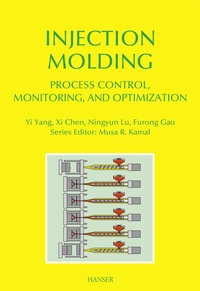
Injection Molding Process Control, Monitoring, and Optimization
1st Edition
Published on 8. August 2016
413 pages
978-1-56990-593-7 (ISBN)
Description

Improvement of injection molding processes remains a topic of great interest in both industry and research institutions. This book introduces the analysis of the molding process from a systems technology point of view.
It is divided into four parts: the first part provides general background to introduce the injection molding process, the second covers the control of the process, the third is on the monitoring technology, and the fourth is concerned with the optimization of the process. Most the results within are from real engineering implementations and experimental tests.
More details
Other editions
Additional editions
Yi Yang | Xi Chen | Ningyun Lu
Injection Molding Process Control, Monitoring, and Optimization
E-Book
04/2017
1st Edition
Hanser Publications
€199.99
Available for download
Yi Yang | Xi Chen | Ningyun Lu
Injection Molding Process Control, Monitoring, and Optimization
Book
08/2016
1st Edition
Hanser Publications
€199.99
Shipment within 3-4 weeks
Persons
Dr. Furong Gao received his B.Eng. degree in Automation from the East China Institute of Petroleum in 1985 and M.Eng. and Ph.D. degrees in Chemical Engineering from McGill University, Canada, in 1989 and 1993, respectively. Currently, he is a Chair Professor of Chemical and Biomolecular Engineering at the Hong Kong University of Science and Technology (HKUST), and a "State Thousand Talents (B)" Professor at the Department of Control Science and Engineering, Zhejaing University, China. Concurrent to his professorial appointment, he serves HKUST also as the Associate Dean of Fok Ying Tung Graduate School, and the Director of the Division of Advanced Manufacturing and Automation.
Professional Affiliations:
Fellow, Society of Plastics Engineers
Consultant, Hong Kong Plastics Machinery Association
Funding Director, Society of Advanced Molding Technology
Member, International Federation of Automatic Control (IFAC) Technical Committee
Associate Editor, Journal of Process Control
Editorial Advisor, Industrial & Engineering Chemistry Research
Engineering Subject Editor, Arabian Journal of Engineering and Science
Editorial Member, China Plastics
Editorial Member, Control & Decision
Professional Affiliations:
Fellow, Society of Plastics Engineers
Consultant, Hong Kong Plastics Machinery Association
Funding Director, Society of Advanced Molding Technology
Member, International Federation of Automatic Control (IFAC) Technical Committee
Associate Editor, Journal of Process Control
Editorial Advisor, Industrial & Engineering Chemistry Research
Engineering Subject Editor, Arabian Journal of Engineering and Science
Editorial Member, China Plastics
Editorial Member, Control & Decision
Content
- Intro
- Foreword
- Contents
- 1 Injection Molding: Background
- 1.1 Plastic Materials and Properties
- 1.1.1 Plastics Classification
- 1.1.1.1 Molecular Structure
- 1.1.1.2 Processability
- 1.1.1.3 Method of Synthesis
- 1.1.1.4 Monomer(s) in Molecules
- 1.1.2 Structural Characteristics of Plastic
- 1.1.2.1 Molecular Weight and Distribution
- 1.1.2.2 Degrees of Crystallinity
- 1.1.2.3 Orientation
- 1.1.3 Basic Rheology Terminology
- 1.1.4 Non-Newtonian Flow: Phenomenon and Constitutive Equations
- 1.1.4.1 Normal Stress Differences in Shear Flows
- 1.1.4.2 Viscoelastic Behavior
- 1.1.4.3 Viscoelastic Models
- 1.1.4.4 Extensional (Elongation) Flow
- 1.1.4.5 Polymer Melt Constitutive Equations for Viscous Flow
- 1.1.4.6 Power Law Constitutive Equation
- 1.1.4.7 Effects of Temperature and Pressure on Viscosity
- 1.1.4.8 Effect of Temperature on Viscosity
- 1.2 Plastics Processing Technologies
- 1.2.1 Extrusion
- 1.2.2 Blow Molding
- 1.2.3 Injection Molding Machine, Process, and Key Variables
- 1.2.3.1 Injection Molding Machine and Process
- 1.2.3.2 Injection Molding Key Process Variables
- References
- 2 Feedback Control Algorithms Developed for?Continuous Processes
- 2.1 Introduction of Feedback Control?Background
- 2.2 Traditional Feedback Control: PID
- 2.3 Adaptive Control
- 2.3.1 Model Estimation
- 2.3.2 Pole-Placement Controller Design
- 2.3.3 Solving the Diophantine Equation
- 2.3.4 Injection Velocity Adaptive Control Result
- 2.3.4.1 Antiwindup Estimation
- 2.3.4.2 Adaptive Feed-Forward Control
- 2.3.4.3 Cycle-to-Cycle Adaptation
- 2.3.4.4 Adaptive Control Results with Different Conditions
- 2.4 Model Predictive Control
- 2.4.1 Basic Principle of MPC and GPC
- 2.4.2 Model Order Determination
- 2.4.3 Comparison with Pole-Placement Control
- 2.4.4 GPC Control with Different Conditions
- 2.5 Fuzzy Systems in Injection Molding Control
- 2.5.1 Fuzzy Inference System Background
- 2.5.2 Fuzzy V/P Switch-Over
- 2.5.3 Fuzzy V/P System Experimental Test
- 2.5.4 Further Improvement
- References
- 3 Learning Type Control for the Injection Molding Process
- 3.1 Learning Type Control Background
- 3.2 Basic Iterative Learning Control
- 3.2.1 PID-Type ILC
- 3.2.2 Time-Delay Consideration
- 3.2.3 P-Type ILC for Injection Velocity
- 3.2.4 P-Type ILC for Packing Pressure
- 3.3 Optimal Iterative Learning Control
- 3.3.1 Problem Formulation
- 3.3.2 Optimal Iterative Learning Controller
- 3.3.3 Robust and Convergence Analysis
- 3.3.4 Selection of the Weighting Matrices
- 3.3.5 Simulation Results
- 3.3.6 Experimental Results of Optimal ILC
- References
- 4 Two-Dimensional Control Algorithms
- 4.1 Two-Dimensional Control Background
- 4.2 Two-Dimensional Generalized Predictive Iterative Learning Control
- 4.2.1 2D-GPILC Control Algorithm
- 4.2.2 Injection Velocity Control with 2D-GPILC
- 4.3 Two-Dimensional Dynamic Matrix Control
- 4.3.1 Problem Formulation
- 4.3.2 Controller Design
- 4.3.2.1 2D Equivalent Model with Repetitive Nature
- 4.3.2.2 2D Prediction Model
- 4.3.2.3 Cost Function and Control Law
- 4.3.2.4 Analysis of Convergence and Robustness
- 4.3.2.4.1 Model of the Closed-Loop Control System
- 4.3.2.4.2 Tracking Error and Convergence Conditions
- 4.3.2.4.3 Robustness Analysis
- 4.3.3 Simulation Illustration
- 4.3.3.1 Case?1: Convergence Test
- 4.3.3.2 Case?2: Repetitive Disturbances
- 4.3.3.3 Case?3: Nonrepetitive Disturbances
- 4.3.4 Experimental Test of 2D-DMC
- References
- 5 Statistical Process Monitoring (SPM) of Injection Molding: Basics
- 5.1 Process Monitoring
- 5.2 Statistical Process Monitoring (SPM)
- 5.2.1 Data Collection and Preprocessing
- 5.2.2 Construction of Nominal Statistical Model
- 5.2.3 Application of Statistical Models
- 5.3 Multivariate Statistical Analysis Methods for SPM
- 5.3.1 Principal Component Analysis and Partial Least Squares
- 5.3.2 PCA/PLS-Based Statistical Process Monitoring
- 5.3.3 Multiway PCA/PLS
- 5.3.4 Multiway PCA/PLS-Based Batch Process Monitoring
- 5.4 Challenges in Monitoring Injection Molding Process
- 5.4.1 Multiple Operation Phases
- 5.4.2 Within-Batch and Batch-to-Batch Dynamics
- 5.4.3 Unequal Batch Length
- References
- 6 Phase-Based SPM?Strategies
- 6.1 Introduction
- 6.2 Phase-Division-Based Sub-PCA Modeling and Monitoring
- 6.2.1 Overview
- 6.2.2 Data Normalization
- 6.2.3 Phase Recognition and Division
- 6.2.4 Phase PCA Modeling
- 6.2.5 Statistics and Control Limits
- 6.2.6 Online Process Monitoring
- 6.2.7 Summary
- 6.3 Application of Phase-Based SPM to?Injection Molding
- 6.3.1 Experimental Setup
- 6.3.2 Result Analysis of Phase Division and Modeling
- 6.3.3 Result Analysis of Process Monitoring and Fault Diagnosis
- 6.4 Improved Phase-Based SPM for?Unequal-Length Batch Processes
- 6.4.1 Overview
- 6.4.2 Data Normalization
- 6.4.3 Phase Recognition and Division
- 6.4.4 Sub-PCA Modeling Procedure
- 6.4.5 Process Monitoring Procedure
- 6.4.6 Summary
- 6.5 Application of Improved Phase-Based SPM to Injection Molding
- 6.5.1 Experimental Setup
- 6.5.2 Result Analysis of Phase Division and Modeling
- 6.5.3 Result Analysis of Process Monitoring and Fault Diagnosis
- 6.5.3.1 Monitoring of a Normal Batch
- 6.5.3.2 Monitoring of Faulty Batches
- References
- 7 Phase-Based Quality?Improvement Strategies
- 7.1 Introduction
- 7.2 Phase-Based Process Analysis and End-Product Quality Prediction (Method?A)
- 7.2.1 Phase-Based PLS Modeling
- 7.2.2 Phase-Based Quality-Related Process Analysis
- 7.2.3 Online Quality Prediction
- 7.3 Application of Phase PLS Model (Method?A) to Injection Molding
- 7.3.1 Experimental Setup
- 7.3.2 Illustration of Phase-Based Process Analysis
- 7.3.2.1 Phase Division
- 7.3.2.2 Process Analysis in the Critical-to-Surface Phase
- 7.3.2.3 Process Analysis in Critical-to-Dimension Phases
- 7.3.3 Illustration of Phase-Based Quality Prediction
- 7.4 Phase-Based Process Analysis and End-Product Quality Prediction (Method?B)
- 7.4.1 Critical Phase Identification
- 7.4.2 Key Variable Selection Based on Variable-Wise Unfolding
- 7.4.3 Phase-Based PLS Modeling Algorithm
- 7.4.4 Online Quality Prediction
- 7.5 Application of Phase PLS Model (Method?B) to Injection Molding
- 7.5.1 Illustration of Correlation Analysis
- 7.5.2 Results of Quality Prediction
- References
- 8 In-Mold Capacitive Transducer for Injection Molding Process
- 8.1 Fundamentals of Capacitive Transducers
- 8.2 Dielectric Properties of Polymers
- 8.3 Principle and Preliminary Tests of Capacitive Transducer in Injection Mold
- 8.4 Design of In-Mold Capacitive Transducer
- 8.4.1 Mold Base Design
- 8.4.2 Mold Insert Design
- 8.4.3 Capacitance Measurement
- 8.5 Applications in Melt Flow Detection during Filling Stage
- 8.5.1 Detection of Filling Start
- 8.5.2 Detection of V/P Transfer
- 8.5.3 Detection of melt flow during filling
- 8.6 Applications for the Packing and Cooling Stages
- 8.6.1 Guide to Packing Pressure Setting
- 8.6.2 Detection of Gate Freezing-Off Time
- 8.6.3 Solidification Rate Monitoring
- 8.7 Online Part Weight Prediction Using the?Capacitive Transducer
- References
- 9 Profile Setting of?Injection Velocity
- 9.1 Constant Melt-Front-Velocity Strategy
- 9.2 Scheme Based on Average-flow-length
- 9.3 Neural Network Model of?Average-flow-length
- 9.3.1 Inputs and Output of the Neural Network Model
- 9.3.2 Architecture of the Neural Network Model
- 9.3.3 Training Algorithm
- 9.3.4 Data Collection of Training and Validation Samples
- 9.3.5 Model Performance
- 9.4 Profiling Strategy via Optimization
- 9.5 Parabolic Velocity Profile
- 9.6 Piece-Wise Ramp Velocity Profile
- 9.7 Conclusions
- References
- 10 Profile Setting of?Packing Pressure
- 10.1 Online Autodetection of Gate Freezing-Off Point
- 10.1.1 Gate Freezing-Off Detection
- 10.1.2 Development of Autodetection System
- 10.1.3 Tests of Constant Packing Pressure Cases
- 10.1.4 Tests of Varying Packing Pressure Profile Cases
- 10.1.4.1 Online Detection Results of Step Pressure Profile
- 10.1.4.2 Online Detection Results of Ramp Pressure Profile
- 10.2 Influence of Packing Profile on?Part?Quality
- 10.2.1 Constant Packing Profile
- 10.2.2 Ramp Packing Profile
- 10.2.3 Step-Change Packing Profile
- 10.2.4 Summary
- 10.3 Profiling of Packing Pressure
- 10.3.1 Profiling Rules
- 10.3.2 Online Profiling of Constant Packing Pressure
- 10.3.3 Ramp Profile for Specific Thickness Distribution
- 10.4 Conclusions
- References
- 11 Parameter Setting for the Plastication Stage
- 11.1 Visual Barrel System Development
- 11.2 Plastication Behavior
- 11.2.1 Melting Behavior
- 11.2.2 Processing Condition Effects
- 11.3 Neural Network Modeling of?Melt?Temperature
- 11.4 Optimal Parameter Setting for?the?Plastication Stage
- References
- Subject Index
- Leere Seite
Chapter 1 INJECTION MOLDING: MACHINE AND PROCESS
1.1 Introduction of general polymer processing
1.2 Polymer material and characteristics
1.3 Injection molding machine
1.4 Injection molding process
Chapter 2 EVOLUTION OF SYSTEMS TECHNOLOGIES IN INJECTION MOLDING
2.1 Introduction of systems technology
2.2 Evolution of process control technology in injection molding
2.3 Evolution of process monitoring technology in injection molding
2.4 Evolution of process optimization technology in injection molding
Control
Chapter 3 FEEDBACK CONTROL ALGORITHMS DEVELOPED FOR CONTINUOUS PROCESSES
3.1 Introduction of feedback control background
3.2 Traditional feedback control: PID
3.3 Adaptive control
3.4 Model predictive control: GPC
3.5 Optimal control
3.6 Fuzzy and Artificial Neural Networks control
Chapter 4 LEARNING TYPE CONTROL DEVELOPED FOR REPETITIVE PROCESS
4.1 Introduction of learning type control background
4.2 Basic iterative learning control
4.3 Optimal iterative learning control
Chapter 5 TWO-DIMENSIONAL CONTROL ALGORITHMS
5.1 Introduction of two-dimensional control background
5.2 Two-dimensional robust control
5.3 Two-dimensional optimal control
5.4 Two-dimensional model predictive control
Chapter 6 FAULT-TOLERANT CONTROL IN INJECTION MOLDING
6.1 Introduction of fault-tolerant control injection molding
6.2 Active fault-tolerant control with sensor failure: an example
Monitoring
Chapter 7 STATISTICAL PROCESS MONITORING (SPM)
7.1 Process monitoring for continuous processes
7.2 Process monitoring for batch processes
Chapter 8 SPM BASED ON PHASE RECOGNITION AND HARD PARTITION STRATEGY
8.1 Data-driven phase recognition and phase partition
8.2 Phase-based SPM in injection molding
8.3 SPM with limited modeling data
8.4 Quality-oriented process monitoring
Chapter 9 SPM BASED ON SOFT PHASE PARTITION STRATEGY
9.1 Transition-based soft phase partition
9.2 Soft phase-based SPM in injection molding
9.3 Dissimilarity analysis based process monitoring
9.4 Dissimilarity analysis based nonlinear process monitoring
9.5 Adaptive process monitoring in injection molding
Chapter 10 TWO-DIMENSIONAL MODEL-BASED PROCESS MONITORING & FAULT DIAGNOSIS
10.1 Two dimensional dynamic principal component analysis (2D-DPCA)
10.2 2D-DPCA based process monitoring
10.3 2D-DPCA based fault diagnosis
Optimization
Chapter 11 IN-MOLD CAPACITIVE TRANSDUCER FOR INJECTION MOLDING PROCESS
11.1 Principle of capacitive transducers
11.2 Hardware design of the in-mold capacitive transducer
11.3 Detection of the melt flow in filling stage
11.4 Detection of in-mold status in packing & cooling stage
11.5 Application for online part weight prediction and fault detection
Chapter 12 OPTIMAL PROFILING FOR FILLING STAGE
12.1 Introduction
12.2 Constant melt-front-velocity strategy
12.3 Soft-sensor development of average-flow-length
12.4 Uniform filling based on optimization
12.5 Optimal profile of injection velocity for different mold shapes
Chapter 13 OPTIMAL PROFILING FOR PACKING STAGE
13.1 Introduction
13.2 Online auto-detection of gate freezing-off point
13.3 Influence of packing profile on part quality
13.4 Profiling of packing pressure
Chapter 14 PARAMETER SETTING FOR PLASTICATION STAGE
14.1 Introduction
14.2 Neural network modeling of melt temperature
14.3 Optimal parameter setting
Chapter 15 MODEL FREE OPTIMIZATION FOR PART QUALITY CONTROL
15.1 Model free optimization strategy for injection molding process
15.2 Gradient-based algorithm
15.3 Non-gradient-based algorithm
15.4 Part weight control via MFO
15.5 Focal length control via MFO
