

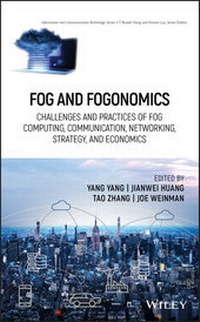
Fog and Fogonomics
Description

Fog and Fogonomics is a comprehensive and technology-centric resource that highlights the system model, architectures, building blocks, and IEEE standards for fog computing platforms and solutions. The "fog" is defined as the multiple interconnected layers of computing along the continuum from cloud to endpoints such as user devices and things including racks or microcells in server closets, residential gateways, factory control systems, and more.
The authors--noted experts on the topic--review business models and metrics that allow for the economic assessment of fog-based information communication technology (ICT) resources, especially mobile resources. The book contains a wide range of templates and formulas for calculating quality-of-service values. Comprehensive in scope, it covers topics including fog computing technologies and reference architecture, fog-related standards and markets, fog-enabled applications and services, fog economics (fogonomics), and strategy.
This important resource:
* Offers a comprehensive text on fog computing
* Discusses pricing, service level agreements, service delivery, and consumption of fog computing
* Examines how fog has the potential to change the information and communication technology industry in the next decade
* Describes how fog enables new business models, strategies, and competitive differentiation, as with ecosystems of connected and smart digital products and services
* Includes case studies featuring integration of fog computing, communication, and networking systems
Written for product and systems engineers and designers, as well as for faculty and students, Fog and Fogonomics is an essential book that explores the technological and economic issues associated with fog computing.
More details
Other editions
Additional editions
Persons
YANG YANG, PHD is a professor with ShanghaiTech University and a Co-Director of Shanghai Institute of Fog Computing Technology (SHIFT), China.
JIANWEI HUANG, PHD is a Presidential Chair Professor and the Associate Dean of School of Science and Engineering, The Chinese University of Hong Kong, Shenzhen, and the Associate Director of Shenzhen Institute of Artificial Intelligence and Robotics for Society, China.
TAO ZHANG, PHD is currently with the National Institute of Standards and Technology (NIST), USA.
JOE WEINMAN is the former Senior Vice President of Cloud Services and Strategy at Telx, and is the founder of Cloudonomics, which takes a rigorous, multidisciplinary approach to valuing the cloud. He is the Cloud economics and strategy editor for IEEE Cloud Computing magazine and author of Cloudonomics: The Business Value of Cloud Computing and Digital Disciplines: Attaining Market Leadership via the Cloud, Big Data, Social, Mobile, and the Internet of Things.
Content
List of Contributors xvii
Preface xxi
1 Fog Computing and Fogonomics 1
Yang Yang, Jianwei Huang, Tao Zhang, and Joe Weinman
2 Collaborative Mechanism for Hybrid Fog-Cloud Scenarios 7
Xavi Masip, Eva Marín, Jordi Garcia, and Sergi Sànchez
2.1 The Collaborative Scenario 7
2.1.1 The F2C Model 11
2.1.1.1 The Layering Architecture 13
2.1.1.2 The Fog Node 14
2.1.1.3 F2C as a Service 16
2.1.2 The F2C Control Architecture 19
2.1.2.1 Hierarchical Architecture 20
2.1.2.2 Main Functional Blocks 24
2.1.2.3 Managing Control Data 25
2.1.2.4 Sharing Resources 26
2.2 Benefits and Applicability 28
2.3 The Challenges 29
2.3.1 Research Challenges 30
2.3.1.1 What a Resource is 30
2.3.1.2 Categorization 30
2.3.1.3 Identification 31
2.3.1.4 Clustering 33
2.3.1.5 Resources Discovery 33
2.3.1.6 Resource Allocation 34
2.3.1.7 Reliability 35
2.3.1.8 QoS 36
2.3.1.9 Security 36
2.3.2 Industry Challenges 37
2.3.2.1 What an F2C Provider Should Be? 38
2.3.2.2 Shall Cloud/Fog Providers Communicate with Each Other 38
2.3.2.3 How Multifog/Cloud Access is Managed 39
2.3.3 Business Challenges 40
2.4 Ongoing Efforts 41
2.4.1 ECC 41
2.4.2 mF2C 42
2.4.3 MEC 42
2.4.4 OEC 44
2.4.5 OFC 44
2.5 Handling Data in Coordinated Scenarios 45
2.5.1 The New Data 46
2.5.2 The Life Cycle of Data 48
2.5.3 F2C Data Management 49
2.5.3.1 Data Collection 49
2.5.3.2 Data Storage 51
2.5.3.3 Data Processing 52
2.6 The Coming Future 52
Acknowledgments 54
References 54
3 Computation Offloading Game for Fog-Cloud Scenario 61
Hamed Shah-Mansouri and Vincent W.S. Wong
3.1 Internet of Things 61
3.2 Fog Computing 63
3.2.1 Overview of Fog Computing 63
3.2.2 Computation Offloading 64
3.2.2.1 Evaluation Criteria 65
3.2.2.2 Literature Review 66
3.3 A Computation Task Offloading Game for Hybrid Fog-Cloud Computing 67
3.3.1 System Model 67
3.3.1.1 Hybrid Fog-Cloud Computing 68
3.3.1.2 Computation Task Models 68
3.3.1.3 Quality of Experience 71
3.3.2 Computation Offloading Game 71
3.3.2.1 Game Formulation 71
3.3.2.2 Algorithm Development 74
3.3.2.3 Price of Anarchy 74
3.3.2.4 Performance Evaluation 75
3.4 Conclusion 80
References 80
4 Pricing Tradeoffs for Data Analytics in Fog-Cloud Scenarios 83
Yichen Ruan, Liang Zheng, Maria Gorlatova, Mung Chiang, and Carlee Joe-Wong
4.1 Introduction: Economics and Fog Computing 83
4.1.1 Fog Application Pricing 85
4.1.2 Incentivizing Fog Resources 86
4.1.3 A Fogonomics Research Agenda 86
4.2 Fog Pricing Today 87
4.2.1 Pricing Network Resources 87
4.2.2 Pricing Computing Resources 89
4.2.3 Pricing and Architecture Trade-offs 89
4.3 Typical Fog Architectures 90
4.3.1 Fog Applications 90
4.3.2 The Cloud-to-Things Continuum 90
4.4 A Case Study: Distributed Data Processing 92
4.4.1 A Temperature Sensor Testbed 92
4.4.2 Latency, Cost, and Risk 95
4.4.3 System Trade-off: Fog or Cloud 98
4.5 Future Research Directions 101
4.6 Conclusion 102
Acknowledgments 102
References 103
5 Quantitative and Qualitative Economic Benefits of Fog 107
Joe Weinman
5.1 Characteristics of Fog Computing Solutions 108
5.2 Strategic Value 109
5.2.1 Information Excellence 110
5.2.2 Solution Leadership 110
5.2.3 Collective Intimacy 110
5.2.4 Accelerated Innovation 111
5.3 Bandwidth, Latency, and Response Time 111
5.3.1 Network Latency 113
5.3.2 Server Latency 114
5.3.3 Balancing Consolidation and Dispersion to Minimize Total Latency 114
5.3.4 Data Traffic Volume 115
5.3.5 Nodes and Interconnections 116
5.4 Capacity, Utilization, Cost, and Resource Allocation 117
5.4.1 Capacity Requirements 117
5.4.2 Capacity Utilization 118
5.4.3 Unit Cost of Delivered Resources 119
5.4.4 Resource Allocation, Sharing, and Scheduling 120
5.5 Information Value and Service Quality 120
5.5.1 Precision and Accuracy 120
5.5.2 Survivability, Availability, and Reliability 122
5.6 Sovereignty, Privacy, Security, Interoperability, and Management 123
5.6.1 Data Sovereignty 123
5.6.2 Privacy and Security 123
5.6.3 Heterogeneity and Interoperability 124
5.6.4 Monitoring, Orchestration, and Management 124
5.7 Trade-Offs 125
5.8 Conclusion 126
References 126
6 Incentive Schemes for User-Provided Fog Infrastructure 129
George Iosifidis, Lin Gao, Jianwei Huang, and Leandros Tassiulas
6.1 Introduction 129
6.2 Technology and Economic Issues in UPIs 132
6.2.1 Overview of UPI models for Network Connectivity 132
6.2.2 Technical Challenges of Resource Allocation 134
6.2.3 Incentive Issues 135
6.3 Incentive Mechanisms for Autonomous Mobile UPIs 137
6.4 Incentive Mechanisms for Provider-assisted Mobile UPIs 140
6.5 Incentive Mechanisms for Large-Scale Systems 143
6.6 Open Challenges in Mobile UPI Incentive Mechanisms 145
6.6.1 Autonomous Mobile UPIs 145
6.6.1.1 Consensus of the Service Provider 145
6.6.1.2 Dynamic Setting 146
6.6.2 Provider-assisted Mobile UPIs 146
6.6.2.1 Modeling the Users 146
6.6.2.2 Incomplete Market Information 147
6.7 Conclusions 147
References 148
7 Fog-Based Service Enablement Architecture 151
Nanxi Chen, Siobhán Clarke, and Shu Chen
7.1 Introduction 151
7.1.1 Objectives and Challenges 152
7.2 Ongoing Effort on FogSEA 153
7.2.1 FogSEA Service Description 156
7.2.2 Semantic Data Dependency Overlay Network 158
7.2.2.1 Creation and Maintenance 159
7.2.2.2 Semantic-Based Service Matchmarking 161
7.3 Early Results 164
7.3.1 Service Composition 165
7.3.1.1 SeDDON Creation in FogSEA 167
7.3.2 Related Work 168
7.3.2.1 Semantic-Based Service Overlays 169
7.3.2.2 Goal-Driven Planning 170
7.3.2.3 Service Discovery 171
7.3.3 Open Issue and Future Work 172
References 174
8 Software-Defined Fog Orchestration for IoT Services 179
Renyu Yang, Zhenyu Wen, David McKee, Tao Lin, Jie Xu, and Peter Garraghan
8.1 Introduction 179
8.2 Scenario and Application 182
8.2.1 Concept Definition 182
8.2.2 Fog-enabled IoT Application 184
8.2.3 Characteristics and Open Challenges 185
8.2.4 Orchestration Requirements 187
8.3 Architecture: A Software-Defined Perspective 188
8.3.1 Solution Overview 188
8.3.2 Software-Defined Architecture 189
8.4 Orchestration 191
8.4.1 Resource Filtering and Assignment 192
8.4.2 Component Selection and Placement 194
8.4.3 Dynamic Orchestration with Runtime QoS 195
8.4.4 Systematic Data-Driven Optimization 196
8.4.5 Machine-Learning for Orchestration 197
8.5 Fog Simulation 198
8.5.1 Overview 198
8.5.2 Simulation for IoT Application in Fog 199
8.5.3 Simulation for Fog Orchestration 201
8.6 Early Experience 202
8.6.1 Simulation-Based Orchestration 202
8.6.2 Orchestration in Container-Based Systems 206
8.7 Discussion 207
8.8 Conclusion 208
Acknowledgment 208
References 208
9 A Decentralized Adaptation System for QoS Optimization 213
Nanxi Chen, Fan Li, Gary White, Siobhán Clarke, and Yang Yang
9.1 Introduction 213
9.2 State of the Art 217
9.2.1 QoS-aware Service Composition 217
9.2.2 SLA (Re-)negotiation 219
9.2.3 Service Monitoring 221
9.3 Fog Service Delivery Model and AdaptFog 224
9.3.1 AdaptFog Architecture 224
9.3.2 Service Performance Validation 227
9.3.3 Runtime QoS Monitoring 232
9.3.4 Fog-to-Fog Service Level Renegotiation 235
9.4 Conclusion and Open Issues 240
References 240
10 Efficient Task Scheduling for Performance Optimization 249
Yang Yang, Shuang Zhao, Kunlun Wang, and Zening Liu
10.1 Introduction 249
10.2 Individual Delay-minimization Task Scheduling 251
10.2.1 System Model 251
10.2.2 Problem Formulation 251
10.2.3 POMT Algorithm 253
10.3 Energy-efficient Task Scheduling 255
10.3.1 Fog Computing Network 255
10.3.2 Medium Access Protocol 257
10.3.3 Energy Efficiency 257
10.3.4 Problem Properties 258
10.3.5 Optimal Task Scheduling Strategy 259
10.4 Delay Energy Balanced Task Scheduling 260
10.4.1 Overview of Homogeneous Fog Network Model 260
10.4.2 Problem Formulation and Analytical Framework 261
10.4.3 Delay Energy Balanced Task Offloading 262
10.4.4 Performance Analysis 262
10.5 Open Challenges in Task Scheduling 265
10.5.1 Heterogeneity of Mobile Nodes 265
10.5.2 Mobility of Mobile Nodes 265
10.5.3 Joint Task and Traffic Scheduling 265
10.6 Conclusion 266
References 266
11 Noncooperative and Cooperative Computation Offloading 269
Xu Chen and Zhi Zhou
11.1 Introduction 269
11.2 Related Works 271
11.3 Noncooperative Computation Offloading 272
11.3.1 System Model 272
11.3.1.1 Communication Model 272
11.3.1.2 Computation Model 273
11.3.2 Decentralized Computation Offloading Game 275
11.3.2.1 Game Formulation 275
11.3.2.2 Game Property 276
11.3.3 Decentralized Computation Offloading Mechanism 280
11.3.3.1 Mechanism Design 280
11.3.3.2 Performance Analysis 282
11.4 Cooperative Computation Offloading 283
11.4.1 HyFog Framework Model 283
11.4.1.1 Resource Model 283
11.4.1.2 Task Execution Model 284
11.4.2 Inadequacy of Bipartite Matching-Based Task Offloading 285
11.4.3 Three-Layer Graph Matching Based Task Offloading 287
11.5 Discussions 289
11.5.1 Incentive Mechanisms for Collaboration 290
11.5.2 Coping with System Dynamics 290
11.5.3 Hybrid Centralized-Decentralized Implementation 291
11.6 Conclusion 291
References 292
12 A Highly Available Storage System for Elastic Fog 295
Jaeyoon Chung, Carlee Joe-Wong, and Sangtae Ha
12.1 Introduction 295
12.1.1 Fog Versus Cloud Services 296
12.1.2 A Fog Storage Service 297
12.2 Design 299
12.2.1 Design Considerations 299
12.2.2 Architecture 300
12.2.3 File Operations 301
12.3 Fault Tolerant Data Access and Share Placement 303
12.3.1 Data Encoding and Placement Scheme 303
12.3.2 Robust and Exact Share Requests 304
12.3.3 Clustering Storage Nodes 305
12.3.4 Storage Selection 306
12.3.4.1 File Download Times 307
12.3.4.2 Optimizing Share Locations 307
12.4 Implementation 309
12.4.1 Metadata 310
12.4.2 Access Counting 311
12.4.3 NAT Traversal 312
12.5 Evaluation 312
12.6 Discussion and Open Questions 318
12.7 Related Work 319
12.8 Conclusion 320
Acknowledgments 320
References 320
13 Development of Wearable Services with Edge Devices 325
Yuan-Yao Shih, Ai-Chun Pang, and Yuan-Yao Lou
13.1 Introduction 325
13.2 Related Works 328
13.2.1 Without Developer's Effort 329
13.2.2 Require Developer's Effort 330
13.3 Problem Description 331
13.4 System Architecture 332
13.4.1 End Device 332
13.4.2 Fog Node 333
13.4.3 Controller 333
13.5 Methodology 333
13.5.1 End Device 334
13.5.1.1 Localization 334
13.5.1.2 Speech Recognition 335
13.5.1.3 Retrieving Google Calendar Information 336
13.5.2 Fog Node 337
13.5.3 Controller 338
13.6 Performance Evaluation 339
13.6.1 Experiment Setup 339
13.6.2 Different Computation Loads 340
13.6.3 Different Types of Applications 342
13.6.4 Remote Wearable Services Provision 344
13.6.5 Estimation of Power Consumption 346
13.7 Discussion 348
13.8 Conclusion 349
References 350
14 Security and Privacy Issues and Solutions for Fog 353
Mithun Mukherjee, Mohamed Amine Ferrag, Leandros Maglaras, Abdelouahid Derhab, and Mohammad Aazam
14.1 Introduction 353
14.1.1 Major Limitations in Traditional Cloud Computing 353
14.1.2 Fog Computing: An Edge Computing Paradigm 354
14.1.3 A Three-Tier Fog Computing Architecture 357
14.2 Security and Privacy Challenges Posed by Fog Computing 360
14.3 Existing Research on Security and Privacy Issues in Fog Computing 361
14.3.1 Privacy-preserving 361
14.3.2 Authentication 363
14.3.3 Access Control 363
14.3.4 Malicious attacks 364
14.4 Open Questions and Research Challenges 366
14.4.1 Trust 367
14.4.2 Privacy preservation 367
14.4.3 Authentication 367
14.4.4 Malicious Attacks and Intrusion Detection 368
14.4.5 Cross-border Issues and Fog Forensic 369
14.5 Summary 369
Exercises 370
References 370
Index 375
Preface
In the eternal dance driven by the evolution of technology and its applications, computing infrastructure has evolved through numerous waves, from the mainframe, to the minicomputer, to the personal computer, client-server, the smartphone, the cloud, and the edge. Whereas the cloud typically is viewed as pooled, centralized resources and the edge comprises the distributed resources that connect to endpoint devices and things, the fog, which is the latest wave, spans the cloud to device continuum.
To understand the fog, it helps to first understand the cloud. Cloud computing has a variety of definitions, ranging from those of standards bodies, to axiomatic and theoretical frameworks, to various vendor and analyst marketing and positioning statements. It typically is viewed as processing, storage, network, platform, software, and services resources that are available to multiple customers and various workload types. These resources are available "for rent" under a variety of pricing models, such as by the hour, by the minute, by the transaction, by the user, and so forth. Further variations include freemium models, discounts for advance reservation and purchase, for sustained flat use, and dynamic pricing. While some analysts define the cloud as having these resources accessed over the (public) Internet, there is no reason that other networking technologies cannot be used as well, ranging from cellular wireless radio access networks to interconnection facilities to dense wave division multiplexing and a variety of other public and private networks.
In any event, the reality of the cloud is that the major cloud providers have each built dozens of large hyper-scale facilities packed with thousands, or even hundreds of thousands of servers, whose capacity and services are accessible on demand and with pay-per-use charging by a wide variety of customers. This "short-term rental" consumption and business model exists in many other industries beyond cloud computing, e.g. overnight stays in hotels for a per-night fee; cars rentals with a daily-rate; airline, train, and bus ticket for each usage; dining at restaurants and cafés. It even exists in places that we do not normally consider: a bank loan is a means of renting capital by the day or month, where the pay-per-use fee is called the interest rate.
Cloud computing use is still growing at astronomical rates, due to the many advantages that it offers. Clouds gain their strength in large part through their consolidation into large masses of resources. This enables cost-effective dynamic allocation of resources to customers on demand and with a pay-per-use charging model. Large hotels can offer rooms for rent at attractive rates because when one convention leaves, another one begins checking in, and the remaining breakage is rented out to other people. Rental car agencies have thousands of customers; when some are returning cars, others are driving them, and still others are arriving at the counters to begin their rentals. In addition to economies of scale, these demand smoothing effects through statistical multiplexing of multiple diverse customer workloads help generate a compelling customer value proposition. They enable elasticity for many workloads, and smoothing enables higher utilization than if the varying workloads were partitioned into smaller silos. Higher utilization reduces wasted resources, lowering the unit cost of each resource.
However, this main advantage of the cloud - consolidated resources - is also its main weakness. Hyper-scale size and centralized pooled resources mean that computing and storage are located far from their actual use in factories, automobiles, smartphones, wearables, irrigation sensors, and the like. Moreover, in stark contrast to the days when computers were housed in temples and only acolytes could tend to them, computing has become pervasive, ubiquitous, low power, and cheap. Rather than the alleged prognostication from decades ago that there was a world market for "maybe five computers," there are tens of billions of intelligent devices distributed in the physical world. It is clear that sooner or later, we will have hundreds of billions - or even a trillion - smart, connected, digital devices. It is an easy calculation to make. There are seven billion people in the world, so it only takes 15 devices per person, on average, to reach 100 billion globally. In the developed world, it is not unusual for an individual to have 4 or 5 video surveillance cameras, a few smart speakers, a laptop, a desktop, a tablet, a smartphone, some smart TVs, a fitness tracker, and a few Wi-Fi lightbulbs or outlets. To this basic observation one can add three main insights.
First, the global economy is developing even as the price of technology is plummeting, suggesting that every individual will be able to own multiple such devices.
Second, ever more devices are becoming smart and connected. For example, the smart voice-activated microwave has been introduced by Amazon; soon it will be virtually impossible to buy an object that is not smart and connected.
Third, these calculations often undercount the number of devices out there. Because in addition to consumer devices with dedicated ownership by an individual or household, there will be additional tens and hundreds of billions of devices such as manufacturing robots and traffic lights and retail point-of-sale systems and hospital wheelchair tracking systems and autonomous delivery vehicles. A trillion connected devices can be deployed if every individual has 60 or seventy devices - not unlikely once you start adding in light bulbs and outlets and nonconsumer device counts make up the other half-trillion.
These massive resource-limited devices with various functionalities and capabilities, when they are deployed and connected, contribute to the future Internet of Things (IoT) to enable different intelligent applications and services, such as environment monitoring, autonomous driving, city management, and medicine and health care. Moreover, emerging wireless capabilities, as embodied in 5G, reduce latency from tens of milliseconds to single digits. To fully take advantage of these capabilities requires processing and storage resources in proximity to the device. There is absolutely no way that the optimal system architecture in such a situation would be to interconnect all these devices across a dumb wide area network to a remote consolidated facility, i.e. the cloud. Instead, multiple layers of processing and storage are needed to bring order, collaboration, intelligence, and solutions out of what otherwise would be a random chaos of devices.
This is the fog.
A number of synonyms and related concepts with nuanced differences exist, such as edge computing, mobile edge computing, osmotic computing, pervasive computing, ubiquitous computing, mini-cloud, cloudlets, and so on and so forth.
And, various bodies have proposed various definitions. The OpenFog Consortium defines fog computing as "a system-level horizontal architecture that distributes resources and services of computing, storage, control and networking anywhere along the continuum from Cloud to Things." The US National Institute of Standards and Technology similarly defines it as a "horizontal, physical or virtual resource paradigm that resides between smart end-devices and traditional cloud or data centers. This paradigm supports vertically-isolated, latency-sensitive applications by providing ubiquitous, scalable, layered, federated, and distributed computing, storage, and network connectivity."
In other words, the fog is simply multiple interconnected layers of computing along the continuum from cloud to endpoints such as user devices and things. This may include racks or microcells in server closets, residential gateways, factory control systems, and the like.
Whereas clouds are hyper-scale, fog nodes may be intermediate size, or even miniature. Whereas clouds rely on multiple customers and workloads, fog nodes may be dedicated to one customer, and even one use. Whereas clouds have state of the art power distribution architectures including multiple grids with diverse access, generators and/or fuel cells, or hydrothermal energy, fog nodes may be powered by batteries or even energy scavenging. Whereas clouds use advanced thermal management strategies including hot-cold aisles, water cooling, airflow simulation and optimization, fog nodes may be cooled by the environmental ambient. Whereas clouds are built in walled data centers, fog nodes may be in homes, factories, agricultural fields, or vineyards. Whereas clouds have fixed street addresses, fog nodes may be mobile. Whereas clouds are engineered for uptime and five nines connectivity, fog nodes may be only intermittently powered, available, within a coverage area, or functional. Whereas clouds are offered by a specific vendor, fog solutions are inherently heterogeneous ecosystems.
Perhaps this is why fog is likely to have an impact across many domains - the economy, technology, standards, market disruption, society and culture, and innovation - on par with cloud computing's impact.
Of course, similar to how cloud's advantages are their weaknesses, fog's advantages can also be its weaknesses. The strength of mobility can lead to intermittent connectivity, which increases the challenges of reliable message passing. Low latency to endpoints means high latency for massive databases, which can be in the cloud....
