

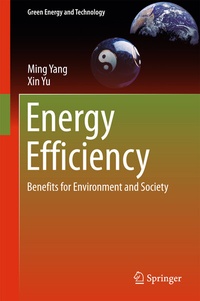
Energy Efficiency
Description

This book discusses how energy efficiency benefits the global environment, national energy security, local pollution mitigation, natural resource conservation, and utility bill reduction. In addition, this book provides many hands-on skills and knowledge to identify and develop energy efficiency projects. The literature review shows that energy efficiency has become the first fuel in the world energy supply. With empirical analyses, this book indicates that without continued investment in energy efficiency, neither China nor the U.S. could achieve their carbon emission reduction targets that were announced on November 13, 2014 during the Beijing 2014 APEC meeting. The authors argue that energy efficiency will become the first tool to mitigate climate change. These include (1) identifying energy efficiency barriers, (2) developing energy policies, (3) investing in energy efficient technologies, (4) undertaking project cost-effectiveness analysis, (5) de-risking and financing energy efficiency projects; (6) developing and managing energy service companies, and (7) promoting urban transport efficiency. Two case studies in energy efficiency improvement in electrical motors and industrial boilers are also presented. This book is written for college and university students, practitioners, researchers, consultants, project developers, and policy makers who want to dedicate their professional careers in global energy efficiency improvement, climate change mitigation, local clean air initiatives, and energy bill reduction.
Reviews / Votes
"Yang (senior climate change specialist, Global Environmental Facility, Washington, DC) and Yu (consultant, International Fund for China's Development, Washington, DC) have written a book that covers barriers, policies, financing, methods of analysis, advances in technology, and service companies. The book has references at the end of each of the 13 chapters . . This book was written for students, government policy analysts, and project developers. . Summing Up: Recommended. All readership levels." (L. E. Erickson, Choice, Vol. 53 (4), December, 2015)
More details
Other editions
Additional editions
Persons
Dr. Ming Yang is senior climate change specialist in the Global Environment Facility headquartered in Washington D.C. of the USA. He used to work in the International Energy Agency in Paris and in the Asian Development Bank in Manila, the Philippines. He was author for three books: (1) Closing the Gap (2013), (2) Negotiation in Decentralization (2012), and (3) Climate Policy Uncertainty and Investment Risk (2007); and contributing author for three books: (1) Energy Technology Perspectives (2008), (2) Light's Labor's Lost (2006), and (3) and Policy Support for the PRC 2020 (2003). In addition, he has authored chapters for two books, 45 peer-reviewed journal papers and 65 short newspaper articles in fields of energy and climate change. Dr. Yang holds Ph.D. in energy economics, M.S. in power economics, and B.S. in electric power engineering.
Dr. Xin Yu is consultant in the International Fund for China's Environment (IFCE). Prior to joining the IFCE, she was research fellow and research assistant in three Australian universities for 10 years. Her expertise covered not only energy and environment, but also higher education teaching, learning, and assessment. She played a key role in writing a number of research reports and teaching and learning resource materials for instructors and students. Before that, she worked as news editor for Asian Energy News, a monthly journal in energy and environment, for 44 issues in a period of five years. She has coauthored three books and more than 20 refereed journal articles in energy, tourism and higher education. Dr. Yu holds Ph.D. in management.
Disclaimer
The views, findings, interpretations, and conclusions expressed in this book are entirely those of the authors and should not be attributed in any manner to the organizations where the authors have worked.
