

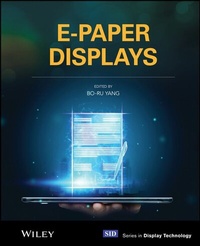
E-Paper Displays
Description

An in-depth introduction to a promising technology, curated by one of its pioneering inventors
Electronic paper (e-paper) has one of the most promising futures in technology. E-paper's potential is unlimited, as the displays require extremely low power and imitate the aesthetic of ink on the page. This allows e-paper devices to have a wider range of viewing angles than traditional LED products and are capable of being viewed in direct sunlight--and without any additional power. As a result, e-paper displays create less eye strain, have a greater flexibility in their use, and have the potential to be used in place of paper for billboard advertising, educational applications, and transport signage, and more.
In E-Paper Displays, editor Bo-Ru Yang and his team of experts present a detailed view into the important technologies involved in e-paper displays, with a particlular emphasis on how this technology's unique properties make possible a wide range of personal and professional electronic products. As climate change makes efficient energy use more important than ever, e-paper can become an essential tool for future products on a large scale. As we rely more and more on technology, having lightweight devices with long battery life will become critical. This book provides engineers and innovators with an introduction to this important technology and shows new pathways for development.
E-Paper Displays readers will also find:
* The editor is one of the leading pioneers in this technology
* Contributions from an international team of experts in e-paper technology
* Descriptions of many advanced display types that rely on different principles than the widely used LCD and OLED types
* Another innovative title from Wiley-SID (Society for Information Displays) series
As we enter a new stage in our industrial development, E-Paper Displays is an essential reference for computer engineers and developers, as well as innovators and scientists, and their students.
More details
Other editions
Additional editions
Person
Bo-Ru Yang, PhD, is a Professor at Sun Yat-Sen University. He is one of the pioneering inventors of full-color e-paper, holding close to 40 patents for materials, devices, driving schemes, and fabrication. He also serves as the Society for Information Display e-paper and flexible display committee chair.
Content
List of Contributors xi
Series Editor's Foreword xiii
Editor's Preface xv
1 The Rise, and Fall, and Rise of Electronic Paper 1
Paul S. Drzaic, Bo-Ru Yang, and Anne Chiang
1.1 Introduction 1
1.2 Why Electronic Paper? 2
1.3 Brightness, Color, and Resolution 2
1.4 Reflectivity and Viewing Angle 4
1.5 Translating Print-on-Paper into Electronic Paper 5
1.6 The Allure of Electronic Paper vs. the Practicality of LCDs 10
1.7 The Evolution of Electrophoretic Display-Based Electronic Paper 11
1.8 Initial Wave of Electrophoretic Display Development 12
1.9 The Revival of EPDs 17
1.10 Developing a Commercial Display 18
1.11 Enhancing Brightness and Contrast 19
1.12 Microencapsulation Breakthrough 20
1.13 Image Retention 21
1.14 Active-Matrix Compatibility 23
1.15 Electronic Book Products, and E Ink Merger 25
1.16 Summary 26
2 Fundamental Mechanisms of Electrophoretic Displays 31
Bo-Ru Yang and Kristiaan Neyts
2.1 General View of Electronic Ink Operation 31
2.2 Charging Mechanism with Inverse Micelle Dynamics 33
2.3 Drift and Diffusion of Charged Inverse Micelles 35
2.4 Motion of Charged Inverse Micelles Under External Field Driving 38
2.5 Stern Layer Formation 41
2.6 Charging Mechanism with Particles and Additives 44
2.7 Observations on a Single Particle 44
2.8 Rheological Effects During Driving 47
2.9 Bistability After Removing External Fields 48
2.10 Full Color E-Paper 49
2.11 Conclusion 50
3 Driving Waveforms and Image Processing for Electrophoretic Displays 53
Zong Qin and Bo-Ru Yang
3.1 Driving Waveforms of EPDs 53
3.2 Image Processing 61
3.3 Advanced Driving Methods for Future E-Papers 69
4 Fast-Switching Mode with CLEARInk Structure 75
Robert J. Fleming
4.1 Introduction 75
4.2 CLEARink Display Optics 78
4.3 CLEARink Reflective Color Displays 85
4.4 Electrophoretic Displays with CLEARink Structure 89
4.5 CLEARink Device Architecture 93
4.6 Manufacturing and Supply Chain 96
4.6.1 Status of Technology and Future Projections 96
Acknowledgments 97
5 Bistable Cholesteric Liquid Crystal Displays -- Review and Writing Tablets 99
Clinton Braganza and Mauricio Echeverri
5.1 Introduction 99
5.2 Materials and Optical Properties 99
5.3 Image Creation Using Cholesteric Liquid Crystals 104
5.4 Applications 108
5.5 Writing Tablets 109
5.6 Conclusions 126
6 The Zenithal Bistable Display: A Grating Aligned Bistable Nematic Liquid Crystal Device 131
Guy P. Bryan-Brown and J. Cliff Jones
6.1 Introduction 131
6.2 Operating Principles and Geometries 132
6.3 Grating Fabrication and Supply Chain 138
6.4 ZBD LCD Manufacturing Processes 141
6.5 Electrical Addressing 144
6.6 Optical Configurations 145
6.7 Novel Arrangements 149
6.8 Conclusions 150
7 Reflective LCD with Memory in Pixel Structure 153
Yoko Fukunaga
7.1 Introduction 153
7.2 Memory in Pixel Technology and Its Super Low Power Operation 154
7.3 Sub-Pixel Pattern to Show Gray Scale 157
7.4 Reflective LCD Optical Design 158
7.5 How to Show a Natural Image 163
7.6 Design Characteristics of Current Market-Available Products and Their Super Low Power Operations 164
7.7 Summary of Power Consumption 167
7.8 Applications 168
7.9 Future Expectations 168
8 Optically Rewritable Liquid Crystal Display 171
Wanlong Zhang, Abhishek Srivastava, Vladimir Chigrinov, and Hoi-Sing Kwok
8.1 Introduction 171
8.2 Photoalignment Technology 172
8.3 Flexible Optically Rewritable LCD 186
8.4 Dye-Doped Optically Rewritable LCD 188
8.5 Conclusion 190
9 Electrowetting Displays 197
Doeke J. Oostra
9.1 Overviews 197
9.2 Introduction 197
9.3 The Promise of Electrowetting Displays 200
9.4 History of Electrowetting Display Development 204
9.5 Electrowetting Cells 205
9.6 Capabilities for Black and White 206
9.7 Capabilities for Video and Color 209
9.8 Driving 215
9.9 Architectures 216
9.10 Manufacturing 217
9.11 Reliability 220
9.12 Failure Mechanisms 220
9.13 In Conclusion: Electrowetting Displays Have Reached Maturity 221
10 Electrochromic Display 225
Norihisa Kobayashi
10.1 Introduction 225
10.2 Structure of Electrochromic Display 226
10.3 EC Materials 228
10.4 Summary 239
11 Phase Change Material Displays 243
Ben Broughton and Peiman Hosseini
11.1 Introduction 243
11.2 Phase Change Materials and Devices 243
11.3 Strong Interference in Ultra-Thin Absorbing Films 244
11.4 Potential for High Brightness, Low Power Color Reflective Displays 245
11.5 Solid-State Reflective Displays (SRD®) 248
11.6 SRD Prototype -- Progress and Performance 259
11.7 Other Approaches 263
11.8 Conclusions 265
12 Optical Measurements for E-Paper Displays 271
Karlheinz Blankenbach
12.1 Introduction 271
12.2 Fundamentals of Reflection 272
12.3 Reflection Measurements Set-Ups 273
12.4 Display Image Quality Parameters 276
12.5 Temporal Parameters 281
12.6 Further Topics 283
12.7 Summary 283
Glossary incl. Abbreviations 284
References 284
Index 287
1
The Rise, and Fall, and Rise of Electronic Paper
Paul S. Drzaic1, Bo-Ru Yang2, and Anne Chiang3
1 Apple, Inc
2 Professor, School of Electronics and Information Technology, State Key Laboratory of Optoelectronic Materials and Technologies, Guangdong Province Key Laboratory of Display Material and Technology, Sun Yat-Sen University, Guangzhou, China
3 Principal, Chiang Consulting, Cupertino, CA
1.1 Introduction
For over a thousand years, before the world of electronics, paper was the dominant medium for people to share written and later printed information. People become familiar with paper at an early age, and there is an enormous worldwide infrastructure for the production and distribution of printed material. Despite this huge built-in advantage, paper and print now fall short in providing for many demands of modern life. The past few decades have seen the emergence of electronic networks that transmit vast amounts of information, on-demand, for use in various ways. Electronic displays are a necessary part of this infrastructure, converting bits to photons and serving as the final stage of transmitting information to people.
Over the years, several electronic display technologies have waxed and waned; cathode ray tubes, plasma displays, and super twisted nematic (STN) displays come to mind. A few technologies are dominant; backlit active-matrix liquid crystal displays, active matrix organic light-emitting diode (OLED) displays, and inexpensive, passively addressed liquid crystal displays. Along the way, tens of different types of display technologies have been invented and explored, but ultimately have failed to catch on. A few displays have found a home in niche products and promise greater future application. Reflective displays, particularly electronic paper, are examples that have managed to find a place in the display ecosystem, with unique applications best served by these technologies.
This book aims to update on some of the most exciting new areas in electronic paper technology. This introductory chapter focuses primarily on electrophoretic displays (EPDs) and how they became synonymous with electronic paper. The story starts in the early 1970's, with the proposal and first demonstration of the electrophoretic movement of charged particles to make an optical effect. After intense effort, the technology was mostly abandoned, only to be resurrected by a start-up company, E Ink. Several key, and rather improbable inventions had to be made to develop a technology competitive to the dominant liquid crystal technology. Finally, the right application and ecosystem, the Amazon Kindle electronic book, was necessary to cement commercial success.
The field of reflective displays is very rich. The many other chapters in this book and recent reviews [1, 2] provide a wealth of resources for understanding the many technologies that have been developed in the quest to achieve a paper-like display. In this chapter, we will examine the following:
- A description of print-on-paper and how the optics of real paper compare with potential electronic paper competitors.
- A hierarchical summary of the different technical approaches for reflective displays.
- A detailed look at the historical development of EPDs, starting with the invention of the technology and ending with the introduction of the Amazon Kindle. Looking at the various developments in the context of its times, the EPD story offers some lessons in what it takes for a technology to transition from the laboratory to commercial success.
1.2 Why Electronic Paper?
Electronic paper has undoubtedly caught the imagination of the world. A Google search for electronic paper in September 2021 returns over 12 billion hits. This interest reflects people's love affair with paper as a medium for transmitting information. Yet, it is easy to recognise that printing ink onto dead trees is not easily compatible with today's networked world. What are the attributes of print-on-paper that make it so important?
- Paper is a reflective medium that automatically adapts to changing lighting
- Unlike most emissive displays, paper can be easily read in bright sunlight.
- The appearance of paper is relatively constant over different viewing angles, without significant shifts in luminance or color.
- Paper can be lightweight and flexible. The user can easily annotate it. with a pen or pencil.
- Paper is inexpensive
- Paper can be archived.
Nevertheless, physical paper cannot be instantly updated with information from electronic networks or easily serve as an interface with electronic devices. Today's backlit LCDs and OLED displays are ubiquitous as a means of transmitting information, but with the limitations that emissive displays possess, including eyestrain and low visibility in sunlight. Electronic paper can combine the power of electronic devices and networks with all the attributes of paper.
So what strategies can be taken to enable electronic paper? It is instructive to understand the composition and design of print-on-paper and see how many of these properties can be converted to something under electronic control to compete with printed media.
1.3 Brightness, Color, and Resolution
Conventional, non-electronic paper consists of a mat of tightly pressed fibers, most commonly derived from parchment or wood pulp. The combination of fibers and embedded air pockets scatter light and provide the reflective characteristics of paper. Historically, additives to the paper pulp during fabrication have also provided glossiness, color, aid in manufacture, or other desirable characteristics (Figure 1.1).
Compared to a white optical standard, the perceived reflectivity of paper often ranges from 50-80%, but can be even higher. The whiteness or brightness of paper depends on several factors, including the density of fibers, the paper thickness, the presence of additives such as titanium dioxide, clays, or fluorescent agents, and whether the viewing surface is made glossy through calendaring and coatings. The color of light reflected from white paper may differ somewhat from a perfect reflector due to the fluorescing whiteners' presence, or some underlying color absorbance from the paper. The human eye readily accommodates for these changes, though, so the perception of consistent color and lightness of a page relative to its surroundings is easily achieved (Figure 1.2).
Print-on-paper consists of drops of colored ink impregnated into the paper fiber. It is straightforward to devise dyes and pigments that absorb red, green, or blue. To generate the color characteristics of print, the CMYK subtractive color system can be used (Figure 1.3). The colors in print are usually comprised of cyan (absorb red), magenta (absorb green), and yellow (absorb blue) (Figure 1.4). Black pigment (the K in CMYK) is also commonly used, as it is challenging to achieve a neutral black color by mixing cyan, magenta, and yellow.
Figure 1.1 Arches 100% cotton rag paper. Scanning electron microscope image @100×.
Source: http://paperproject.org,[3] Used with permission of CJ Kazilek.
Figure 1.2 CIELAB color system [4] John Wiley & Sons.
Figure 1.3 Color separation of an image into its CMYK components, and the final printed image. The absence of a color is white.
Figure 1.4 Subtractive color mixing. Cyan and magenta overlap to make blue, cyan, and yellow overlap to make green, yellow, and magenta overlap to make red, and all three mixed together provide black.
To achieve a wider color gamut, inkjet printing may use six or more colors to print. Additionally, spot color printing can deposit specialty inks (such as fluorescent pigments) that currently have no analog in emissive displays.
Depending on the industry, a variety of different color spaces and metrics have been developed for printed and reflected color. For example, the CIE 1976 (L*a*b*) color space is widely used to measure reflective colors and print. The human perception of lightness is measured by L*, which roughly scales as the cube root as the reflected luminance level.
For color reproduction in the print industries, the SNAP standard (Specifications for Newspaper Advertising Production) and SWOP standard (Specifications for Web Offset Publications) are widely used [1]. These print standards are rarely applied to electronic displays, though the advent of colored reflective displays approaching print-like appearance could change this situation.
Grayscale in printing is achieved using halftones (Figure 1.5). Each dot on a printed page defines an area where smaller halftone dots are printed. The more halftone dots, the deeper the color or darker the black while white is the absence of halftone dots. The smaller the dots, the higher the resolution. Print is often defined in lines per inch." Some examples of everyday printed objects include:
- Newspaper (monochrome) - 65-100 LPI
- Books and magazines (color) - 120-150 LPI
- Art books (color) -...
