

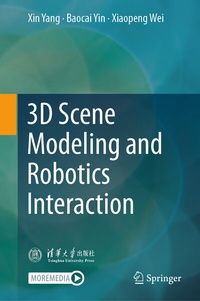
3D Scene Modeling and Robotics Interaction
Description

This book focuses on the intelligent perception and interaction module in intelligent robotic systems, establishes a multidisciplinary cross-fertilization knowledge system, explores the related technology frontiers and research frontiers as comprehensively as possible from the perspective of scene modeling and understanding, and develops a practical exposition of practical application tasks such as robotic navigation, obstacle avoidance, and grasping.
The main contents of this book include 3D reconstruction, scene exploration, scene understanding, robot navigation and obstacle avoidance, robot grasping and comprehensive project practice. Combining theory and practice, the book contains both basic algorithms and covers the latest technologies with detailed code or pseudo-code resources. This book can be used as a teaching reference book for information and intelligence related majors in higher education institutions, computer graphics, computer vision and intelligent robotics and other related fields, as well as a reference book for technicians engaged in related fields.
This book takes intelligent robots as the carrier, focuses on the technologies of environment perception and understanding and applying them to practical tasks such as robot navigation, obstacle avoidance and grasping. The book consists of six chapters. Chapters 1 to 3 provide a comprehensive introduction to the development and application of scene modeling and understanding technologies, including 3D reconstruction, scene exploration, and scene understanding. Chapters 4 and Chapter 5 provide a comprehensive introduction to the development and application of robot perception technologies, including visual relocalization and robot navigation, obstacle avoidance and grasping. Chapter 6 introduces comprehensive project practice with 3D scene modeling and understanding for robot tasks as an example, which facilitates readers to have a comprehensive understanding and mastery of theory and practice.
The translation was done with the help of artificial intelligence. A subsequent human revision was done primarily in terms of content.
More details
Other editions
Additional editions
Persons
Xin Yang: Professor and Ph.D. supervisor at the School of Computer Science and Technology, Dalian University of Technology. He also serves as the Deputy Director of the Office for Academic Discipline Construction (Double First-Class Initiative and Academic Committee).
Baocai Yin: Professor and Ph.D. supervisor at the School of Information Science and Technology, Beijing Institute of Technology. He is also the director of Beijing Artificial Intelligence Research Institute, and the director of Beijing Key Laboratory of Multimedia and Intelligent Software Technology.
Xiaopeng Wei: Professor and Ph.D. supervisor at the School of Computer Science and Technology, Dalian University of Technology. He is the Chairman of the Development Strategy Advisory Committee of the Key Laboratory of Social Computing and Cognitive Intelligence under the Ministry of Education.
Content
3D Reconstruction.- Scene Exploration.- Scene Understanding.- Robot Navigation and Obstacle Avoidance.- Robot Grasping.- Integrated Project Practice: 3D Scene Modelling and Understanding for Robotic Tasks.
