

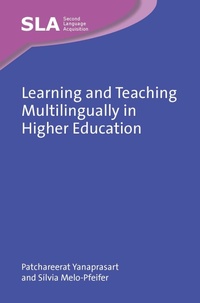
Learning and Teaching Multilingually in Higher Education
Published on 27. April 2026
160 pages
978-1-80041-219-4 (ISBN)
Description

Critical and reflective discussion of the challenges and possibilities of increasingly multilingual higher education.
This book investigates the role and place of language in the complex process of internationalising academic knowledge and work, and offers a unique focus on the lived experiences of both teachers and students in multilingual university contexts.
The authors explore how multilingual teachers and students navigate issues of identity, authenticity and belonging, centring their voices and underscoring their beliefs, struggles and innovations when navigating multilingual higher education environments.
The book bridges policy, teaching practice and student experience in higher education and is grounded in empirical, cross-national research, providing a comparative insight into how multilingualism is experienced in different higher education systems. It provides fresh insights into what it means to teach and learn multilingually and envisions a more inclusive, humanised and equitable approach to multilingual higher education.
This book investigates the role and place of language in the complex process of internationalising academic knowledge and work, and offers a unique focus on the lived experiences of both teachers and students in multilingual university contexts.
The authors explore how multilingual teachers and students navigate issues of identity, authenticity and belonging, centring their voices and underscoring their beliefs, struggles and innovations when navigating multilingual higher education environments.
The book bridges policy, teaching practice and student experience in higher education and is grounded in empirical, cross-national research, providing a comparative insight into how multilingualism is experienced in different higher education systems. It provides fresh insights into what it means to teach and learn multilingually and envisions a more inclusive, humanised and equitable approach to multilingual higher education.
More details
Other editions
Additional editions
Patchareerat Yanaprasart | Silvia Melo-Pfeifer
Learning and Teaching Multilingually in Higher Education
Book
approx. 07/2026
Multilingual Matters
€111.50
Shipment within 10-20 days
Persons
Author
University of Geneva
Patchareerat Yanaprasart is Senior Lecturer at the University of Geneva, Switzerland. Her research focuses on intercultural and multilingual communication, particularly in professional, educational and expatriate contexts, and explores how language, culture and identity interact in multilingual workplaces and international mobility.
Patchareerat Yanaprasart is Senior Lecturer at the University of Geneva, Switzerland. Her research focuses on intercultural and multilingual communication, particularly in professional, educational and expatriate contexts, and explores how language, culture and identity interact in multilingual workplaces and international mobility.
Didaktik der sprachlichen und ästhetischen FächerUniversität Hamburg
Sílvia Melo-Pfeifer is Full Professor at the University of Hamburg, Germany. Her research focuses on visual methods, multilingual pedagogies and language teacher education. She is Co-editor, with Paula Kalaja, of Visualising Language Students and Teachers as Multilinguals (Multilingual Matters, 2024).
Sílvia Melo-Pfeifer is Full Professor at the University of Hamburg, Germany. Her research focuses on visual methods, multilingual pedagogies and language teacher education. She is Co-editor, with Paula Kalaja, of Visualising Language Students and Teachers as Multilinguals (Multilingual Matters, 2024).
Content
Preface
Yongyan Zheng: Foreword
Chapter 1. Introduction: Why a Book on Learning and Teaching Multilingually in Higher Education?
Part 1: Internationalisation of and Linguistic Diversity in Higher Education: Institutional Voices on an Apparent Conundrum
Chapter 2. Internationalisation in and of Higher Education
Chapter 3. Language Policies in Higher Education
Chapter 4. Academic Mobility
Discussion Part 1: Xuesong (Andy) Gao: Learning Multilingually in Higher Education
Part 2: Multilingualism in Teaching and Learning in Higher Education
Chapter 5. The Bi-National Empirical Study: Methodological Considerations
Chapter 6. Beliefs about Authentic (Multilingual) Teachers and Teaching in Higher Education
Chapter 7. Students' Beliefs about Multilingual Teachers and Teaching in Higher Education
Chapter 8. Language, Knowledge and Power in Higher Education: Teaching and Producing Knowledge Multilingually
Discussion Part 2: Vander Tavares: Teaching and Living Multilingualism in Higher Education during Neoliberal Times
Susana Pinto: Afterword: Humanising Learning and Teaching in Higher Education through Multilingualism
Yongyan Zheng: Foreword
Chapter 1. Introduction: Why a Book on Learning and Teaching Multilingually in Higher Education?
Part 1: Internationalisation of and Linguistic Diversity in Higher Education: Institutional Voices on an Apparent Conundrum
Chapter 2. Internationalisation in and of Higher Education
Chapter 3. Language Policies in Higher Education
Chapter 4. Academic Mobility
Discussion Part 1: Xuesong (Andy) Gao: Learning Multilingually in Higher Education
Part 2: Multilingualism in Teaching and Learning in Higher Education
Chapter 5. The Bi-National Empirical Study: Methodological Considerations
Chapter 6. Beliefs about Authentic (Multilingual) Teachers and Teaching in Higher Education
Chapter 7. Students' Beliefs about Multilingual Teachers and Teaching in Higher Education
Chapter 8. Language, Knowledge and Power in Higher Education: Teaching and Producing Knowledge Multilingually
Discussion Part 2: Vander Tavares: Teaching and Living Multilingualism in Higher Education during Neoliberal Times
Susana Pinto: Afterword: Humanising Learning and Teaching in Higher Education through Multilingualism
