

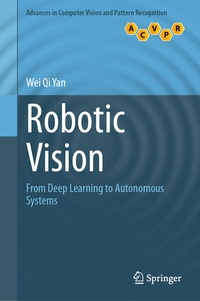
Robotic Vision
Description

Robotic vision represents the cutting edge of modern computing, combining artificial intelligence, deep learning, and advanced robotics to enable intelligent machines. As universities worldwide pivot from conventional machine learning to robotic vision, this book serves as an essential guide for researchers, educators, and students entering this transformative field.
This comprehensive resource introduces core topics such as humanoid and arm-type robots, robotic image processing, stereo vision, 3D reconstruction, scene understanding, and vision-based control. Advanced algorithms, including Kalman filters, imitation learning, inverse reinforcement learning, diffusion transformers, and multimodal approaches, are explored in depth. Practical applications are seamlessly integrated with theoretical knowledge, offering lab-based exercises and discussions to enhance hands-on learning.
Readers will gain unique insights into robotic navigation and planning, visual servoing, federated learning, and cutting-edge techniques like the "third eye algorithm" and camera retreat. Designed for accessibility, the book assumes no prerequisites beyond foundational courses in machine learning and deep learning, making it suitable for diverse audiences.
With its structured learning approach and emphasis on both foundational principles and emerging innovations, this book is an indispensable tool for mastering robotic vision. Whether readers aim to advance research, develop autonomous systems, or integrate AI-driven robotics into real-world applications, this book provides the knowledge and skills to succeed.
More details
Other editions
Additional editions
Person
Wei Qi Yan is with the Department of Computer and Information Sciences at the Auckland University of Technology (AUT), New Zealand. His expertise covers robotics, deep learning, machine intelligence, computer vision, and multimedia computing.
Dr. Yan is an associate editor of ACM Transactions on Multimedia Computing, Communications and Applications , a senior area editor of IEEE Signal Processing Letters , a section editor of Springer journal Discover Artificial Intelligence (AI). Dr. Yan has worked as an exchange computer scientist between the Royal Society Te Aparangi (RSNZ) and the Chinese Academy of Sciences (CAS) in China.
Dr. Yan is the director of joint research laboratory with the Shandong Academy of Sciences (SDAS) Shandong China, the director of the joint laboratory with China Jiliang University (CJLU), Zhejiang China. Dr. Yan is recognized as one of the "Top Two Percent of Scientists in the World," he currently holds the position of Chair of ACM Multimedia Chapter of New Zealand, and he is a Fellow of Engineering New Zealand (FEngNZ).
Content
Chapter 1. Introduction to Robotic Vision.- Chapter 2. Robotics.- Chapter 3. Image Processing for Robotics.- Chapter 4. Stereo Vision and 3D Reconstruction.- Chapter 5. Deep Learning for Robotic Vision.- Chapter 6. Robotic Perception and Intelligence.- Chapter 7. Vision-Based Robotic Control.- Chapter 8. Computational Tools for Robotic Vision.
