

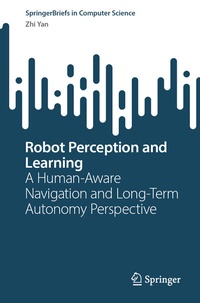
Robot Perception and Learning
Description

This book is divided into five chapters. Chapter 1 introduces the background of the research, the content positioning, and some related open source resources. Chapter 2 discusses some benchmarking issues related to the field of embodied intelligence and mobile robotics. Chapter 3 introduces robot perception, especially the object detection and tracking based on 3D lidar with contemporary characteristics. Chapter 4 introduces robot learning, especially robot online learning methods with strong embodied intelligence features. Chapter 5 summarizes the book and provides prospects for future research and application directions.
Reading this book helps readers have a systematic understanding of the latest research in related fields. The book mainly introduces methods and principles, and the corresponding experimental results need to refer to the corresponding scientific papers. This book is aimed at practitioners in the field with a certain knowledge base, including but not limited to graduate students, Ph.D. students, postdocs, etc.
More details
Other editions
Additional editions
Person
Dr. Zhi Yan is currently a teacher-researcher of computer science at ENSTA - Institut Polytechnique de Paris, France. From 2017 to 2024, he was an Assistant Professor of computer science and a Referent for open science at the Université de technologie de Belfort Montbéliard (UTBM), France. From 2016 to 2017, he was a Postdoctoral Research Fellow in the Lincoln Centre for Autonomous Systems (L-CAS) at the University of Lincoln, UK, mainly working on the Horizon 2020 project FLOBOT, but also involved in the Horizon 2020 project ENRICHME. From 2013 to 2015, he was a Postdoctoral Research Fellow in software engineering for mobile robotics in the CAR Team at the École des Mines de Douai, France. From 2009 to 2012, he was a Ph.D. student in multi-robot systems in the Laboratoire d'Intelligence Artificielle de Saint-Denis (LIASD, founded in 1969) at the Université Paris 8. He has been a visiting scholar at TU Wien (Austria), CTU (Czechia), Hunan University (China), and Central South University (China). As the first or co-first author, one of his papers was ranked among the "ESI Top 1% Highly Cited Papers", and another was named the "Best Paper of 2020" by the journal Intelligent Service Robotics.
Content
Introduction.- Benchmarking.- Robot Perception.- Robot Learning.- Conclusions and Perspectives.
