

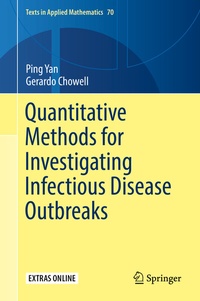
Quantitative Methods for Investigating Infectious Disease Outbreaks
Description

This book provides a systematic treatment of the mathematical underpinnings of work in the theory of outbreak dynamics and their control, covering balanced perspectives between theory and practice including new material on contemporary topics in the field of infectious disease modelling. Specifically, it presents a unified mathematical framework linked to the distribution theory of non-negative random variables; the many examples used in the text, are introduced and discussed in light of theoretical perspectives.
The book is organized into 9 chapters: The first motivates the presentation of the material on subsequent chapters; Chapter 2-3 provides a review of basic concepts of probability and statistical models for the distributions of continuous lifetime data and the distributions of random counts and counting processes, which are linked to phenomenological models. Chapters 4 focuses on dynamic behaviors of a disease outbreak during the initial phase while Chapters 5-6 broadly cover compartment models to investigate the consequences of epidemics as the outbreak moves beyond the initial phase. Chapter 7 provides a transition between mostly theoretical topics in earlier chapters and Chapters 8 and 9 where the focus is on the data generating processes and statistical issues of fitting models to data as well as specific mathematical epidemic modeling applications, respectively.
This book is aimed at a wide audience ranging from graduate students to established scientists from quantitatively-oriented fields of epidemiology, mathematics and statistics. The numerous examples and illustrations make understanding of the mathematics of disease transmission and control accessible. Furthermore, the examples and exercises, make the book suitable for motivated students in applied mathematics, either through a lecture course, or through self-study. This text could be used in graduate schools or special summer schools covering research problems in mathematical biology.
Reviews / Votes
"With the current Covid-19 pandemic the book can be very useful and timely for many interested readers. . The book has exercises of different levels of difficulty, and some can be extended for student projects. Thus, this book can be useful for graduate students, and researchers involved in mathematical epidemiology." (MAA Reviews, August 1, 2020)More details
Other editions
Additional editions
Persons
Ping Yan is the manager of a research team in modelling and projection at Public Health Agency of Canada and an adjunct professor at Department of Statistics and Actuarial Science, University of Waterloo. He applies statistical and mathematical models in communicable diseases transmission, prevention and control, with a wide range of topics from estimation of HIV/AIDS and viral hepatitis disease burden to informing policy regarding pandemic influenza preparedness, vaccination and emergency response.
Gerardo Chowell is Professor of Epidemiology and Biostatistics at the Georgia State University School of Public Health in Atlanta, where he is also Chair of the Department of Population Health Sciences. He is also an adjunct faculty member at Arizona State University and a Senior Research Fellow at the Fogarty International Center, National Institutes of Health. His research program focuses on the development mathematical models and statistical methods to investigate the spread and control of infectious diseases.
