

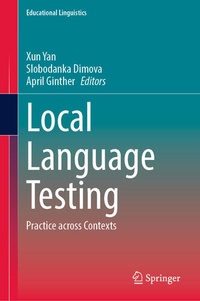
Local Language Testing
Description

This book describes language testing practices that exist in the intermediate space between large-scale standardized testing and classroom assessment, an area that is rarely addressed in language testing literature. Drawing empirical research on a variety of languages, the volume discusses local language tests' ability to represent local contexts and values, explicitly and purposefully embed test results within instructional practice, and provide data for program evaluation and research. Although local testing practices have been grounded in the theoretical principles of language testing, the authors in this volume supplement the theoretical content with practical examples of how local tests can be designed to effectively function within and across different institutional contexts.
More details
Other editions
Additional editions
Persons
Slobodanka Dimova received her Ph.D. in English as a Second Language from Purdue University in 2005. She is an Associate Professor in Language Testing and the coordinator of the Test of Oral English Proficiency for Academic Staff (TOEPAS) at the University of Copenhagen, Denmark. She currently serves as the Book Review Editor for the journal Language Testing , a member of the Executive Committee of the European Association of Language Testing and Assessment (EALTA), and a member of the Editorial Board of the Journal of English Medium Instruction . She teaches graduate courses in Language Testing, Second Language Acquisition, Research Methods, and Oral Production in L2. Her current research interests include rater training and rater behavior for oral proficiency tests, the development and validation of scales for performance-based tests, the use of technology in language testing and assessment, the policies and practices related to the implementation of English-medium instruction (EMI) programs at non-Anglophone universities.
April Ginther received her Ph.D. in Educational Linguistics from the University of New Mexico in 1994. She is a Professor of English, the Director of The Oral English Proficiency Program, and the Director of The Purdue Language and Cultural Exchange at Purdue University in West Lafayette, Indiana. For both the OEPP and PLaCE, she supervised the development of local tests, the Oral English Proficiency Test (OEPT) and the Assessment of College English, International (ACE-In). From 2012-2017, she was the co-editor of the journal Language Testing . She teaches graduate courses in the Second Language Studies Program and regularly offers two seminars: Quantitative Research Design and Language Testing and Assessment. Her current research interests include rater training, the development of second language reading and speaking fluency, and the development, implementation, and evaluation of university programs promoting internationalization and English language learning.
