

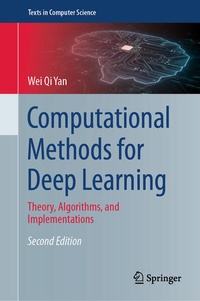
Computational Methods for Deep Learning
Description

The first edition of this textbook was published in 2021. Over the past two years, we have invested in enhancing all aspects of deep learning methods to ensure the book is comprehensive and impeccable. Taking into account feedback from our readers and audience, the author has diligently updated this book.
The second edition of this textbook presents control theory, transformer models, and graph neural networks (GNN) in deep learning. We have incorporated the latest algorithmic advances and large-scale deep learning models, such as GPTs, to align with the current research trends. Through the second edition, this book showcases how computational methods in deep learning serve as a dynamic driving force in this era of artificial intelligence (AI).
This book is intended for research students, engineers, as well as computer scientists with interest in computational methods in deep learning. Furthermore, it is also well-suited for researchers exploring topics such as machine intelligence, robotic control, and related areas.
More details
Other editions
Additional editions
Person
Wei Qi Yan is Director of Institute of Robotics & Vision (IoRV) at Auckland University of Technology (AUT) in New Zealand (NZ). Dr. Yan's research interests encompass deep learning, intelligent surveillance, computer vision, and multimedia computing. His expertise lies in computational mathematics, applied mathematics, computer science, and computer engineering. He holds the positions of Chief Technology Officer (CTO) of Screen 2 Script Limited (NZ) and Director and Chief Scientist of the Joint Laboratory between AUT and Shandong Academy of Sciences China (NZ). Dr. Yan also serves as Chair of ACM Multimedia Chapter of New Zealand and is Member of the ACM. Additionally, he is Senior Member of the IEEE and TC Member of the IEEE. In 2022, Dr. Yan was recognized as one of the world's top 2% cited scientists by Stanford University.
Content
1. Introduction.- 2. Deep Learning Platforms.- 3. CNN and RNN.- 4. Autoencoder and GAN.- 5. Reinforcement Learning.- 6. CapsNet and Manifold Learning.- 7. Boltzmann Machines.- 8. Transfer Learning and Ensemble Learning.
