

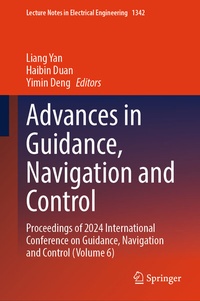
Advances in Guidance, Navigation and Control
Description

This book features the latest theoretical results and techniques in the field of guidance, navigation, and control (GNC) of vehicles and aircrafts. It covers a wide range of topics, including but not limited to, intelligent computing communication and control; new methods of navigation, estimation, and tracking; control of multiple moving objects; manned and autonomous unmanned systems; guidance, navigation, and control of miniature aircraft; and sensor systems for guidance, navigation and control, etc.
Presenting recent advances in the form of illustrations, tables, and text, it also provides detailed information of a number of the studies, to offer readers insights for their own research. In addition, the book addresses fundamental concepts and studies in the development of GNC, making it a valuable resource for both beginners and researchers wanting to further their understanding of guidance, navigation, and control.
More details
Other editions
Additional editions
Persons
Prof. Liang Yan holds a Ph.D. degree from Nanyang Technological University (NTU), Singapore. He has worked as a lecturer at Beijing Institute of Technology, as a research fellow at Nanyang Technological University, and as an associate professor and professor at Beihang University. He is currently a Chang Jiang distinguished professor at Beihang University. His research mainly focuses on high-performance actuation technology and its applications in robotics and aerospace technology.
Prof. Haibin Duan is the vice director of the State Key Laboratory of Virtual Reality Technology and Systems and the chair of Technical Committee on Guidance, Navigation, and Control (TCGNC), Chinese Society of Aeronautics and Astronautics (CSAA). He received the National Science Fund for Distinguished Young Scholars of China in 2014. He is also enrolled in the Chang Jiang Scholars Program of China. He is the steering general chair of 2024 International Conference on Guidance, Navigation, and Control. He is currently an associate editor of the IEEE Transactions on Cybernetics, and he is the editor-in-chief of Guidance, Navigation, and Control.
Prof. Yimin Deng received the B.S. and Ph.D. degrees in control science and engineering from Beihang University in 2011 and 2017, respectively. He is currently an associate professor with the School of Automation Science and Electrical Engineering at Beihang University. He has authored over 20 prestigious journal papers, including IEEE Transactions and AIAA Journals. His current research interests include biological computer vision, autonomous navigation, and control of unmanned aerial vehicles. Prof. Deng was enrolled in the Young Elite Scientists Sponsorship Program by Chinese Association for Science and Technology (CAST) and Young Top Talent Support Program by Beihang University.
