

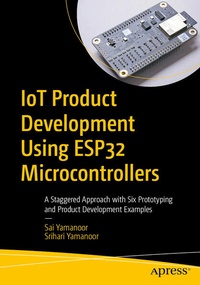
IoT Product Development Using ESP32 Microcontrollers
Description

Develop a comprehensive understanding of IoT product development using ESP32 microcontrollers. This book takes readers on a journey from sensor interface example to an ESP32-based product example where we discuss all aspects of a product including rapid prototyping, cloud interface, product provision, and device fleet management.
We will start with an introduction to the ESP32 microcontroller series and discuss programming language options for the ESP32 platform. Next, we explore publishing sensor data to the cloud using the ESP32. This is followed by a review of using the ESP32 to pull data from a public source and display it using a visual aid.
The next few chapters demonstrate the construction of a low-cost Bluetooth sensor node using the ESP32, data aggregation with the ESP32, where collect and publish data aggregated from low-power radio networks, and the development of edge devices using the ESP32.
The final chapter shows how to build an ESP32-enabled product that publishes data to the cloud, giving you confidence to start building on your own.
What You Will Learn
· Learn about the rich and powerful features of the ESP32 family of microcontrollers
· Get a thorough idea of rapid prototyping tools and techniques for IoT product development
· Understand the various communication protocols and standards available for IoT product development
Who Is This Book For
Readers with some experience with electronics and at least one programming language will be able to make the most of this book.
More details
Other editions
Additional editions
Persons
Sai Yamanoor is an Embedded Engineer based in Santa Clara, California. He has over ten years of experience as an embedded systems expert, working on hardware, firmware, and software design and implementations. He is a co-author of three books on using Raspberry Pi to execute DIY projects and has also presented DIY IoT projects at international conferences and Maker Faires. Sai is also working on projects to improve Quality of Life for people with chronic health conditions. Sai also enjoys collaborating and creating citizen science projects to benefit the general public of various backgrounds.
Srihari Yamanoor has over 15 years of experience in the medical device industry. He has worked on new product development and introduction, reliability improvements, manufacturing, and quality. His areas of work include diabetes, women's health, dermatology, cardiology, robotic and conventional diagnostics and surgery, orthopedics and oncology. He has co-authored three books on the applications of the Raspberry Pi family of products in technology, education, hobbies and other areas. In 2021, Srihari was named one of the Top 100 Healthcare Visionaries by IFAH.
Content
Chapter 1. Introduction to the ESP32 Platform.- Chapter 2. Building a Weather Station.- Chapter 3. Visual Aid for Air Quality.- Chapter 4. Building Bluetooth Products using ESP32.- Chapter 5. Low Power & Long Range Radios with ESP32.- Chapter 6. Building TinyML Products.- Chapter 7. Let's Build a Product!.
