

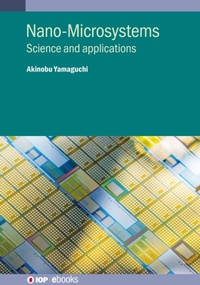
Nano-Microsystems
Description

When conducting scientific experiments, scientists design ideal experimental systems to elucidate their hypotheses, controlling various parameters and taking measurements to confirm their assumptions and accumulate objective facts. Engineers, on the other hand, aim to apply scientific findings to new devices and systems and implement them in society.
The nano-microsystem is a useful platform that can fulfil both these requirements by providing an ideal experimental system constructed through semiconductor microfabrication, as well as a platform for automatically controlling measurements. This makes it possible to carry out the desired scientific experiments with high precision. This nano-microsystem can also be used for applied research aimed at engineers, and the constructed system can be built as a device or system that can be implemented in society.
The aim of this book is to provide an overview on how to utilise nano-microsystems by introducing the relevant concepts, policies, fabrication methods and examples of implementation. In particular, the principles and design principles of microfluidic systems are introduced, along with their fabrication methods and concrete examples, and the research policy is presented to novice students. The authors provided useful information for scientists who have struggled to construct experimental systems systematically when conducting scientific experiments, and for engineers seeking applied research. Additionally, the book provides novice students with information on nano-microsystems that will be useful for their own research.
More details
Other editions
Additional editions
Person
Akinobu Yamaguchi is a professor at Toyo University, Japan, in the department of Electrical, Electric and Communications Engineering, Faculty of Science and Engineering. His research focuses on nano-microsystems, spintronics, synchrotron radiation reactions, operando molecular sensing during electrochemical reaction and photo-induced chemical reaction etc. and other applications. He is researching and teaching the creation of nano-microsystems and their applications of scientific research results.
Content
- Introduction of nano-microsystems
- Design and concept for system thinking
- Nano/microfabrication for creating nano/microsystems
- Nano/microfluidics
- Lab-on-a-disk
- Actuator systems based on surface acoustic wave devices
- On-chip synthesis of organic and chemical materials
- Optoelectrofluidics, platforms based on combination of electrokinetics and optics
- Future systems
