

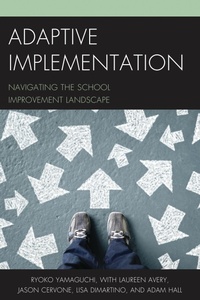
Adaptive Implementation
Navigating the School Improvement Landscape
1st Edition
Published on 21. July 2017
112 pages
979-8-216-34516-9 (ISBN)
Description

After decades spent pondering basic questions about adopting or implementing 'best practices' in education, educators have assembled a canon of evidence-based strategies and programs that should consistently produce good outcomes. So why is the work of educating students still such challenging work for so many? The best, most skilled educators adapt programs every day to meet the changing needs of their students. One size does not fit all, and one textbook, teaching strategy, or program will never meet the needs of all teachers and learners. Adaptive Implementation: Navigating the School Improvement Landscape focuses on how practitioners and researchers together continue to improve their craft by systematically collecting data on adaptations, testing them out, and figuring out what works. We provide a framework for building an adaptive implementation process in education, with tools and templates for practitioners to use. In the end, we hope that this book sparks a dialogue among educators as they continue to create adaptive implementation processes that work for their context.
More details
Edition
1. Auflage
Language
English
Place of publication
United States
Publishing group
Bloomsbury Publishing Plc
ISBN-13
979-8-216-34516-9 (9798216345169)
Copyright in bibliographic data and cover images is held by Nielsen Book Services Limited or by the publishers or by their respective licensors: all rights reserved.
Schweitzer Classification
Other editions
Additional editions
Ryoko Yamaguchi | Laureen Avery | Jason Cervone
Adaptive Implementation
Navigating the School Improvement Landscape
Book
07/2017
Rowman & Littlefield Publishers
€72.20
Shipment within 10-20 days
Persons
Ryoko Yamaguchiis a social scientist and former special education teacher with over 25 years of experience in K-12 education serving disadvantaged students as a practitioner, researcher, parent leader, and advocate. Dr. Yamaguchi has advised state and local education policy makers, school and teacher leaders, school board members, and community and parent leaders across the country on effective school practices to increase student learning and ameliorate achievement gaps.
Laureen Avery leads the work of UCLA's Center X efforts in the Northeastern US, and has more than 30 years of experience in K-12 public education as a researcher and practitioner. Avery developed and leads whole school improvement programs focused on improving outcomes for English learners and at-risk students.
Jason Cervone is the Northeast Region Project Director for UCLA Center X's Project ExcEL Leadership Academy. He has over a decade of experience in public education as a researcher, advisor, and evaluator, focusing on improving instruction for English Learners.
Lisa DiMartino is a former Program Manager for UCLA Center X, Northeast Region, and is currently pursuing her doctoral degree at Lesley University. DiMartino has over fifteen years of experience working with educators, administrators, and community organizations to improve student achievement through professional development and program evaluation.
Adam Hall is an education research and policy consultant. He has served the education community as an evaluator, technical assistance provider, and professional developer for over 20 years.
Laureen Avery leads the work of UCLA's Center X efforts in the Northeastern US, and has more than 30 years of experience in K-12 public education as a researcher and practitioner. Avery developed and leads whole school improvement programs focused on improving outcomes for English learners and at-risk students.
Jason Cervone is the Northeast Region Project Director for UCLA Center X's Project ExcEL Leadership Academy. He has over a decade of experience in public education as a researcher, advisor, and evaluator, focusing on improving instruction for English Learners.
Lisa DiMartino is a former Program Manager for UCLA Center X, Northeast Region, and is currently pursuing her doctoral degree at Lesley University. DiMartino has over fifteen years of experience working with educators, administrators, and community organizations to improve student achievement through professional development and program evaluation.
Adam Hall is an education research and policy consultant. He has served the education community as an evaluator, technical assistance provider, and professional developer for over 20 years.
Content
Preface
Introduction
Schools: A combination of technical and adaptive systems
What are your core goals?
Are you Scaling Up? Or Scaling Down?
Adaptive Implementation (AI) Team
Adaptive Implementation (AI) Cycle
Step 1: What do we need to see?
Step 2: What resources do we have?
Step 3: What will we do?
Step 4: What did we do?
Step 5: What did we learn?
CASE STUDY: PROJECT EXCEL
The ExcEL model
STEP 1: WHAT DO WE NEED TO SEE?
How Ambitious Should We Be?
Identify Waypoints
Create your roadmap
Five Characteristics of Strong Waypoints
Project ExcEL Example
STEP 2: WHAT RESOURCES DO WE HAVE?
Assess what you have
Assess what you don't have
Assess what you could have
Project ExcEL Example
STEP 3: WHAT ARE WE GOING TO DO?
Conduct Pro and Con Assessment (PCA)
Create a Design and Action Plan (DAP)
The problem with logic models
Process for developing the DAP
Identify the group of activities using the PCA
Determine the relationships and synergies of activities
Map out the activities
Conduct a series of face validity meetings with stakeholders
Revise, revise, and revise again
Project ExcEL Example
STEP 4: WHAT DID WE DO?
Annotate your roadmap
What to annotate and document?
Annotating is not evaluating
Project ExcEL Example
STEP 5: WHAT DID WE LEARN?
Will we do it again?
When we do it again ...
Scaling Up
Scaling down
Learning through reflection
Project ExcEL Example
CONCLUSION AND DISCUSSION
To use or not to use?
Who's at the table?
A note to evaluators - and funders
Making the time
The final word - momentum
Appendix
Adaptive Implementation (AI) Tools:
Templates for the AI Process
Adaptive Implementation (AI) Process Template
Step 1: What do we want to see? Five Characteristics of Strong Waypoints Checklist
Step 2: What resources do we have? AI Resource Management Tool
Step 3: What will we do? Pro/ Con Assessment (PCA) Template
Step 3: What will we do? Design and Action Plan (DAP) Template
Step 4: What did we do? Data Review Sheet
Step 5: What Did We Learn? Discussion Protocol Tool
REFERENCES
Introduction
Schools: A combination of technical and adaptive systems
What are your core goals?
Are you Scaling Up? Or Scaling Down?
Adaptive Implementation (AI) Team
Adaptive Implementation (AI) Cycle
Step 1: What do we need to see?
Step 2: What resources do we have?
Step 3: What will we do?
Step 4: What did we do?
Step 5: What did we learn?
CASE STUDY: PROJECT EXCEL
The ExcEL model
STEP 1: WHAT DO WE NEED TO SEE?
How Ambitious Should We Be?
Identify Waypoints
Create your roadmap
Five Characteristics of Strong Waypoints
Project ExcEL Example
STEP 2: WHAT RESOURCES DO WE HAVE?
Assess what you have
Assess what you don't have
Assess what you could have
Project ExcEL Example
STEP 3: WHAT ARE WE GOING TO DO?
Conduct Pro and Con Assessment (PCA)
Create a Design and Action Plan (DAP)
The problem with logic models
Process for developing the DAP
Identify the group of activities using the PCA
Determine the relationships and synergies of activities
Map out the activities
Conduct a series of face validity meetings with stakeholders
Revise, revise, and revise again
Project ExcEL Example
STEP 4: WHAT DID WE DO?
Annotate your roadmap
What to annotate and document?
Annotating is not evaluating
Project ExcEL Example
STEP 5: WHAT DID WE LEARN?
Will we do it again?
When we do it again ...
Scaling Up
Scaling down
Learning through reflection
Project ExcEL Example
CONCLUSION AND DISCUSSION
To use or not to use?
Who's at the table?
A note to evaluators - and funders
Making the time
The final word - momentum
Appendix
Adaptive Implementation (AI) Tools:
Templates for the AI Process
Adaptive Implementation (AI) Process Template
Step 1: What do we want to see? Five Characteristics of Strong Waypoints Checklist
Step 2: What resources do we have? AI Resource Management Tool
Step 3: What will we do? Pro/ Con Assessment (PCA) Template
Step 3: What will we do? Design and Action Plan (DAP) Template
Step 4: What did we do? Data Review Sheet
Step 5: What Did We Learn? Discussion Protocol Tool
REFERENCES
