

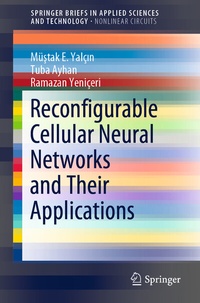
Reconfigurable Cellular Neural Networks and Their Applications
Description

This book explores how neural networks can be designed to analyze sensory data in a way that mimics natural systems. It introduces readers to the cellular neural network (CNN) and formulates it to match the behavior of the Wilson-Cowan model. In turn, two properties that are vital in nature are added to the CNN to help it more accurately deliver mimetic behavior: randomness of connection, and the presence of different dynamics (excitatory and inhibitory) within the same network. It uses an ID matrix to determine the location of excitatory and inhibitory neurons, and to reconfigure the network to optimize its topology.
The book demonstrates that reconfiguring a single-layer CNN is an easier and more flexible solution than the procedure required in a multilayer CNN, in which excitatory and inhibitory neurons are separate, and that the key CNN criteria of a spatially invariant template and local coupling are fulfilled. In closing, the application of the authors' neuron population model as a feature extractor is exemplified using odor and electroencephalogram classification.
More details
Other editions
Additional editions
Persons
Mustak E. Yalcin was born in Unye, Turkey, in 1971. In 1993, he obtained the degree in Electronics and Telecommunications Engineering from Istanbul Technical University (I.T.U.), Electrical and Electronic Engineering Faculty. In 1997, he received the Master degree in Electronics and Communications Engineering from I.T.U. Institute of Science andTechnology. In 2004, he recieved the Ph.D. degree in Applied Sciences from the Katholieke Universiteit Leuven, Belgium. Between June 2004-December 2004, he was a postdoctoral fellow at Katholieke Universiteit Leuven, Department of Electrical Engineering (ESAT)/SCD-SISTA. He was also a Visiting Research Fellow at The Institute for Nonlinear Science, University of California San Diego (UCSD) in 2009. He is currently a full Professor with Istanbul Technical University, Turkey. His research interests are mainly in the areas of the theory and application of nonlinear circuit and systems. He is co-author of the book "Cellular Neural Networks, Multi-Scroll Chaos and Synchronization" (World Scientific). Mustak E. Yalcin has been elected Chair of IEEE CAS Cellular Nanoscale(Neural) Networks and Array Computing Technical Committee form 2015. He was appointed as Associate Editor for the International Journal of Bifurcation and Chaos in Applied Sciences and Engineering from 2015.
RamazanYeniceri was born in Denizli, Turkey in 1985. He received his B.Sc., M.Sc. and Ph.D. degrees in Electronics and Communication Engineering Department from Istanbul Technical University (ITU). He has received ITU Annual Award for Best PhD Thesis in 2015. After six years of Research and Teaching Assistant experience in ITU Department of Electronics and Communication Engineering and one year of Senior Design and Verification Engineer experience in Electra IC, he has been with ITU Aerospace Research Center (ITUARC) in a Senior Researcher position. He is now with Department of Aeronautical Engineering as Assistant Professor and Board Member of ITUARC. His current research topics are unmanned aerial vehicles, embedded systems and avionics.
