

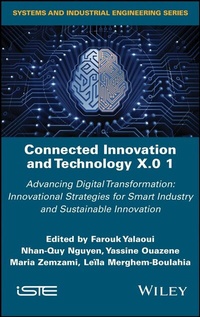
Connected Innovation and Technology X.0 1
Description

Connected Innovation and Technology X.0 1 studies the development of industry and logistics through digital technologies, presenting novel approaches to efficiency and innovation. It highlights the core of Industry X.0, showing how the digital transformation of business models, the focus on human-centric experiences and the application of advanced technologies all drive growth across various fields.
Emphasizing smart supply chain management, performance optimization and sustainable solutions, the book provides insights into using Industry X.0 technologies to enhance supply chain sustainability, network security, and innovation in the manufacturing, healthcare and energy sectors. By integrating lean methodologies, advanced planning and the latest tech solutions, it serves as an efficient resource, not only for professionals, but also for students who seek to map digital transformation complexities and seize the opportunities given to develop future-oriented business models and achieve operational excellence.
More details
Other editions
Additional editions
Persons
Farouk Yalaoui is Full Professor at UTT, France. He specializes in optimization and industrial engineering, and is a founding member of the Algerian Academy of Sciences and Technologies.
Nhan-Quy Nguyen is a researcher at UTT, France. He specializes in optimizing complex systems, with applications in logistics, healthcare and energy management.
Yassine Ouazene is Associate Professor at UTT, France. He specializes in combinatorial optimization and operations research, and his research focuses on production systems, manufacturing design and smart pricing.
Maria Zemzami is Professor at Université Mohammed V, Morocco. She specializes in software engineering, cloud computing and network security, and her research focuses on information system interoperability and optimization algorithms.
Leïla Merghem-Boulahia is Full Professor at UTT, France, and the head of the ISIFT. Her main research interests include multi-agent systems, quality of service, smart grids, the IoT and the IIoT.
Content
Preface: Connected Innovation, the Heart of Industry X.0 xiii
Farouk YALAOUI, Nhan-Quy NGUYEN, Yassine OUAZENE, Maria ZEMZAMI and Leïla MERGHEM-BOULAHIA
Part 1. Innovations in Production and Smart Supply Chain Management 1
Chapter 1. Supply Chain Views from an Industry 4.0 Perspective 3
Ghita BOUCHTAOUI, Lamia HAMMADI, Ridha DERROUICHE, Roberta COSTA-AFFONSO and Abdessamad EL BALLOUTI
1.1. Introduction 3
1.2. Smart supply chain 4
1.3. The essential technologies for the development of the smart supply chain 6
1.4. Methodology 8
1.6. Discussion 14
1.7. Conclusion 15
1.8. References 15
Chapter 2. A Bibliometric Analysis of the Integration of Lean and Industry 4.0 in the Sustainable Supply Chain 19
Assiya ZAHID, Lamia HAMMADI, Patrice LECLAIRE, Roberta COSTA-AFFONSO and Abdessamad EL BALLOUTI
2.1. Introduction 19
2.2. Theoretical background 21
2.3. Research methodology 25
2.4. Results and discussion 27
2.5. Conclusion 31
2.6. References 31
Chapter 3. Integrated Strategy for Condition-Based Maintenance, Production and Quality Control in Manufacturing Systems 35
Dorsaf DALDOUL and Nadia BAHRIA
3.1. Introduction 35
3.2. Literature review 36
3.3. Integrated strategy, working hypotheses and notations 38
3.4. Mathematical model 44
3.5. Numerical example 50
3.6. Conclusion 50
3.7. References 51
Chapter 4. Optimizing Energy Efficiency in a Two-Level Supply Chain Model with Shortage Consideration 53
Hong-Nguyen NGUYEN, Matthieu GODICHAUD and Lionel AMODEO
4.1. Introduction and literature review 53
4.2. Problem description and mathematical modeling 56
4.3. Resolution 58
4.4. Numerical analysis 61
4.5. Conclusion 63
4.6. References 63
Chapter 5. Advanced Planning and Scheduling in Off-Site Construction 67
Amin CHAABANE, Nadia BAHRIA and Salim HEDFI
5.1. Introduction 67
5.2. Literature review 68
5.3. Problem description 71
5.4. Mathematical model 74
5.5. Experimentations 78
5.6. Conclusion 81
5.7. References 82
Part 2. Performance Evaluation and Optimization for Industry X.0 85
Chapter 6. Performance Evaluation of Networking Protocols for Industrial Internet of Things 87
Samira CHOUIKHI, Leïla MERGHEM-BOULAHIA, Moez ESSGHIR and Nur BINTI RAHMAT
6.1. Introduction 88
6.2. Quality of service and protocols for IIoT applications 90
6.3. Experiments and performance evaluation 95
6.4. Conclusion 101
6.5. Acknowledgments 101
6.6. References 101
Chapter 7. Navigating Toward Enhanced Security and Resilience in 5G and 6G Network Architectures 103
Atiq AHMED, Ihsan ULLAH, Leïla MERGHEM-BOULAHIA, Dominique GAITI and Guy PUJOLLE
7.1. Introduction 103
7.2. Authentication and key agreement in NGN 105
7.3. Terminal equipment security in NGN 111
7.4. Virtual environment security in NGN 114
7.5. Digital forensics operations in NGN 115
7.6. Conclusion 117
7.7. References 118
Chapter 8. New Technique for Selecting Key Metaheuristic Parameters: Case Study on the SAR Metaheuristic Algorithm 121
Hakima REDDAD, Maria ZEMZAMI, Nhan-Quy NGUYEN, Norelislam EL HAMI and Nabil HMINA
8.1. Introduction 121
8.2. Literature review and contribution 123
8.3. Identifying SAR key parameters approach 127
8.4. Conclusion and perspectives 135
8.5. References 135
Chapter 9. Precedence-Based and Time-Indexed Formulations for the Flexible Job Shop Scheduling with Machine Availability Constraints 141
Tom PERROUX, Taha ARBAOUI and Leïla MERGHEM-BOULAHIA
9.1. Introduction 141
9.2. Problem definition 143
9.3. Mathematical models 143
9.4. Computational results 147
9.5. Conclusion 150
9.6. References 151
Chapter 10. Multi-Criteria Approach Using Discrete Event Simulation to Balance Staff Workload and Reduce Patient Wait Time: An Emergency Department Case Study 153
Dorsaf DALDOUL
10.1. Introduction 153
10.2. Case study 158
10.3. Simulation approach 160
10.4. Numerical results 163
10.5. Conclusion 166
10.6. References 166
Part 3. Sustainable and Efficient Solutions Design 169
Chapter 11. Automatic Weed Detection Using YOLOv5 Object Detector 171
Mohammed HABIB, Salma SEKHRA, Adil TANNOUCHE and Youssef OUNEJJAR
11.1. Introduction 171
11.2. Materials and methods 173
11.3. Results and discussion 179
11.4. Conclusion and future work 185
11.5. References 186
Chapter 12. Energy Management of Smart Buildings in the Era of Connected Innovation and Technology 189
Lotfi DERRADJI, Chaima MAGRAOUI, Amel LIMAM, Abdelouahab BOUTTOUT and Abdelatif MERABTINE
12.1. Introduction 189
12.2. Presentation of the case study 191
12.3. Materials and methods 192
12.4. Results and discussion 196
12.5. Conclusion 200
12.6. References 202
Chapter 13. The Relevance of Frugal Innovation for Sustainability: The Case of Developing a Solution for Water Scarcity 205
Luis Miguel LÓPEZ SANTIAGO
13.1. Introduction 205
13.2. Prior research 206
13.3. Research methodology 210
13.4. Findings 211
13.5. Discussion and contributions 214
13.6. Conclusion and perspectives 216
13.7. Acknowledgments 216
13.8. References 216
Chapter 14. Finite Element Analysis of the Tensile Stiffness of Additive Manufactured Triply Periodic Minimal Surface Lattices 221
Mohamed ABOUELMAJD, Issam EL KHADIRI, Ismail EZZARAA, Maria ZEMZAMI, Ismail ARROUB, Manuel LAGACHE, Ahmed BAHLAOUI, Nabil HMINA and Soufiane BELHOUIDEG
14.1. Introduction 221
14.2. Design and finite element modeling 224
14.3. Results and discussion 227
14.4. Conclusion and perspectives 231
14.5. References 232
Chapter 15. Enhancing Heat Dissipation Using Optimized TPMS Designs in Additive Manufacturing 235
Issam EL KHADIRI, Mohamed ABOUELMAJD, Maria ZEMZAMI, Manuel LAGACHE, Nabil HMINA and Soufiane BELHOUIDEG
15.1. Introduction 235
15.2. Methodology 237
15.3. Results and discussion 242
15.4. Conclusion 248
15.5. References 249
List of Authors 253
Index 259
1
Supply Chain Views from an Industry 4.0 Perspective
Today, building and running a smart supply chain (SSC) is difficult. To handle these issues, supply networks must become more intelligent. More intelligent supply chains have shown a lot of promise. Before any modifications can be made, the commercial and technical obstacles must be resolved, as well as any issues with the policy. A total of 294 studies have been examined in depth as part of a systematic literature review. The examination of the papers centered on scrutinizing the analytical unit and identifying the most cutting-edge technological approaches for establishing an intelligent supply chain. The outcomes of the study revealed a predominant emphasis among researchers on exploring the concepts and methodologies associated with intelligent supply chains.
1.1. Introduction
There has been an increase in interest in Industry 4.0 in the supply chain in recent years, which represents an interconnected system in the various processes and activities that produce value in the form of goods and services in the customer's hands (Christopher 2005). The majority of supply chains are known for having numerous supply-demand issues, such as overstocking, stock-outs and delivery delays, which have been hot topics in the literature (Wong et al. 2012). This is because of complexity, uncertainty and other factors.
The supply chains have become more complicated, expensive and fragile. For instance, when supply chains interlace more and more, a company's sensitivity to unanticipated consequences and interruptions grows significantly (Abdel-Basset et al. 2018). The adage "cheaper, faster and better" is still common in management, but traditional supply chain tactics and procedures have shown some inconsistency in dealing with the increased complexity, unpredictability and vulnerability of supply chains. According to Sam Palmisano, who served as Chairman of the IBM Corporation from 2003 to 2012, the incorporation of "smart" into decision-making procedures and management systems represents an enhancement compared to the previous narrow focus on speed and capacity. In fact, it is anticipated that conventional supply chain management improvements will continue to progress further (Zhao et al. 2020).
The notion of the "smart supply chain" is being used to implement intelligent transformation using advanced technologies, such as the Internet of Things (IoT), Big Data, blockchain, artificial intelligence (AI), cloud computing, cyber physical systems, paperless warehousing and digital twins. These phrases were developed based on the connectivity of intelligent devices and systems that make use of the technologies listed above, allowing them to self-correct and self-adapt to changing environmental conditions (Wu et al. 2016).
The remainder of this chapter is organized as follows. The definition of an SSC and its characteristics are presented in section 1.2. The crucial technologies for the creation of SSC are then covered in section 1.3. The methods used to conduct a systematic literature review are presented in section 1.4. Section 1.5 analyzes the literature and presents its findings. The debate and potential research directions are presented in section 1.6. Section 1.7 concludes the chapter.
1.2. Smart supply chain
1.2.1. Definition
Today, creating and managing an SSC is difficult. This entails a supply chain that is outfitted with cutting-edge technology that enable process automation, real-time inventory tracking and ongoing supervision (Tripathi and Gupta 2020). It also makes it possible for customers, supply chain participants and the technology itself to interact. Applications for SSCs undoubtedly offer several benefits that would otherwise be unattainable. For instance, they allow us to track the position of a product along the value chain. Additionally, understanding customer needs helps to optimize production and reduce costs. Using emerging technologies for in-depth analysis can steer decision-making upstream in the production process, allowing for the evaluation or exclusion of specific stakeholders (Xie et al. 2020). This wealth of information can be leveraged to enhance overall business decision-making. Enhanced corporate procedures are being developed to enhance efficiency and enable quicker responses.
SSCs have the potential to eliminate numerous recurring inefficiencies, as the human capacity to identify and resolve many system issues has been surpassed by the dynamic complexity. Consequently, it has become more challenging to enhance performance using traditional methods, leading companies to recognize the urgent need for innovative solutions driven by technological advancements and changes in business models. Furthermore, smart devices are being used everywhere, and instrumentation prices have dropped significantly in recent years (Zhu et al. 2012). Nowadays, instrumentation, monitoring and analytics can be supported widely by computing and information technology (Xie et al. 2020).
1.2.2. Characteristics of smart supply chain
Using these criteria as a foundation, Abdel-Basset et al. (2018) offered the six most important SSC traits, which are in line with the suggestions in IBM's study on its Future of Supply Chain survey from 2017 (IBM 2017). The following is our informational summary:
- Instrumented: it includes use of sensors, actuators, intelligent devices to automate transaction, along with RFID technology, which stands for radio frequency identification and is a low-cost, low power wireless communication system that is fully passive or battery-assisted passive (BAP) (Witkowski 2017 and Lee 2015). For example, smart devices collect and integrate data in real time and with transparency from point of sale to manufacturing to row material. It also includes the use of sensors to predict and act.
- Interconnected: every element within the supply chain must be interconnected, encompassing components, products and various smart devices used for supply chain monitoring, along with customers, suppliers and information systems. The extensive connectivity within global supply chain networks enables collaborative planning and decision-making.
- Intelligence: it is anticipated that making big decisions will make it easier for the SSC to achieve its ideal overall performance. It is important to note that the supply chain makes decisions on its own, independent of any outside factors. For instance, the supply chain network reconfigures itself after a disruption. Comprehensive modeling, simulation and the ability to make wise decisions all contribute to the perfect prediction-response paradigm, which is used to predict future events.
- Automated: it will develop the ability to assign responsibility for decisions by placing orders for the raw materials needed in accordance with the production schedule created, or by rearranging the networks in response to disruptions. Machines and robots will replace low efficiency and unskilled labor in the (manual) processes.
- Integrated: the wide interconnectedness will make global collaboration and supply chain stage coordination easier. By becoming socially responsible, innovative and smart, collaboration is quickly becoming recognized as being fundamental to successful companies.
- Innovated: along with self-learning and the exploration of novel techniques to incorporate ongoing developments for better meeting needs, continuous improvement is a crucial element of the rapidly evolving SSC.
1.3. The essential technologies for the development of the smart supply chain
1.3.1. Internet of Things
Traditional supply chain management methods pose a number of problems, such as overstocking, lengthy deliveries and stock-outs. These problems are due to the various complexities and uncertainties that exist in real-life supply chains (Azizi et al. 2021). We need to make supply chain management systems smarter in order to solve these problems, so we have used IoT in supply chain systems (Sharma et al. 2020). IoT is described in a variety of ways; some academics define it as a network of cooperative and connected software, hardware, databases, virtual and physical items, and sensors (Kumar and Sharma 2021). The IoT provides greater visibility into various enterprise processes and data. By having a better control of these different aspects and statistics, organizations will be able to offer superior services, improve product quality and customer satisfaction, and decrease labor costs. The monitoring and analysis of collected data will also facilitate production and automation (Azizi et al. 2021).
RFIDs can be added to objects to identify materials and things, including equipment and furniture. The correct information provided by RFID use will aid in efficient management. It is also possible to track an object's complete lifecycle (Abdel-Basset et al. 2018). In the case of storage in warehouses, intelligent shelving and pallets will support modern inventory management. Commodity tracking and tracing becomes speedier, more precise, predictable and secure (Witkowski 2017). Analysis relating to the development of a "connected fleet" can be used to automatically plan supply chain improvement operations and forecast failure. The effects of IOT on SC include the following (Abdel-Basset et al. 2018):
- Improving...
