

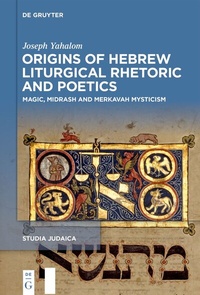
Origins of Hebrew Liturgical Rhetoric and Poetics
Description

This book follows the origins of the Kedushta, a sequence of poems that leads up to the epitome of Jewish prayer, the Kedusha or Sanctus. It tracks back the earliest forms of prayer in late antiquity and by doing so defines the main characteristics of this genre, both from the standpoint of Rhetoric and poetics. This genre draws from Midrash and Mysticism- adjacent literary forms that influence liturgical poetry.
How has such an enigmatic and complex liturgical genre survived the twists and turns of history and is recited to this day, for over 1500 years?
The answer to this question pertains to both form and content. When analyzing form, we address rhyme, alphabetical acrostics, and different poetic forms. Those all have a specific rhetorical function in determining the structure of the poem, pushing it forward, and musically aligning the different segments. The form cannot be detached from narratology, referencing early midrash and mysticism. In addition, the emotional approach of the private prayer can express one's existential pain as part of an oppressed community. We can follow the composition of the prayer book for each community over the ages, through the first millennium, starting with Geniza fragments to the European prayer books. Finally, these poems use of sophisticated etymology, correlation by sound, leads to innovative Medieval interpretation of the Torah.
It seems that the combination of a public recitation, simulating a divine choir, the musicality of the text and emotional depth all contributed to this eternal poetic genre to penetrate cross cutting traditions of prayer throughout the ages.
More details
Other editions
Additional editions
Person
Content
- Intro
- Preface
- Contents
- Chapter I The Hekhalot and the Qedusha
- Chapter II As For Me, My Prayer is to You
- Chapter III Rhyme and Midrash
- Chapter IV Forms determined by Alphabetical Acrostics
- Chapter V Poetic Forms
- Chapter VI Narrative Chronologies
- Chapter VII Rapidly Rolling Rehitim
- Chapter VIII An Oppressed Community's Adaptations
- Chapter IX Liturgical Collections
- Chapter X Adapting Adaptations
- Postscript: The History of Responses to Piyyut
- Bibliography
- Index of Names
