

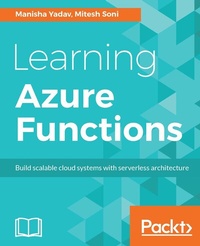
Learning Azure Functions
Build scalable cloud systems with serverless architecture
Published on 13. January 2025
240 pages
978-1-78728-899-7 (ISBN)
Description

No detailed description available for "Learning Azure Functions".
More details
Edition
Digital original
Language
English
Place of publication
Birmingham
United Kingdom
Target group
Professional and scholarly
US School Grade: College Graduate Student
Edition type
Digital original
File size
17,67 MB
ISBN-13
978-1-78728-899-7 (9781787288997)
Copyright in bibliographic data and cover images is held by Nielsen Book Services Limited or by the publishers or by their respective licensors: all rights reserved.
Schweitzer Classification
Other editions
Additional editions
Manisha Yadav | Mitesh Soni
Learning Azure Functions
Book
09/2017
Packt Publishing
€50.60
Shipment within 3-4 weeks
Person
Manisha Yadav is a system engineer. She has worked on Java-based projects, web application projects, and Azure and AWScloud services. She has experience of working with tools such as Jenkins and SonarQube.
She also has work experience on databases such as MYSQL and MongoDB, and frontend technology such as HTML, CSS, JavaScript, and Angular JS.
She loves to explore new cloud services and new technologies.
She loves traveling and spending time with her family. She also likes cooking. Mitesh Soni is an avid learner with 10 years of experience in the IT industry. He is an SCJP, SCWCD, VCP, IBM Urbancode, and IBM Bluemix certified professional, and Certified Scrum Master. He loves DevOps and cloud computing and he also has an interest in programming in Java. He finds design patterns fascinating. He believes a picture is worth a thousand words.
He occasionally contributes to etutorialsworld.com. He loves to play with kids, fiddle with his camera, and take photographs at Indroda Park. He is addicted to taking pictures without knowing many technical details. He lives in the capital of Mahatma Gandhi's home state.
Mitesh has authored the following books with Packt:
Jenkins Essentials, Second Edition
DevOps Bootcamp
Implementing DevOps with Microsoft Azure
DevOps for Web Development
Jenkins Essentials
Learning Chef
She also has work experience on databases such as MYSQL and MongoDB, and frontend technology such as HTML, CSS, JavaScript, and Angular JS.
She loves to explore new cloud services and new technologies.
She loves traveling and spending time with her family. She also likes cooking. Mitesh Soni is an avid learner with 10 years of experience in the IT industry. He is an SCJP, SCWCD, VCP, IBM Urbancode, and IBM Bluemix certified professional, and Certified Scrum Master. He loves DevOps and cloud computing and he also has an interest in programming in Java. He finds design patterns fascinating. He believes a picture is worth a thousand words.
He occasionally contributes to etutorialsworld.com. He loves to play with kids, fiddle with his camera, and take photographs at Indroda Park. He is addicted to taking pictures without knowing many technical details. He lives in the capital of Mahatma Gandhi's home state.
Mitesh has authored the following books with Packt:
Jenkins Essentials, Second Edition
DevOps Bootcamp
Implementing DevOps with Microsoft Azure
DevOps for Web Development
Jenkins Essentials
Learning Chef
Content
- Intro
- Copyright
- Credits
- About the Authors
- About the Reviewers
- www.PacktPub.com
- Customer Feedback
- Dedication
- Table of Contents
- Preface
- Chapter 1: Introducing Microsoft Azure Services and Functions
- An overview of serverless architectures
- Cloud computing and service models
- Cloud computing and its basics
- Serverless computing
- Benefits
- Why Azure Functions?
- An overview of Microsoft Azure Services
- Regions
- Resource groups
- App Services - Microsoft Azure Web Apps
- App Service plan
- Azure Active Directory
- App Insights
- Azure Services versus AzureFunctions versus AWS Lambda
- Summary
- Chapter 2: First Function App - Anatomy and Structure of a Function App
- Anatomy of Azure Functions
- Azure Function App
- Function code
- Function configuration
- Function settings
- Runtime
- Setting up a basic Azure Function
- Summary
- Chapter 3: Application of Triggers
- Common types of triggers
- Example of creating a simple scheduled trigger
- HTTP trigger
- Event hubs
- Service bus
- Summary
- Chapter 4 : Bindings
- Available input and output bindings
- Types of input bindings
- Types of output bindings
- Types of Event Hubs
- Event Hubs
- Example
- Service Bus
- Storage
- Example
- Summary
- Chapter 5: Webhooks for Azure Functions
- Creating a JavaScript function triggered by a Webhook
- Using a Webhook with an Azure Function
- Using an event with an Azure Function
- Summary
- Chapter 6: The Real World - Functions to Build Consumable APIs
- Outlining a project
- Architecting the solution
- Building the project
- Using storage
- Test
- Summary
- Chapter 7: Managing and Deploying your Code
- Projects in VSTS
- Continuous Integration
- Continuous Delivery
- Summary
- Chapter 8: Business Considerations
- Monitoring of Azure Functions
- Integration of Application Insights and Azure Functions
- Pricing/hosting plans
- Best practices
- Summary
- Chapter 9: Working with Different Languages
- The Python Function App
- Example
- The PHP Function App
- Example
- Summary
- Index
