

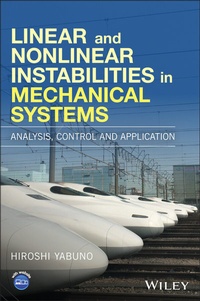
Linear and Nonlinear Instabilities in Mechanical Systems
Description

An in-depth insight into nonlinear analysis and control
As mechanical systems become lighter, faster, and more flexible, various nonlinear instability phenomena can occur in practical systems.
The fundamental knowledge of nonlinear analysis and control is essential to engineers for analysing and controlling nonlinear instability phenomena. This book bridges the gap between the mathematical expressions of nonlinear dynamics and the corresponding practical phenomena. Linear and Nonlinear Instabilities in Mechanical Systems: Analysis, Control and Application provides a detailed and informed insight into the fundamental methods for analysis and control for nonlinear instabilities from the practical point of view.
Key features:
* Refers to the behaviours of practical mechanical systems such as aircraft, railway vehicle, robot manipulator, micro/nano sensor
* Enhances the rigorous and practical understanding of mathematical methods from an engineering point of view
* The theoretical results obtained by nonlinear analysis are interpreted by using accompanying videos on the real nonlinear behaviors of nonlinear mechanical systems
Linear and Nonlinear Instabilities in Mechanical Systems is an essential textbook for students on engineering courses, and can also be used for self-study or reference by engineers.
More details
Other editions
Additional editions
Person
HIROSHI YABUNO is Professor of Mechanical Engineering at University of Tsukuba in Japan. In 1990, he attained his Ph.D. in Engineering from Keio University, Japan and was appointed Professor at Keio University. He was a Visiting Scholar at the Virginia Polytechnic Institute and State University in 1997 and, in 2002 and 2008, he was a Visiting Professor at the University of Rome "La Sapienza". He was also Chair of Working Party II (Dynamical Systems and Mechatronics) of IUTAM. He is an associate editor of international journals including Journal of Computational and Nonlinear Dynamics (ASME), Nonlinear Dynamics, Journal of Vibration and Control, and International Journal of Dynamics in Various Mechanical Systems and Control. His research interests include analysis and control of nonlinear dynamics and positive utilization of the nonlinear instability phenomena to mechanical systems in particular, micro/nano resonators.
Content
Preface 1
References 8
1 Equilibrium States and their Stability 11
1.1 Equilibrium states 11
1.1.1 Spring-mass system 12
1.1.2 Magnetically levitated system 16
1.1.3 Simple pendulum 20
1.2 Work and potential energy 23
1.3 Stability of the equilibrium state in conservative systems 27
1.4 Stability of mechanical systems 29
1.4.1 Stability of spring-mass system 29
1.4.2 Stability of magnetically levitated system 31
1.4.3 Pendulum 32
1.4.4 Stabilization control of magnetically levitated system 32
References 34
2 Linear Dynamical Systems 35
2.1 Vector field and phase space 35
2.2 Stability of equilibrium states 40
2.3 Linearization and local stability 41
2.4 Eigenvalues of linear operators and phase portraits in a single-degree-offreedom system 44
2.4.1 Description of the solution by matrix exponential function 44
2.4.2 Case with distinct eigenvalues 45
2.4.3 Case with repeated eigenvalues 49
2.4.4 Case with complex eigenvalues 54
2.5 Invariant subspaces 60
2.6 Change of stability due to the variation of system parameters 61
References 67
3 Dynamic Instability of Two-Degree-of-Freedom-Systems 69
3.1 Positional forces and velocity-dependent forces 69
3.2 Total energy and its time-variation 71
3.2.1 Kinetic energy 71
3.2.2 Potential energy due to conservative force FK 72
3.2.3 Effect of velocity dependent damping force FD 76
3.2.4 Effect of circulatory force FN 78
3.2.5 Effect of gyroscopic force FG 81
References 83
4 Modal Analysis of Systems Subject to Conservative and Circulatory Forces 85
4.1 Decomposition of the matrix M 86
4.2 Characteristic equation and modal vector 89
4.3 Modal analysis in case without circulatory force 90
4.4 Modal analysis in case with circulatory force 97
4.4.1 Case study 1: _i are real 100
4.4.2 Case study 2: _i are complex 103
4.5 Synchronous and nonsynchronous motions in a fluid-conveying pipe (video) 114
References 115
5 Static Instability and Practical Examples 117
5.1 Two-link model for a slender straight elastic rod subject to compressive forces 117
5.1.1 Static instability due to compressive forces 117
5.1.2 Effect of a spring attached in the longitudinal direction 122
5.2 Spring-mass-damper models in MEMS 125
5.2.1 Comb-type MEMS actuator devices 125
5.2.2 Cantilever-type MEMS switch 129
References 131
6 Dynamic Instability and Practical Examples 135
6.1 Self-excited oscillation of belt-driven mass-spring-damper system 135
6.2 Flutter of wing 139
6.2.1 Static destabilization in case when the mass center is located in front of the elastic center 145
6.2.2 Static and dynamic destabilization in case when the mass center is located behind the elastic center 146
6.3 Hunting motion in a railway vehicle 149
6.4 Dynamic instability in Jeffcott rotor due to internal damping 161
6.4.1 Fundamental rotor dynamics 161
6.4.2 Effects of the centrifugal force and the Coriolis force on static stability 166
6.4.3 Effect of external damping 170
6.4.4 Dynamics instability due to internal damping 174
6.5 Dynamic instability in fluid-conveying pipe due to follower force 178
References 180
7 Local Bifurcations 183
7.1 Nonlinear analysis of a two-link-model subjected to compressive forces 184
7.1.1 Nonlinearity of equivalent spring stiffness 184
7.1.2 Equilibrium states and their stability 186
7.2 Reduction of dynamics near a critical point 190
7.3 Pitchfork bifurcation 196
7.4 Other codimension one bifurcations 197
7.4.1 Saddle-node bifurcation 197
7.4.2 Transcritical bifurcation 199
7.4.3 Hopf bifurcation 200
7.5 Perturbation of pitchfork bifurcation 204
7.5.1 Bifurcation diagram 204
7.5.2 Analysis of bifurcation point 207
7.5.3 Equilibrium surface and bifurcation diagrams 209
7.6 Effect of Coulomb friction on pitchfork bifurcation 211
7.6.1 Linear analysis 212
7.6.2 Nonlinear analysis 214
7.7 Nonlinear characteristics of static Instability in spring-mass-damper models of MEMS 217
7.7.1 Pitchfork bifurcation in comb-type MEMS actuator device 218
7.7.2 Saddle-node bifurcation in MEMS switch 220
References 222
8 Reduction Methods of Nonlinear Dynamical Systems 225
8.1 Reduction of the dimension of state space by center manifold theory 226
8.1.1 Nonlinear stability analysis at pitchfork bifurcation point 226
8.1.2 Reduction of nonlinear dynamics near bifurcation point 229
8.2 Reduction of degree of nonlinear terms by the method of normal forms 233
8.2.1 Reduction by nonlinear coordinate transformation: Method of normal forms 233
8.2.2 Case in which the linear part has distinct real eigenvaules 235
8.2.3 Nonlinear term remaining in normal form 238
8.2.4 Reduction in the neighborhood of Hopf bifurcation point 240
References 246
9 Method of Multiple Scales 247
9.1 Spring-mass system with small damping 248
9.2 Introduction of multiple time scales 251
9.3 Method of multiple scales 253
9.4 Slow time scale variation of amplitude and stability of periodic solutions 256
References 256
10 Nonlinear Characteristics of Dynamic Instability 259
10.1 Effect of nonlinearity on dynamic instability due to negative damping force 260
10.1.1 Cubic nonlinear damping (Rayleigh type and van der Pol type) 260
10.1.2 Self-excited oscillation produced through Hopf bifurcation 261
10.1.3 Self-excited oscillation by linear feedback and its amplitude control by nonlinear feedback 269
10.2 Effect of nonlinearity on dynamic instability due to circulatory force 271
10.2.1 Derivation of amplitude equations by solvability condition 272
10.2.2 Effect of cubic nonlinear stiffness on steady state response 278
References 281
11 Parametric Resonance and Pitchfork Bifurcation 283
11.1 Parametric resonance of vertically-excited inverted pendulum 284
11.1.1 Equation of motion 284
11.2 Dynamics in case without excitation 285
11.2.1 Dimensionless equation of motion subject to vertical excitation 286
11.2.2 Trivial equilibrium state and its stability 290
11.2.3 Nontrivial steady state amplitude and its stability 291
References 295
12 Stabilization of Inverted Pendulum under High-Frequency Excitation 297
12.1 Equation of motion 298
12.2 Analysis by the method of multiple scales 299
12.2.1 Scaling of some parameters 299
12.2.2 Averaging by the method of multiple scales 300
12.3 Bifurcation analysis of inverted pendulum under high-frequency excitation 302
12.3.1 Subcritical pitchfork bifurcation and stabilization of inverted pendulum 302
12.3.2 Global stability of equilibrium states 305
12.4 Experiments 307
12.5 Effects of the excitation direction on the bifurcation 308
12.5.1 Averaging by the method of multiple scales 309
12.5.2 Excitation inclined from the vertical direction and perturbed subcritical pitchfork bifurcation 310
12.5.3 Supercritical pitchfork bifurcation in horizontal excitation and its perturbation due to inclination of the excitation direction 311
12.6 Stabilization of statically unstable equilibrium states by high-frequency excitation 311
References 312
13 Self-excited Resonator in Atomic Force Microscopy (Utilization of Dynamic Instability) 315
13.1 Principle of frequency modulation atomic force microscope (FM-AFM) 316
13.2 Detection of frequency shift based on external excitation 322
13.3 Detection of frequency shift based on self-excitation 325
13.4 Amplitude control for self-excited microcantilever probe 327
References 328
14 High-Sensitive Mass Sensing by Eigenmode Shift 331
14.1 Conventional mass sensing by frequency shift of resonator 332
14.2 High-sensitive mass sensing by coupled resonators 333
14.3 Solution of equations of motion 335
14.4 Mode shift due to measured mass 336
14.5 Experimental detection methods for mode shift 337
14.5.1 Use of eternal excitation 338
14.6 Use of self-excitation 339
References 344
15 Motion Control of Underactuated Manipulator without State Feedback Control 345
15.1 What is an underactuated manipulator 345
15.2 Equation of motion 346
15.3 Averaging by the method of multiple scales and bifurcation analysis 348
15.4 Motion control of free link 352
15.5 Experimental results 354
References 355
16 Experimental Observations 359
16.1 Experiments of a single degree-of-freedom system (Chapters 2 and 6) 359
16.1.1 Stability of spring-mass-damper system depending on the stiffness k and the damping c 359
16.1.2 Self-excited oscillation of a window shield wiper blade around the reversal 362
16.2 Buckling of a slender beam under a compressive force 362
16.2.1 Observation of pitchfork bifurcation (sections 5.1 and 7.1) 362
16.2.2 Observation of perturbed pitchfork bifurcation (section 7.5) 363
16.2.3 Effect of Coulomb friction on pitchfork bifurcation (section 7.6) 364
16.3 Hunting motion of a railway vehicle wheelset (section 6.3) 365
16.4 Stabilization of hunting motion by gyroscopic damper (section 6.3) 367
16.5 Self-excited oscillation of fluid-conveying pipe (section 6.5) 368
16.6 Realization of self-excited oscillation in a practical cantilever (section 10.1.3) 369
16.7 Parametric resonance (Chapter 11) 373
16.8 Stabilization of an inverted pendulum under high-frequency vertical excitation (Chapter 12) 374
16.9 Self-excited coupled cantilever beams for ultrasensitive mass sensing (section 14.6) 375
16.10Motion control of an underactuated manipulator by bifurcation control (Chapter 15) 375
References 376
A Cubic Nonlinear Characteristics 379
A.1 Symmetric and nonsymmetric nonlinearities 380
A.2 Nonsymmetric nonlinearity due to the shift of the equilibrium state 381
A.3 Effect of harmonic external excitation 383
B Nondimensionalization and Scaling Nonlinearity 385
B.1 Nondimensionalization of equations of motion 385
B.2 Scaling of nonlinearity 389
B.3 Nondimensionalization of the governing equation of a nonlinear oscillator 391
B.4 Effect of harmonic external excitation 392
References 394
C Occurrence Prediction for Some Types of Resonances 395
C.1 Dynamics of a linear spring-mass-damper system subject to harmonic external excitation 396
C.1.1 Case with viscous damping 396
C.1.2 Case under no viscous damping 399
C.2 Occurrence prediction of some types of resonances in a nonlinear springmass-damper system 401
References 405
D Order Estimation of Responses 407
D.1 Order symbol 407
D.2 Asymptotic expression of solution 408
D.3 Linear oscillator under harmonic external excitation 409
D.3.1 Non-resonant case 410
D.3.2 Resonant case 411
D.3.3 Near-resonant case 411
D.4 Cubic nonlinear oscillator under external harmonic excitation 412
D.4.1 Large damping case ( = O(1)) 412
D.4.2 Relatively small damping case ( = O(_2=3)) 413
D.4.3 Small damping case ( = O(_)) 414
D.5 Linear oscillator with negative damping 415
D.6 Van der Pol oscillator 416
D.6.1 Large response case (_0(_) = 1) 417
D.6.2 Small but finite response case (_0(_) = o(1)) 417
D.7 Parametrically excited oscillator 418
D.7.1 Large damping case ( = O(1)) 419
D.7.2 Small damping case ( = O(_)) 420
D.7.3 Case with cubic nonlinear component of restoring force 422
D.7.4 Near-resonant case 423
References 425
E Free Oscillation of Spring-Mass System under Coulomb Friction and its Dead Zone 427
E.1 Characteristics of friction 427
E.2 Free oscillation under Coulomb friction 429
E.3 Variation of the final rest position with decrease in the stiffness 434
References 436
F Projection by Adjoint Vector 439
G Solvability Condition 441
G.1 Kernel and image of linear transformation 441
G.2 Solvability condition 443
H Effect of Contact Force on the Dynamics of Railway Vehicle Wheelset 451
H.1 A slip at the contact point of rolling disk on a plane 452
Preface
Mechanical systems have been often analyzed using linearized mathematical models in order to obtain the solution through the application of the well-established linear theory. As they become lighter, faster, and more flexible, the systems are easily enforced in a nonlinear regime. The linearized mathematical models and the linear theoretical analysis have turned out to be not applicable for the complete interpretation and description of the complex dynamics produced by nonlinear effects. In such a context, the aim of this book is to provide fundamental methods for analyzing nonlinear instability phenomena as well as linear instability ones. Additional relevant goals of this book are to seek positive exploitations of nonlinear effects to develop innovative high-performance mechanical systems, to gain insights into the physical meaning (phenomenological understanding) of analytical results obtained by mathematical procedures as well as the dynamical systems theory (Thompson and Stewart (2002)) through real phenomena observation. The mathematical descriptions and the consequent interpretation of linear and nonlinear instability phenomena from a physical point of view are emphasized throughout this book for engineering applications of the dynamical systems theory. For each subject discussed in the book, several videos showing the real instability phenomena produced in mechanical systems are supplied to bridge the theoretical results and the corresponding phenomena.
Key properties of linear systems are (i) the principle of superposition from a mathematical point of view and (ii) the uniqueness of the equilibrium state from a physical point of view. In single-degree-of-freedom conservative systems, since the potential energy curve is expressed by a quadratic function with respect to the displacement and has only one extremum, it indicates that there is only one equilibrium state. In nonlinear systems, there can exist multiple equilibrium states, and the number of such equilibrium states may be changed by acting on the system parameters, according to the so called control parameter in the dynamical systems theory. A linearized spring-mass-damper system in resonance - subject to an external or forced periodic excitation-exhibits a response amplitude determined by the magnitude of the damping effect since the inertia and restoring forces are cancelled out each other. Thus, the applied excitation balances the remaining force, that is, the damping effect. On the other hand, the occurrence of self-excited oscillation due to negative damping can be theoretically predicted from the linearized mathematical model, but the theoretical result shows that the amplitude infinitely grows with time. This result is caused by the fact that there is no term balancing the negative damping effect because of the above cancellation of the inertia and restoring forces. In the situation when the amplitude becomes not so small after the growth, the nonlinear effects neglected in linearization of the mathematical model turn out to affect the dynamics. Therefore, to elucidate the behavior in the nonlinear regime, accounting for the nonlinear effects on the mathematical model and the nonlinear analysis is essential, and the finite response amplitude can be realized by the balance of the negative damping force to the nonlinear effects. Such phenomena other than self-excited oscillation occur in a variety of practical systems as described in literature (for example, Lacarbonara (2013); Nayfeh and Mook (2008); Shaw and Balachandran (2008); Thompson and Stewart (2002); Thomsen (2003); Troger and Steindl (2012)) and include buckling and parametric excitation, which are dealt with in this book. While the critical load to produce buckling is obtained by the linear analysis in the linearized model, the postbuckling state, i.e. the state in the case when the compressive force is above the critical load, is obtained by nonlinear analysis in the nonlinear mathematical model. Similarly, in parametric resonance, only the resonance region with respect to excitation frequency and amplitude is obtained by the linear analysis of the linearized mathematical model, whereas in order to obtain the steady-state amplitude after the growth of response amplitude, nonlinear analysis has to be carried out for the mathematical model accounting for the nonlinear effects.
To conduct the nonlinear analysis, mathematical models with different accuracy are introduced depending on the behavior of interest. For example, let us consider the motion of a pendulum (Meirovitch 1975). The restoring force due to gravity is proportional to , where is the angle of the pendulum. Taylor expansion of is . If only the behavior at small amplitudes is of interest, since the nonlinear terms with respect to can be truncated, the linearization of is suitable. On the other hand, in the analysis of the rotary motion, no approximation is applicable. Furthermore, in the analysis of parametric resonance produced by the periodically vertical excitation, at least the cubic nonlinear term in addition to the linear term is kept in the mathematical model, as mentioned in Chapter 11 for detail. Dynamical behaviors often consist of components changing with different time scales. A familiar example of coexisting time scales is the resonance in a linear spring-mass-damper system subject to external excitation mentioned above. The time history of the response is characterized by the rapid periodic oscillation with the same frequency as the excitation frequency and the growth of the amplitude, which can be regarded as the fast and slow dynamics, respectively. The slow dynamics often reveal directly the essential characteristics of system dynamics as stability. The equations governing the slow dynamics, which is also called amplitude equation, can be extracted from the equations of the original system through singular perturbation methods as the method of multiple scales dealt with in Chapter 9. This can be regarded as a reduction method for the original dynamics while another reduction is the center manifold reduction (Chapter 8), in which the lower dimensional system is approximately obtained in the neighborhood of the critical condition of stability by focusing on the subspaces classified by the difference of flow speed. Based on the special strategies mentioned above, this book provides analytical approaches for linear and nonlinear instability phenomena. This book consists of the following chapters, which are related as shown in the "Reading Paths of the Chapters" and the level is advanced step by step and straightforward.
- From Chapters 1 through 4, to prepare the reader understanding the nonlinear analysis, the underlying linear theory is sufficiently treated so as to smoothly lead to the nonlinear theory in subsequent chapters. Chapter 1 introduces the definitions of equilibrium states and their stability as some of the most important concepts to analyze dynamical systems. Chapter 2 is devoted to the analysis of linear dynamical systems and clarifies the local stability of equilibrium states by relating it to the eigenvalues of the linear operator. Chapters 3 and 4 present the linear stability of nonconservative systems due to circulatory force and mathematically characterize the mechanism to produce the self-excited oscillation using the nonorthogonality of each modal vector.
- Chapter 5 discusses static instabilities based on the linear theory introduced in Chapters 1 and 2. Through the static unstable dynamics of a two-link model for a slender straight elastic rod subject to compressive force and spring mass damper models representing MEMS (Micro-Electro-Mechanical Systems) actuator and switch, the mathematical descriptions of the static instabilities are interpreted from a physical point of view showing how they are obtained by linear analysis of the linearized models. In some conditions, linear analysis results in unacceptable phenomena from a physical point of view and the necessity of nonlinear analysis to a suitable nonlinear mathematical model is indicated.
- Chapter 6 is concerned with dynamic instabilities. First, we deal with a belt-driven mass-spring-damper system. The produced dynamics instability is caused by a negative damping characteristic due to the Coulomb friction between belt and mass. In the remaining part of the chapter, the dynamic instabilities of a wing, a railway vehicle, a rotor, and a fluid-conveying pipe are introduced. The resonance mechanisms caused by the circulatory forces are clarified based on the theory of Chapters 3 and 4.
- Chapter 7 introduces local bifurcations that are produced in the neighborhood of the trivial equilibrium state. It is analytically shown, by taking into account the effects of nonlinearity in a system, that, as the parameters in the system are varied, the stability of equilibrium states may be changed or the equilibrium states may be created or destroyed. Such changes depending on the parameters are called bifurcations. The newly generated equilibrium states created by nonlinear effects often solve the unacceptable phenomena obtained by the linear theory.
- Chapter 8 is devoted to reduction methods of nonlinear dynamical systems. By using center manifold theory, the decrease of the dimension is achieved. By using a nonlinear coordinate transformation, the nonlinear terms in the original nonlinear dynamical system are eliminated as many as possible to obtain a reduced equivalent dynamical system.
- Chapter 9 deals with the method of multiple scales as one of singular perturbation...
