

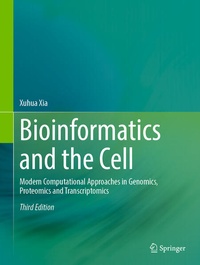
Bioinformatics and the Cell
Description

This thoroughly updated third edition integrates the more technical and mathematical aspects of bioinformatics with concrete examples of their application to current research problems in molecular, cellular, and evolutionary biology. This broad, unified approach is made possible, in large part, by the very wide scope of Dr. Xia's own research experience. The integration of genomics, proteomics, and transcriptomics into a single volume makes this book required reading for anyone entering the new and emerging fields of Systems Biology and Evolutionary Bioinformatics. In particular, this book should appeal to biologists, as well as mathematicians, biostatisticians, and computational scientists, especially those with an ambition to conquer the rough terrain of computational molecular biology. The new integration solidifies the foundation of bioinformatics as the computational framework for advancing our understanding of the regulation and optimization of the three essential biological processes shared among all forms of life: genome replication, transcription, and translation.
More details
Other editions
Additional editions
Person
Dr. Xuhua Xia obtained his PhD in population biology at the University of Western Ontario in 1990 and ventured into the field of molecular evolution and phylogenetics at the University of Washington in 1993. He joined the University of Hong Kong in 1996 as an assistant professor and served as a senior scientist and the founding head of the Bioinformatics Laboratory of HKU-Pasteur Research Centre in 2001. Dr. Xia moved to the University of Ottawa in 2002, where he is a full professor in the Department of Biology. He served as an associate editor for Molecular Biology and Evolution from 2012 to 2025 and is an active member in the Ottawa Institute of Systems Biology.
Content
BLAST FASTA and String Mathematics.- Sequence alignment.- Position weight matrix and Perceptron.- Gibbs sampler and de novo motif discovery.- Transcriptomic characterization of gene expression.- Splicing efficiency and alternative splicing.- Algorithms for characterizing regulons.- Hidden Markov Model and its biological applications.-Bioinformatics and Translation Initiation.- Bioinformatics and Translation Elongation.- Bioinformatics and Translation Termination.- Bioinformatic characterization of genomes and epigenomes.- Fundamentals of Proteomics.- Protein functions and gene ontology.- Protein Isoelectric Point and Helicobacter pylori.- Identification of posttranslational modifications.-Introduction to molecular phylogenetics.
