

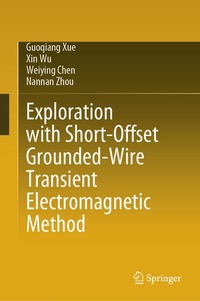
Exploration with Short-Offset Grounded-Wire Transient Electromagnetic Method
Description

This book provides an introduction to the forward and inverse modeling, information extraction techniques, and applications of the Short Offset Transient Electromagnetic Method (SOTEM). It highlights the effectiveness of this method in various sectors, including metallic mines, coal mines, and engineering, showcasing its success across multiple mining regions. The book serves as a reference for both professionals and graduate students working at geophysical electromagnetic field and its related area.
The basis of English translation of this book, originally in Chinese, was facilitated by artificial intelligence. The content was later revised by the author for accuracy.
More details
Other editions
Additional editions
Persons
Guoqiang Xue, is a researcher at the Institute of Geology and Geophysics, Chinese Academy of Sciences, a professor at the University of Chinese Academy of Sciences, and the director of the Earth Detection and Information Technology Research Office at the College of Earth Sciences. His primary research focus is on the theory and application of transient electromagnetic detection. He has established near-field detection theory for transient electromagnetic methods, proposed the Short Offset Transient Electromagnetic Method (SOTEM), developed a fine detection equipment system for electrical source transient electromagnetic methods, and created technologies for efficient noise removal based on deep learning, imaging of subsurface interfaces, and constrained imaging of electrical structures. He serves as the associate editor for several journals. He has published 162 SCI papers (47 as first author and 52 as corresponding author), with approximately 3,225 citations, and holds 75 authorized patents, including 7 US patents and 19 Chinese patents (as the first inventor). He has received numerous awards, including the National Science and Technology Progress Award (Second Class), the Chinese Academy of Sciences Outstanding Achievement Award.
Content
Chapter 1: Introduction.- Chapter 2: Mechanism and theory of SOTEM.- Chapter 3: 3D forward modeling.- Chapter 4: Data inversion.- Chapter 5: IP effect and information extraction.- Chapter 6: Machine learning in EM data processing.- Chapter 7: Equipment of SOTEM method.- Chapter 8: Case studies.- Chapter 9: Prospection.
