

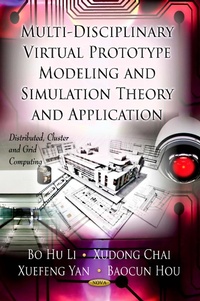
Multi-Disciplinary Virtual Prototype Modeling and Simulation Theory and Application
Published on 7. January 2019
301 pages
978-1-62100-371-7 (ISBN)
Description

The research of modeling and simulation has made great progress during the past few decades. A number of institutions and scholars from various domains have proposed different modeling theories and simulation technologies. Great variety and diversity tools and commercial software, which are mainly oriented to specific single-discipline, are rushing out and being applied in their own fields successfully. Multi-discipline virtual prototype has been applied in a wide range of engineering applications, especially the design, testing and evaluation of complex product. The growing complexity of the product and simulation system, as well as the user requirement, bring many challenges to modeling and simulation. This book examines the major theories and methods involved in modeling, simulation, optimization, evaluation and application of multi-discipline virtual prototype, based on component oriented thinking.
More details
Other editions
Additional editions
Xudong Chai | Baocun Hou | Bo Hu Li
Multi-Discipline Virtual Prototype Modeling & Simulation Theory & Application
Book
03/2012
Nova Science Publishers Inc
€289.68
Shipment within 15-20 days
Content
- Intro
- MULTI-DISCIPLINARY VIRTUALPROTOTYPE MODELING ANDSIMULATION THEORYAND APPLICATION
- MULTI-DISCIPLINARY VIRTUALPROTOTYPE MODELING ANDSIMULATION THEORYAND APPLICATION
- CONTENTS
- PREFACE
- ACKNOWLEDGMENTS
- FOREWORD
- Chapter 1INTRODUCTION
- ABSTRACT
- 1.1. INTRODUCTION
- 1.2. COMPLEX PRODUCT
- 1.3. THE COMPLEX PRODUCT VIRTUALPROTOTYPING TECHNOLOGY
- 1.4. COMPLEX PRODUCTS VIRTUAL PROTOTYPE ENGINEERING
- 1.5. THE TECHNOLOGIES INVOLVED IN COMPLEX PRODUCTVIRTUAL PROTOTYPE ENGINEERING
- 1.5.1. The General Technology of Virtual Prototype
- 1.5.2. The Modeling Technology of Virtual Prototype
- 1.5.3. Collaborative Simulation
- 1.5.4. Management Technology of Virtual Prototype
- 1.5.5. The Conceptual Design and Argumentation of Virtual Prototype
- 1.5.6. Virtual Reality
- 1.5.7. Verification, Validation and Accreditation (VV&A) of VirtualPrototype
- 1.5.8. Integrated Platform of Virtual Prototype
- 1.5.9. Current Research Hotspots
- 1.6. RELATED APPLICATIONS OF COMPLEX PRODUCTVIRTUAL PROTOTYPE
- (1) BMW
- (2) Volkswagen
- The Application in Ergonomic Research
- The Application in Surface Detection of the Car
- Diagnosis of the Car
- Assembly/Disassembly Simulation for the Manufacturing and Maintenance ofthe Automotive
- (3) EDO Marine and Aircraft Systems (EDO)
- 1.7. CHALLENGES OF COMPLEX PRODUCT VIRTUAL PROTOTYPEMODELING AND SIMULATION
- 1. Unified Modeling and Reusing of Heterogeneous Multi-DisciplinaryModels
- 2. Collaborative Simulation of Distributed, Hierarchical and HeterogeneousModels
- 2. Life-Cycle Support throughout the R&D Process of Complex Product
- CONCLUSION
- REFERENCES
- Chapter 2BASIC THEORY OF MULTI-DISCIPLINARY VIRTUALPROTOTYPE MODELING AND SIMULATION
- ABSTRACT
- 2.1. INTRODUCTION
- 2.2. RELATED RESEARCH AND DEVELOPMENT
- 2.2.1. Multi-Disciplinary Virtual Prototype Modeling Theory and Method
- 1. Direct Modeling Methods Based on the Structure and Behavior of the PhysicalSystems
- 2. Modeling According to the Continuous/Discrete Characteristics of the System
- 3. Modeling Based on Causal Relationship between the Internal Factors and Variables
- 4. Modeling Based on the Design Thinking of Software
- 2.2.2. Multi-Disciplinary Virtual Prototype Collaborative SimulationTechnology
- 1. Simulation Interoperability
- 2. Sharing and Reuse of Models
- Reuse of Professional Models Based on MDA
- Reuse Based on Software Technology
- Domain-Oriented Sharing and Reuse for Specific Professional Field
- New Concept of Sharing Based on Grid and Service
- 3. Modularized Simulation
- 2.2.3. Summary of the Research
- 2.3. PRIMARY PRINCIPLE OF COSIM
- 2.3.1. Metaphor
- 2.3.2. The Proposal of COSIM
- 2.3.3. The Content of COSIM
- 2.4. HIERARCHICAL MODEL FRAMEWORK OF M2F
- 2.4.1. Hierarchical M2F
- 2.4.2. Meta-Meta Model Layer: CAP Model
- 2.4.3. Meta Model Layer: CIM Model
- 2.4.4. Model Layer: High-Level Model, HLM
- 2.4.5. The Self-Nested Feature of High-Level Model
- 2.5. THE ARCHITECTURE OF COSIM
- 2.5.1. M2F: a Hierarchical Model Framework
- 2.5.2. High-Level Modeling Theory
- 2.5.3. Collaborative Simulation Technology
- 2.5.4. Multi-Disciplinary Optimization Technology
- 2.5.5. Engineering Methodology of Multi-Disciplinary Virtual Prototype
- CONCLUSION
- REFERENCES
- Chapter 3HIGH-LEVEL MODELING THEORY
- ABSTRACT
- 3.1. INTRODUCTION
- 3.1.1. Overview of Heterogeneous System Modeling Strategy
- 3.1.1.1. Modeling Based on Multi-Domain Unified Modeling Language
- 3.1.1.2. Modeling Based on Formalism Transformation
- 3.1.1.3. Modeling Based on Integration of Multi-Domain Simulation Software
- 3.1.1.4. Modeling Based on General Conceptual Specification
- 3.1.2. System Modeling Based on Meta-Model
- 3.2. HIGH-LEVEL MODELING THEORY
- 3.2.1. Basic Rules of High-Level Modeling
- 3.2.2. The Factors of High-Level Modeling
- 3.2.2.1. Basic Factors
- 3.2.2.1.1. The Interface
- 3.2.2.1.2. State and Its Transition
- 3.2.2.1.3. Coupling
- 3.2.2.1.4. Interaction Situation
- 3.2.2.2. Element Model
- 3.2.2.3. Composition Model
- 3.2.3. Hierarchy and Self-Nested Feature of High-Level Model
- 3.2.3.1. Hierarchy Coupling of Simulation Component Models
- 3.2.3.2 Hierarchical States and their Transformation of Simulation Component Models
- 3.2.3.3. The Self-Closed Feature of Composition Component Model
- 3.2.4. The Static Structure and Dynamic Behavior
- 3.2.4.1. The View of Static Structure and Dynamic Behavior
- 3.2.4.2. The Matched Static Structure and Dynamic Behavior
- 3.3. COSIM MODELING PLATFORM
- 3.3.1. Graphic Primitives of the Static Structure Model
- 3.3.2. Graphic Primitives of the Dynamic Behavior Model
- 3.2.3. Component Model Interface Specification
- 3.4. APPLICATION: THE LANDING GEAR VIRTUAL PROTOTYPE
- CONCLUSION
- REFERENCES
- Chapter 4COLLABORATIVE SIMULATION OFMULTI-DISCIPLINARY VIRTUAL PROTOTYPE
- ABSTRACT
- 4.1. INTRODUCTION
- 4.1.1. Simulation for the Specific Professional Field
- 4.1.2. Collaborative Simulation of Homogeneous Models
- 4.1.3. Collaborative Simulation Based on Software Interface and Middleware
- 4.2. THE PRIMARY CONNOTATION OF COLLABORATIVESIMULATION OF MVP
- 4.2.1. Conception of Collaborative Simulation of MVP
- 4.2.2. Features of MVP Collaborative Simulation
- 4.2.3. The Integration and Interoperability of Heterogeneous Compositioncomponent
- 4.3. COLLABORATIVE SIMULATION OF MULTI-DISCIPLINARYVIRTUAL PROTOTYPE
- 4.3.1. Primary Coverage of Collaborative Simulation
- 4.3.1.1. Collaborative Execution of the Simulation Component
- 4.3.1.2. Principal Services of the Collaborative Simulation
- Component management
- Coupling management
- Time Management
- Behavior Management
- Experiment management
- 4.3.1.3. Relationship of Principal Services of the Collaborative Simulation
- 4.3.2. Component Management
- 4.3.2.1. The Fundamental Principles of Component Management
- 4.3.2.2. The Services of Component Management
- (1) Element component loading service
- (2) Component information service
- (3) Running control service
- Running service
- Stopping service
- 4.3.3. Coupling Management
- 4.3.3.1. The Fundamental Principle of Coupling Management
- (1) The effective port-based coupling
- (2) The hierarchy of coupling management
- (3) Hierarchical management of static structure and dynamic information transmission
- 4.3.3.2. The Services of Coupling Management
- (1) Management service of static connection relationship
- (2) Inquiry service of interaction situation
- (3) Information transmission service
- 4.3.4. Time Management
- 4.3.4.1. The Fundamental Principles of Time Management
- (1) Basic concepts
- (2) Unified time advancement of heterogeneous simulation components
- (3) Hierarchical simulation time management mechanism
- The next allowed time of the system
- 4.3.4.2. The Services of Time Management
- (1) Time parameter configuration service
- (2) The next time calculation command
- (3) The next time reporting
- (4) The next time calculating
- (5) Time advance grant service
- 4.3.5. Behavior Management Service
- 4.3.5.1. The fundamental Principles of Behavior Management
- 4.3.5.2. Composition Component State Maintenance
- 4.3.5.3. Information Transmission Scheduling
- 4.3.5.4. Behavior Scheduling
- 4.3.5.5. The Services of Behavior Management
- 4.3.5.6. Maintaining the Component State
- 4.3.5.7. Information transmission
- 4.3.5.8. Component Scheduling
- (1) Scheduling of Serial coupling
- (2) Scheduling of branched structure
- (3) Scheduling of the merged structure
- (4) Scheduling of cyclic coupling
- (5) Hierarchical scheduling
- 4.3.5.9. The Internal Functions of Behavior Management
- 4.3.6. Experiment Management
- 4.3.6.1. The Fundamental Principles of Experiment Management
- 4.3.6.2. The Services of Experiment Management
- (1) Simulation experiment creation service
- (2) Simulation experiment configuration service
- (3) Simulation experiment control service
- (4) Simulation component running control service
- (5) Simulation experiment destruction service
- 4.4. MULTI-DISCIPLINARY COLLABORATIVE SIMULATION
- 4.4.1. Concept of Simulation Engine
- 4.4.2. The Execution of the Simulation Engine
- 4.4.3. The Service interfaces of the Simulation Engine
- 4.5. INTEGRATING COMMERCIAL OFF-THE-SHELF SIMULATIONSOFTWARE ON COSIM
- 4.5.1. Integration Methods of Simulation Software
- 4.5.1.1. Integration of Process-Based Discipline Simulation Software
- 4.5.1.2. Integration of Real-Time Interactive Software
- 4.5.1.3. Related Integration Examples
- 4.5.1.3.1. Integration Capability of MSC EASY5
- 4.5.3.1.2. Integration EASY5 Based on Document Exchange
- 4.5.1.3.3. Integration EASY5 Based on Second Development Interface
- 4.5.1.3.4. Indirect Integration of EASY5 through MATLAB
- 4.5.1.3.5. Analysis and Comparison of the Integration Approaches
- 4.5.2. Integration Process of Multi-Disciplinary Software on COSIM
- 4.5.2.1. The Necessary Functionality of Integration
- 4.5.2.2. Solving Engine Control and Schedule
- 4.5.2.3. Intermediate State Process
- 4.5.2.4. Input/Output Data Exchange
- 4.5.2.5. Interface Specification of the Adapter
- 4.5.2.6. The Architecture of the Adapter
- 4.6. COLLABORATIVE SIMULATION OFLANDING GEAR VIRTUAL PROTOTYPE
- CONCLUSION
- REFERENCES
- Chapter 5OPTIMIZATION OF MULTI-DISCIPLINARYVIRTUAL PROTOTYPE
- ABSTRACT
- 5.1. INTRODUCTION
- 5.1.1. Analysis of Multi-Disciplinary Virtual Prototype Optimization
- 5.1.2. Optimization Technology
- (1) Approximate Method of Optimization
- (2) Decomposition-Coordination Technique
- (3) Sensitivity Analysis
- (4) Optimization Algorithm
- 5.1.3. Related Research and Application
- 5.2. DEFINITION AND DESCRIPTION OF MULTI-DISCIPLINARYVIRTUAL PROTOTYPE OPTIMIZATION
- 5.2.1. Related Definition
- 5.2.2. Mathematical Description of Multi-Disciplinary Virtual PrototypeOptimization
- 5.2.3. Formal Description of Multi-Disciplinary Virtual PrototypeOptimization
- 5.3. OPTIMIZATION MODEL OF MULTI-DISCIPLINARYVIRTUAL PROTOTYPE
- 5.3.1. Single-Layer Optimization Model
- 5.3.1.1. Framework of Single-Layer Optimization
- 5.3.1.2. Description of Single-Layer Optimization Based on M2F
- 5.3.2. Multi-Layer Optimization Model
- 5.3.2.1. Framework of Multi-Layer Optimization
- 5.3.2.2. New Multi-Layer Optimization Frameworks of Multi-Disciplinary VirtualPrototype
- 5.3.2.3. Description of Multi-Layer Optimization Based on M2F
- 5.4. AN APPLICATION: THE OPTIMIZATION OF LANDING GEAR
- CONCLUSION
- REFERENCES
- Chapter 6MULTI-DISCIPLINARY VIRTUALPROTOTYPE ENGINEERING
- ABSTRACT
- 6.1. INTRODUCTION
- 6.1.1. Design Methodology of Multi-Disciplinary Virtual Prototype
- 6.1.2. The Design and Development Process
- 6.1.2.1. Step 1: Requirements Analysis
- 1. Activity 1.1: Defining the User Requirements
- 2. Activity 1.2: Defining the Design and Development Objective
- 6.1.2.2. Step 2: Development of CMMS
- 3. Activity 2.1: Scenario Deduction
- 4. Activity 2.2: Establishing the Conceptual Model
- 5. Activity 2.3: Task Decomposition
- 6.1.2.3. Step 3: Model Design
- 6.1.2.3.1. Sub-step 3.1: High-Level Modeling of the System
- 6. Activity 3.1.1: Define the System Components
- 7. Activity 3.1.2: Design the System Structure and Behavior
- 6.1.2.3.2. Sub-step 3.2: Design of Composition Component
- 8. Activity 3.2.1: Define the Composition Component
- 9. Activity 3.2.2: Design Structure and Behavior of the Composition Component
- 6.1.2.3.3. Sub-step 3.3: Design of Element Component
- 6.1.2.4. Step 4: Model Implementation
- 10. Activity 4.1: Implementation the Simulation Components
- 11. Activity 4.2: Make the Plan for System Integration
- 12. Activity 4.3: Make the Plan for System Testing
- 13. Activity 4.4: Set up the System Integration and Test Environment
- 6.1.2.5. Step 5: System Integration
- 14. Activity 5.1: System Model Integration
- 15. Activity 5.2: System Model Testing
- 6.1.2.6. Step 6: Execution of the Integrated System
- 16. Activity 6.1: Make Execution Plan of the Integrated System
- 17. Activity 6.2: Execute the Integrated System
- 6.1.2.7. Step 7: Simulation Experiment and Results Evaluation
- 18. Activity 7.1: Simulation Experiment
- 19. Activity 7.2: Analysis and Evaluation
- 6.2. VV&A OF MULTI-DISCIPLINARY VIRTUAL PROTOTYPE
- 6.2.1. Related Research of VV&A
- 6.2.2. Principles of VV&A
- 6.2.3. Process of VV&A
- 6.2.3.1. Phase 1: Verify the Requirements
- 20. Activity 1.1: Support the Developers Understanding the User Requirement
- 21. Activity 1.2: Make Plan of System Accreditation
- 22. Activity 1.3: Verify the Objectives of Design and Development
- 23. Activity 1.4: Collect the System Evaluation Reference Data
- 24. Activity 1.5: Define the System Acceptability Criteria
- 25. Activity 1.6: Support Risk Assessment and Cost Estimation
- 26. Activity 1.7: Draw Up V&V Plan
- 6.2.3.2. Phase 2: Verify the Conceptual Model
- 27. Activity 2.1: Assist the Scenario Deduction
- 28. Activity 2.2: Verify Conceptual Model
- 29. Activity 2.3: Verify the Design Specifications
- 6.2.3.3. Phase 3: Verify the Model Design
- 30. Activity 3.1: Verify the High-Level Modeling of the System
- 31. Activity 3.2: Verify the Design of Composition Component
- 32. Activity 3.3: Verify the Design of Element Component
- 6.2.3.4. Phase 4: Verify the Model Implementation
- 33. Activity 4.1: Verify Implementation of the Simulation Component
- 34. Activity 4.2: Support to Make System Integration Plan
- 35. Activity 4.3: Support to Make Testing Plan
- 36. Activity 4.4: Support to Construct the System Integration and TestingEnvironment
- 37. Activity 4.5: Verify and Validate Datasets
- 6.2.3.5. Phase 5: Validate the System Integration
- 38. Activity 5.1: Support Integration of MVP System
- 39. Activity 5.2: Verify the Integrated MVP System
- 40. Activity 5.3: Support MVP System Testing
- 41. Activity 5.4: Validate Output Data of System Testing
- 6.2.3.6. Phase 6: Validate the Execution of the Integrated MVP System
- 42. Activity 6.1: Support to Make the Execution Plan of the Integrated System
- 43. Activity 6.2: Validate the Execution of the Integrated System
- 6.2.3.7. Phase 7: Accredit the MVP System
- 44. Activity 7.1: Assist the Experiment on the MVP Simulation System
- 45. Activity 7.2: Assist in Analyzing and Evaluating the Simulation Result
- 46. Activity 7.3: Validate the Simulation Experiment Data
- 47. Activity 7.4: Accredit the System
- 48. Activity 7.5: Prepare the VV&A Products
- 6.3. CREDIBILITY OF MULTI-DISCIPLINARY VIRTUAL PROTOTYPE
- 6.4. MANAGEMENT METHODOLOGY OF MULTI-DISCIPLINARYVIRTUAL PROTOTYPE ENGINEERING
- 6.4.1. Virtual Prototype Engineering Management Pattern
- 6.4.2. Multi-Disciplinary Team/Organization Management
- 6.4.3. Process Management
- 6.4.3.1. Requirements Management
- 6.4.3.2. Project Planning Management
- 6.4.3.3. Project Tracking and Supervision Management
- 6.4.4. Product Management
- 6.4.5. Specification System of Multi-Disciplinary Virtual PrototypeEngineering
- 6.4.5.1. Specification of Description and Exchange of the Model
- 6.4.5.2. Data Access, Transfer, Control and Exchange Specifications
- 6.4.5.3. Specification of Resource Sharing and Integration
- 6.4.5.4. Collaborative Simulation Platform Specification
- 6.4.5.5. Management Standard of Virtual Prototype Engineering
- 6.5. APPLICATION OF VV&A FOR LANDING GEAR VIRTUALPROTOTYPE SYSTEM
- 6.5.1. STEP 1: Verify the Requirement
- 6.5.2. STEP 2: Verify the Conceptual Model
- 6.5.3. STEP 3: Verify the Design of the Landing Gear Virtual PrototypeSystem
- 6.5.4. STEP 4: Verify the Implementation of Landing Gear Virtual PrototypeSystem
- 6.5.5. STEP 5: Validate the Landing Gear Virtual Prototype SystemIntegration
- 6.5.6. STEP 6: Validate the Execution of Landing Gear Virtual PrototypeSystem
- 6.5.7. STEP 7: Accredit the Landing Gear Virtual Prototype System
- CONCLUSION
- REFERENCES
- Chapter 7THE FUTURE OF MULTI-DISCIPLINARY VIRTUALPROTOTYPE MODELING AND SIMULATION
- ABSTRACT
- 7.1. INTRODUCTION
- 7.2. THE FUTURE OF COSIM
- 7.2.1. The Coverage of the Meta-Modeling Framework M2F
- 7.2.2. Automatic Integration and Reuse of High-Level Model
- 7.2.3. Parallel Collaborative Simulation
- 7.2.4. Simulation Application Technology
- 7.3. FUTURE OF MULTI-DISCIPLINARY VIRTUAL PROTOTYPE
- 7.3.1. More Complex Products
- Complex System Modeling and Simulation
- Modeling and Simulation of Integrated Natural/Artificial Environment
- 7.3.2. More Advanced Infrastructure Environment
- Cloud Simulation
- High-Performance Simulation Technology of Complex System
- 7.3.3. More Comprehensive Application Requirement
- Cloud Manufacturing
- Simulation-Based Acquisition
- CONCLUSION
- REFERENCES
- ABOUT THE AUTHORS
- READ THIS BOOK
- INDEX
- Blank Page
